

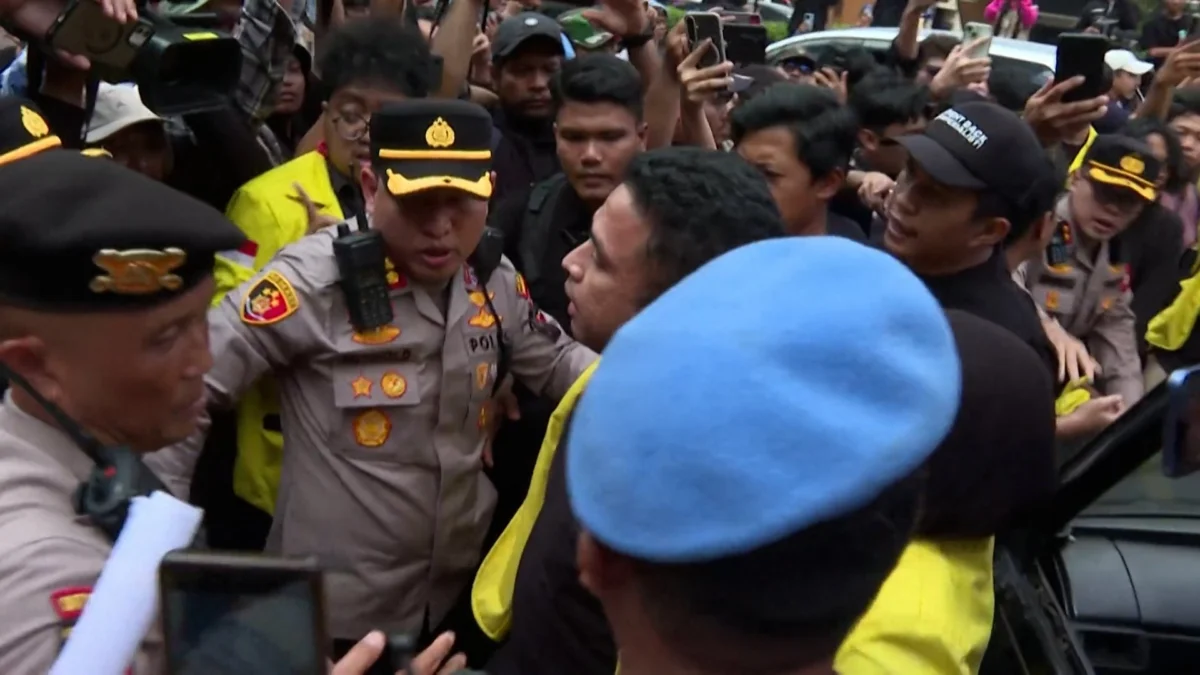
JAKARTA, Indonesia – Hundreds of university students took to the streets of Jakarta on Tuesday, August 18, 2026, to protest what they described as the Indonesian government’s regressive policies and perceived failures, leading to violent clashes with police that resulted in at least 21 arrests. The demonstrations, which erupted just one day after the nation marked its 81st Independence Day, underscored simmering discontent among the youth regarding the direction of the country. Eyewitness accounts and reports from local media outlets depicted scenes of chaos as riot police deployed water cannons and tear gas against the student demonstrators, who had gathered near prominent government buildings in the capital.
The confrontation began mid-morning when student groups, representing various universities across Jakarta and surrounding areas, attempted to march towards the Presidential Palace. Their objective was to deliver a list of demands addressing issues ranging from economic inequality and environmental degradation to concerns over democratic erosion and human rights. As the procession advanced, it was met by a heavy police contingent blocking key access roads. Initial attempts by student leaders to negotiate passage were unsuccessful, leading to a tense standoff that escalated rapidly into direct confrontation.
The Escalation of Conflict: A Day of Disruption
The protests commenced with a relatively peaceful assembly at a central meeting point, where student representatives delivered impassioned speeches detailing their grievances. Banners and placards, emblazoned with slogans such as "Protect Our Future, Not Your Power" and "Accountability for the People," were prominently displayed. The students, many identifiable by their university jackets, chanted slogans calling for government transparency and a more equitable society.
However, as the march progressed through the bustling streets of Jakarta, police presence intensified. At approximately 11:30 AM local time, near a major intersection leading to the presidential complex, police units moved to disperse the crowd. According to statements from the Jakarta Metropolitan Police, the students were deemed to be in violation of public assembly regulations and posed a risk to public order. Students, however, asserted their constitutional right to peaceful protest.
The initial dispersal efforts involved verbal warnings, which were largely ignored by the determined protesters. This was swiftly followed by the deployment of water cannons, drenching the front lines of the demonstration. As some students attempted to push through the barricades, rocks and other projectiles were reportedly thrown from within the crowd, prompting riot police to respond with tear gas canisters. The ensuing chaos saw protesters scattering, while others stood their ground, leading to direct physical altercations between a segment of the student body and law enforcement officers. It was during this phase of intense clashes that at least 21 individuals were apprehended. Reports indicated minor injuries on both sides, with several students requiring medical attention for exposure to tear gas and blunt force trauma.
Background to the Protests: A Nation’s Discontent
The August 18th protests did not emerge in a vacuum but were the culmination of growing frustrations among Indonesian youth. The timing, a day after the nation’s 81st Independence Day, was particularly symbolic. Independence Day, a moment traditionally reserved for national unity and celebration of progress, served as a poignant backdrop for students to highlight the perceived gap between the ideals of the nation’s founders and the contemporary realities faced by its citizens.
Indonesia, a vibrant democracy in Southeast Asia, has a rich history of student activism playing a pivotal role in shaping its political landscape. From the movements that contributed to the downfall of Sukarno in the 1960s to the pivotal role in the 1998 reforms that ended the Suharto era, students have historically been a powerful voice for change. In recent years, youth-led protests have continued to challenge government policies, notably against controversial legislative reforms like the Omnibus Law on Job Creation in 2020, and earlier demonstrations against proposed revisions to the Criminal Code in 2019. These past movements established a precedent for students to act as a critical check on government power, often mobilizing against policies they believe undermine democratic principles, social justice, or environmental protections.
In 2026, student grievances had coalesced around several key issues. Economic challenges, including persistent youth unemployment, rising cost of living, and perceived corruption within government institutions, were central to their demands. Additionally, environmental concerns, particularly regarding large-scale resource extraction projects and their impact on indigenous communities and ecosystems, featured prominently. There was also a palpable sense of disillusionment with political processes, with many students feeling that their voices were not adequately represented in policymaking. Specific policy decisions, though not explicitly detailed in initial reports, were understood to include recent legislative initiatives affecting land rights, labor laws, and the oversight of state-owned enterprises, which students argued favored corporate interests over public welfare.
Chronology of Events: From Independence Day to Confrontation
- August 16, 2026: Student coalitions from various Jakarta universities issue public statements and social media calls for a major demonstration on August 18th, articulating their intent to protest government policies. The timing is deliberately chosen to follow Independence Day, aiming to draw a stark contrast between national aspirations and perceived current realities.
- August 17, 2026: Indonesia celebrates its 81st Independence Day. Official ceremonies take place across the nation, including the Presidential Palace. While the nation commemorates its freedom, student groups finalize their plans and logistics for the following day’s protest, maintaining a high degree of coordination.
- Morning of August 18, 2026:
- 08:00 AM: Student contingents begin to gather at designated assembly points near the National Monument (Monas) area, displaying banners and preparing for their march.
- 09:30 AM: The collective body of protesters, estimated to be several hundred strong, begins its march towards the Presidential Palace, chanting slogans and attracting onlookers.
- 10:00 AM: Police forces, including units from the Mobile Brigade Corps (Brimob) and Jakarta Metropolitan Police, establish barricades and deploy personnel along key routes to the palace, effectively blocking the protesters’ path.
- 10:45 AM: The leading elements of the student march encounter the police barricade. Student leaders attempt to engage in dialogue with police commanders to negotiate passage.
- Mid-day August 18, 2026:
- 11:15 AM: Negotiations break down. Police issue multiple warnings, urging the crowd to disperse, citing public order concerns.
- 11:30 AM: Police deploy water cannons against the protesters.
- 11:45 AM: As some protesters resist dispersal and allegedly throw objects, police deploy tear gas. Clashes erupt, leading to a disorganized retreat by some students and direct confrontations between others and riot police.
- 12:00 PM – 01:00 PM: During the most intense period of clashes and subsequent dispersal efforts, police make at least 21 arrests. Injured individuals, both students and police officers, receive initial medical attention.
- Afternoon of August 18, 2026:
- 01:30 PM: The main protest crowd largely disperses, with smaller groups remaining in the vicinity, engaging in sporadic chants and discussions.
- 02:00 PM: Law enforcement maintains a heavy presence in the area, securing the perimeter around government buildings.
- 03:00 PM onwards: Student organizations begin issuing statements condemning the police action and demanding the release of their detained colleagues. Legal aid groups mobilize to assist the arrested students.
Voices from the Frontlines: Student Demands and Grievances
Student leaders, speaking anonymously to protect themselves from potential repercussions, articulated a broad spectrum of demands. A core concern was the perceived lack of accountability and transparency in governance. "We are here because the promises of our independence have not been fulfilled," stated one student activist from the University of Indonesia. "Corruption continues to plague our institutions, the rich get richer, and the environment is being destroyed for profit."
Specific policy critiques included:
- Economic Inequality: Calls for more equitable distribution of wealth, job creation initiatives for youth, and a review of foreign investment policies deemed exploitative.
- Environmental Protection: Stronger enforcement of environmental laws, cessation of projects leading to deforestation and pollution, and greater protection for indigenous lands.
- Human Rights: Concerns over freedom of expression, arbitrary arrests, and alleged police brutality, particularly in the context of protests. Students demanded investigations into past incidents and guarantees for peaceful assembly.
- Democratic Erosion: Apprehension regarding proposed amendments to laws that could limit civil liberties, weaken independent institutions, or extend political terms beyond constitutional limits.
"Our demands are not radical; they are fundamental," another student leader asserted. "We want a government that listens to its people, especially the youth who will inherit this nation."
Official Response and Justification
In the wake of the clashes, officials from the Jakarta Metropolitan Police held a press conference. A spokesperson, identified as Chief Commissioner Adi Santoso, confirmed the arrests, stating, "We took necessary measures to ensure public order and safety. The demonstration had become unruly and posed a threat to public infrastructure and commuter traffic. Our officers acted according to standard operating procedures to disperse an illegal assembly." He added that those arrested would be processed according to law and could face charges related to public disturbance or assault on officers. Commissioner Santoso denied allegations of excessive force, stating that police actions were proportionate to the threat posed by elements within the protesting crowd.
The Ministry of Home Affairs also issued a statement, acknowledging the right to peaceful assembly but emphasizing the importance of adhering to legal procedures. "The government respects the constitutional right of citizens to express their views," the statement read. "However, such expressions must not disrupt public order, threaten safety, or damage public property. We urge all parties, especially students, to engage in constructive dialogue rather than resorting to actions that lead to confrontation." The statement also reiterated the government’s commitment to national development and addressing public concerns through established channels.
Human Rights Concerns and Civil Society Reaction
Human rights organizations and civil society groups swiftly condemned the police’s handling of the protest. Amnesty International Indonesia released a statement calling for an immediate and impartial investigation into the use of force by police, and demanding the unconditional release of all students detained solely for exercising their right to peaceful protest. "The images and reports from Jakarta are deeply concerning," said Usman Hamid, Executive Director of Amnesty International Indonesia. "The right to protest is a cornerstone of democracy, and authorities have a duty to facilitate peaceful demonstrations, not suppress them with violence."
Legal aid groups also announced their intention to provide assistance to the arrested students, ensuring their legal rights were upheld during detention and interrogation. They raised concerns about the swiftness of the arrests and the potential for politically motivated charges. University rectors and academic associations, while urging calm and dialogue, also expressed concern for the welfare of their students and called for a fair and transparent legal process for those detained.
Historical Echoes: A Legacy of Student Activism
The events of August 18, 2026, resonate deeply with Indonesia’s history of student movements. From the 1966 "Generation of ’66" which helped usher in the New Order, to the 1998 Reformasi movement that ended Suharto’s authoritarian rule, students have consistently served as a moral compass and a catalyst for political change. Their activism is often seen as a reflection of the nation’s conscience, particularly when other avenues for dissent are perceived as stifled.
The choice to protest directly after Independence Day further amplified this historical legacy. It suggested that for many students, the promise of true independence – freedom from corruption, social injustice, and economic disparity – remained unfulfilled. This symbolic timing invoked a powerful narrative of unkept promises and a generational struggle to reclaim the nation’s founding ideals. Data on youth political participation in Indonesia consistently shows a high level of awareness and desire for engagement, often channeled through non-traditional means such as social media activism and street protests when formal political avenues are seen as unresponsive.
The Broader Implications: A Test of Democratic Space
The clashes in Jakarta highlight a critical juncture for Indonesian democracy. The government’s response to student protests will be closely watched as an indicator of its commitment to democratic freedoms, particularly freedom of expression and assembly. A heavy-handed approach risks alienating a significant segment of the population – the youth – and could fuel further unrest. Conversely, a willingness to engage constructively with student demands could pave the way for a more inclusive policy-making process.
The incident also carries implications for Indonesia’s international standing. As a leading democracy in Southeast Asia, the nation’s treatment of its citizens’ rights is often scrutinized by international observers and human rights bodies. Episodes of police violence against peaceful protesters can tarnish its reputation and potentially impact foreign relations and investment. The domestic political landscape could also be affected, potentially galvanizing opposition movements or creating new alliances among civil society groups.
Looking Ahead: An Uncertain Future
The immediate aftermath of the August 18th protests is marked by uncertainty. Student organizations have vowed to continue their struggle, demanding the release of their detained peers and an official response to their grievances. The government faces the challenge of managing public discontent while upholding law and order. Dialogue, transparency, and accountability will be crucial in navigating this volatile situation.
The events in Jakarta serve as a powerful reminder that even in established democracies, the struggle for a truly just and equitable society is ongoing. The youth of Indonesia, echoing the voices of past generations, are once again asserting their role as critical actors in shaping the nation’s future, ensuring that the ideals of independence remain central to its journey forward. The coming weeks will reveal whether this latest wave of student activism will lead to genuine policy reforms or further entrench the divisions between the state and its vibrant civil society.
