

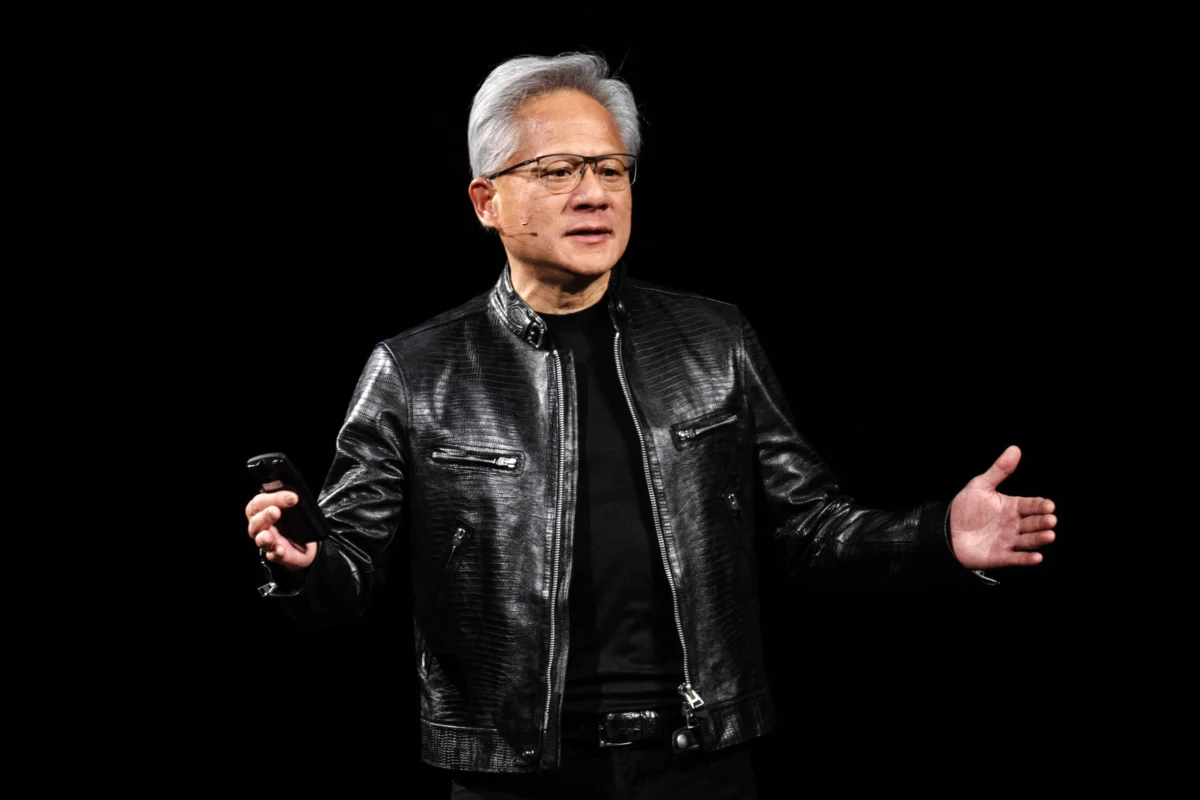
Nvidia Corp. Chief Executive Officer Jensen Huang publicly identified Marvell Technology as the most likely candidate to join the elite trillion-dollar market capitalization club, a pronouncement that triggered a significant rally in the semiconductor firm’s shares during premarket trading on Tuesday. Speaking at the high-profile Computex 2026 conference in Taipei, Taiwan, Huang emphasized that the rapid expansion of artificial intelligence infrastructure has created an unprecedented demand for the specialized networking and connectivity solutions that Marvell provides. The endorsement came during a joint appearance with Marvell CEO Matthew Murphy, where the two industry leaders discussed the evolving landscape of data center architecture and the shifting requirements of generative AI workloads.
The endorsement by Huang, whose own company became the centerpiece of the AI revolution and reached multi-trillion-dollar heights, carries immense weight in the global technology sector. His remarks focused on the fundamental shift in how computing is organized. According to Huang, the industry has moved beyond individual servers toward "disaggregated computing," where tasks are no longer confined to a single processor but are instead distributed across thousands of interconnected chips. In this new paradigm, the speed and efficiency with which data moves between these chips—the connectivity—becomes the primary determinant of overall system performance.
The Computex 2026 Context and the "Jensen Effect"
The annual Computex event in Taipei has long served as the premier stage for hardware innovation, but the 2026 iteration has been dominated almost entirely by the integration of AI into every facet of the global economy. As Nvidia remains the primary provider of the GPUs that power AI training, Huang’s appearances are closely watched by investors seeking "second-derivative" plays—companies that benefit directly from the massive build-out of Nvidia-based clusters.
During the onstage dialogue, Huang explained that while GPUs provide the "brains" or the raw computational horsepower, the infrastructure required to link these brains together is equally vital. "When you take a computing problem, and you disaggregate it into a lot of parts, and you distribute it across the entire data center, what’s necessary is connectivity," Huang stated. "That’s the reason why Matt’s doing so well. That’s the reason why Marvell is so essential."
This public validation resulted in an immediate surge in Marvell’s stock price, as market participants reacted to the prospect of Marvell capturing a larger share of the AI networking market. For years, Marvell has positioned itself as a leader in data infrastructure, but Huang’s "trillion-dollar" forecast suggests a growth trajectory that exceeds even the most optimistic previous analyst projections.
Understanding the Necessity of AI Connectivity
To understand why Huang views Marvell as a trillion-dollar company, it is necessary to examine the technical bottlenecks currently facing AI developers. Modern AI models, such as those used for large-scale natural language processing and video generation, require billions of parameters to be processed simultaneously. This cannot happen on one chip. Instead, it happens across a "fabric" of thousands of GPUs.
Marvell specializes in the high-performance chips that facilitate this communication. Their portfolio includes optical interconnects, Ethernet switches, and storage controllers that are designed to handle the massive bandwidth requirements of modern data centers. As Huang noted, the goal of modern architecture is to aggregate the total compute, total memory, and total bandwidth of an entire data center so it functions as one giant computer. Without the specialized networking silicon produced by firms like Marvell, the GPUs would spend more time waiting for data to arrive than actually processing it, a phenomenon known as "data starvation."
Huang’s comments highlight a strategic reality: as AI models grow, the "interconnect" becomes the most valuable real estate in the data center. By labeling Marvell as the "next trillion-dollar company," Huang is signaling that the value of the network is beginning to catch up to the value of the processor.
Financial Performance and Strategic Growth
The bold prediction by Nvidia’s chief executive is supported by Marvell’s recent financial trajectory. In May 2026, Marvell reported its first-quarter earnings for fiscal year 2027, which surpassed Wall Street expectations. The company posted $2.4 billion in revenue, driven primarily by its data center business unit.
Marvell’s CEO, Matthew Murphy, has overseen a strategic pivot for the company over the last several years. By divesting from legacy consumer businesses and focusing heavily on cloud, enterprise networking, 5G carrier networks, and automotive systems, Marvell has aligned its R&D with the most capital-intensive sectors of the tech industry.
The company’s growth is fueled by two primary engines:

- Optical Interconnects: As data centers transition from copper to optical wiring to increase speed and reduce power consumption, Marvell’s PAM4 DSP (Digital Signal Processor) technology has become an industry standard.
- Custom Silicon: Marvell has expanded its "compute" offerings by helping major cloud service providers (hyperscalers) design their own custom AI accelerators and ARM-based server CPUs. This allows cloud giants to optimize their hardware for specific internal workloads while relying on Marvell’s proven IP.
Analysts suggest that for Marvell to reach a trillion-dollar valuation, it will need to maintain its dominance in these high-margin segments while successfully navigating the competitive pressure from rivals such as Broadcom and Cisco.
A Timeline of the Marvell-Nvidia Partnership
The relationship between Nvidia and Marvell has matured alongside the AI boom. While Nvidia produces its own networking hardware—most notably through its acquisition of Mellanox—the sheer scale of the global AI build-out has created a "rising tide" effect that benefits multiple players.
- 2023-2024: Marvell begins to see a massive uptick in orders for its 800G optical products as Nvidia’s H100 and B100 shipments accelerate.
- 2025: Marvell introduces next-generation 1.6T (terabit) connectivity solutions, specifically designed to match the bandwidth requirements of Nvidia’s newest Blackwell-architecture systems.
- June 2026: At Computex, Huang and Murphy appear together, solidifying the narrative that Nvidia’s "AI Factories" are built on a foundation of Marvell’s connectivity silicon.
This timeline demonstrates that Marvell is not merely a bystander in the AI race but a deeply integrated partner whose roadmap is synchronized with the leading GPU manufacturer.
Market Reactions and Analyst Perspectives
While Huang’s comments were the primary catalyst for the stock’s movement, institutional investors have been quietly accumulating Marvell shares for months. Following the Computex session, several investment banks raised their price targets for Marvell, citing the "scarcity value" of high-end networking assets.
"Jensen Huang is essentially confirming what we have suspected: the AI trade is moving into the plumbing of the data center," said one senior semiconductor analyst. "You cannot build a trillion-parameter model without the type of low-latency switching and optical transport that Marvell provides. If Nvidia is the engine, Marvell is the high-performance transmission."
However, reaching a trillion-dollar market cap remains a monumental task. As of mid-2026, only a handful of companies globally have achieved this milestone. For Marvell to bridge the gap from its current valuation to $1 trillion, it would require not only continued growth in AI but also a sustained recovery in the 5G and enterprise networking markets, which have seen more cyclical fluctuations compared to the red-hot data center sector.
Broader Implications for the Semiconductor Industry
The endorsement of Marvell reflects a broader trend in the technology industry: the "platformization" of the data center. We are no longer in an era where companies buy individual components from disparate vendors. Instead, the entire stack—from the GPU to the switch to the optical cable—must be engineered as a cohesive unit.
This trend favors large, diversified silicon providers like Marvell that have the scale to invest billions in R&D and the breadth of IP to offer end-to-end solutions. Huang’s comments also serve as a warning to smaller, niche players: in the age of the "AI Factory," being "essential" requires being able to solve the most complex connectivity problems at a massive scale.
Furthermore, the focus on "disaggregated computing" suggests that the future of the industry will be defined by "system-level" innovation. This means that the value is shifting away from the individual chip and toward the system architecture. Marvell’s ability to provide the "glue" for these systems puts them in a unique position of power within the global supply chain.
Conclusion and Future Outlook
As Computex 2026 continues, the industry is left to digest the implications of Jensen Huang’s prediction. While "trillion-dollar" forecasts are often seen as hyperbole, the track record of Nvidia’s CEO in predicting the trajectory of the AI market gives his words a level of credibility that few others possess.
For Marvell Technology, the challenge now lies in execution. With a record-breaking backlog and a seat at the table with the world’s most powerful tech companies, the company is no longer just a supplier; it is a cornerstone of the global AI infrastructure. Whether Marvell reaches the trillion-dollar mark in the coming years will depend on its ability to stay ahead of the rapid pace of innovation and maintain its critical role in the "disaggregated" future that Huang described. For now, the market has sent a clear signal: the era of connectivity has arrived, and Marvell is leading the charge.
