

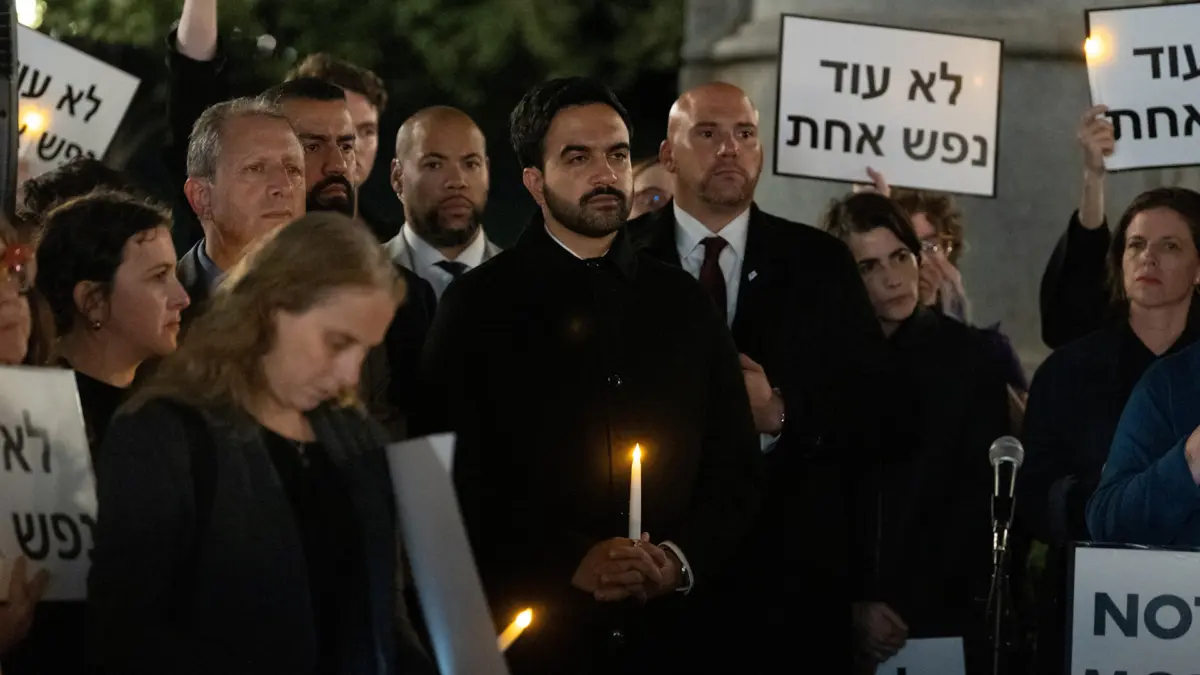
New York City Mayor Zohran Mamdani faced intense scrutiny and public demonstrations on Tuesday evening after attending a memorial vigil organized by the advocacy group Israelis for Peace. The event, held to commemorate the third anniversary of the October 7 attacks, became a flashpoint for the city’s deeply divided political landscape, with the Mayor being met by a chorus of protesters labeling him a "traitor." The backlash against the Mayor was not limited to the physical presence at the vigil; it extended to a formal statement released by City Hall earlier that day, which drew sharp condemnation from several pro-Israel organizations and political opponents who argued the administration’s rhetoric failed to adequately address the gravity of the anniversary.
The scene at the vigil, held in a public square in Manhattan, reflected the heightened tensions that have characterized New York City politics since Mamdani’s narrow election victory the previous year. As the Mayor approached the podium to offer remarks, a segment of the crowd—composed of both counter-protesters and attendees disillusioned with his administration’s foreign policy stances—erupted in chants. The accusations of "betrayal" stemmed from a variety of grievances, ranging from his past legislative record as a State Assemblymember to his current executive decisions regarding city-funded security for religious institutions and his vocal calls for a permanent ceasefire in the Middle East.
The Context of the Third Anniversary
The October 7, 2026, commemorations marked three years since the initial incursions and the subsequent, protracted conflict that has reshaped global geopolitics. In New York City, home to the largest Jewish population outside of Israel and a significant Arab and Muslim diaspora, these anniversaries have historically been periods of high alert and civic friction. Unlike previous years, the 2026 anniversary occurred under the leadership of a Mayor whose political origins lie within the Democratic Socialists of America (DSA), a group that has frequently clashed with mainstream pro-Israel organizations.
Mayor Mamdani’s decision to attend the "Israelis for Peace" vigil was seen by his supporters as an attempt to bridge the gap between his progressive base and the city’s grieving Jewish community. The organization, founded by Israeli expatriates living in New York, focuses on a dual message of mourning for the victims of the 2023 attacks and advocacy for a diplomatic resolution to the ongoing violence in the region. However, for many traditional advocacy groups, the Mayor’s presence at this specific event—rather than at more mainstream communal commemorations held at major synagogues—was interpreted as a political calculation intended to sideline centrist and conservative Jewish voices.
Chronology of the Day’s Events
The controversy began early on the morning of October 8, following a day of city-wide memorials. The timeline of the day’s events highlights the escalating tension between City Hall and various advocacy sectors:
- 8:00 AM: Mayor Mamdani participates in a private moment of silence at City Hall with staff members of diverse backgrounds.
- 10:30 AM: The Mayor’s Office releases an official press statement regarding the three-year anniversary. The statement acknowledges the "profound loss of life on October 7, 2023," but also emphasizes the "catastrophic humanitarian toll" of the ensuing years and calls for an immediate cessation of all regional hostilities.
- 1:00 PM: Pro-Israel organizations, including the Jewish Community Relations Council (JCRC) and the Anti-Defamation League (ADL), issue rebuttals to the Mayor’s statement, criticizing the "moral equivalence" they claim was drawn between the initial attack and the subsequent military response.
- 6:30 PM: Mayor Mamdani arrives at the Israelis for Peace vigil in Manhattan. He is immediately met by a large group of protesters.
- 7:15 PM: During the Mayor’s brief address, the "traitor" chants reach a volume that briefly interrupts the ceremony. Security personnel are forced to create a wider perimeter around the stage.
- 9:00 PM: The Mayor’s office issues a follow-up statement defending his attendance at the vigil, stating that "grief is not a zero-sum game."
Analysis of the Controversial Statement
The primary catalyst for the day’s outrage was the specific wording of the Mayor’s official statement. Critics pointed to the fact that the Mayor used the anniversary not only to mourn those killed in the initial attacks but also to pivot toward a critique of current international policy.
In the statement, Mamdani wrote: "As we mark three years since the horrific events of October 7, we must hold the memory of the innocent lives lost in our hearts. Yet, we cannot ignore that the cycle of violence has only expanded, claiming tens of thousands more lives and leaving entire generations in ruin. True remembrance requires us to commit to a future where no child, whether in Sderot or Gaza, lives in fear of the sky."
Pro-Israel groups argued that by merging the commemoration of the October 7 victims with a broader critique of the war, the Mayor effectively "diluted the tragedy." A spokesperson for the New York Jewish Caucus stated, "To use this specific day of mourning as a platform for political lecturing is a slap in the face to the families of the hostages and the victims. The Mayor has once again shown that he is more interested in his ideological agenda than in the communal healing of his constituents."
Supporting Data and Demographic Shifts
The backlash against Mayor Mamdani occurs against a backdrop of shifting demographics and voting patterns within New York City. According to data from the 2025 municipal election, Mamdani’s path to City Hall was paved by a coalition of younger voters, progressives, and the city’s growing Muslim and Arab American populations.
- Youth Vote: Exit polls in 2025 indicated that 68% of voters under the age of 30 supported Mamdani’s platform, which included a "Human Rights First" approach to city-level international engagement.
- The Jewish Vote: Conversely, Mamdani received less than 15% of the vote in heavily Jewish districts in Southern Brooklyn and parts of the Upper West Side, a historic low for a Democratic mayoral candidate.
- Public Safety Concerns: City-wide polling conducted in September 2026 showed that 54% of New Yorkers felt that "international tensions" were negatively impacting local community safety, with a 30% increase in reported hate crimes over the previous 24 months.
These statistics suggest that while Mamdani is operating within the mandate provided by his core constituency, he faces an uphill battle in achieving the "citywide unity" he promised during his inauguration. The divide over the October 7 vigil is a physical manifestation of a statistical reality: New York City is increasingly polarized along generational and ethnic lines regarding the conflict in the Middle East.
Official Responses and Political Repercussions
The reactions from the New York City Council were swift and divided. Council Minority Leader Joseph Borelli issued a statement calling for a formal censure of the Mayor’s rhetoric. "The Mayor’s presence at a fringe vigil while ignoring the mainstream community is a dereliction of his duty to represent all New Yorkers," Borelli said. "He is acting like an activist, not the chief executive of the world’s greatest city."
On the other hand, several members of the Council’s Progressive Caucus defended the Mayor. Councilmember Tiffany Cabán noted, "Mayor Mamdani is being targeted simply for acknowledging the humanity of everyone involved. The idea that mourning Israeli lives and Palestinian lives simultaneously makes someone a ‘traitor’ is a dangerous escalation of political discourse."
The New York Police Department (NYPD) reported four arrests following the vigil, primarily for disorderly conduct and harassment. Police Commissioner Jessica Tisch confirmed that security for the Mayor has been "re-evaluated and increased" in light of the aggressive nature of the protests at the event.
Broader Implications for NYC Governance
The controversy surrounding Mayor Mamdani’s actions has implications that extend beyond symbolic gestures. In the coming weeks, the City Council is set to debate the "Divestment and Accountability Act," a controversial piece of legislation supported by the Mayor that would prohibit city pension funds from being invested in companies that provide military equipment used in the conflict.
The events of October 8 have likely hardened the positions of those on both sides of the divestment debate. Opponents of the Mayor will use the vigil incident as evidence that his administration is biased and incapable of fair governance. Supporters will see the "traitor" chants as proof of a coordinated effort by conservative forces to silence progressive dissent.
Furthermore, the tension highlights a growing trend in American municipal politics where local leaders are increasingly expected to take stances on international issues. In a global hub like New York, the distinction between "local" and "international" has become nearly non-existent. The Mayor’s struggle to navigate these waters reflects a broader challenge for urban leaders across the United States who represent diverse and often conflicting diasporas.
Conclusion: A City at a Crossroads
As New York City moves past the third anniversary of October 7, the fallout for Mayor Zohran Mamdani remains significant. The visual of the city’s leader being shouted down at a peace vigil serves as a stark reminder of the volatility inherent in his administration’s attempt to redefine the city’s relationship with the Middle East conflict.
While the Mayor’s office maintains that his participation was an act of "radical empathy," the fierce opposition he encountered suggests that for many New Yorkers, the wounds of 2023 remain too raw for the type of inclusive mourning the Mayor sought to promote. The coming months will determine whether Mamdani can pivot from the controversy to focus on his domestic agenda, or if the "traitor" labels and the friction over international policy will become the defining characteristic of his tenure in Gracie Mansion.
The events of October 8, 2026, will likely be remembered as a pivotal moment in the Mamdani administration—a day when the complexities of global politics and local leadership collided in the streets of Manhattan, leaving a city to grapple with the meaning of peace, loyalty, and the limits of political rhetoric in a time of persistent crisis.
