

The mortgage banking industry stands at a critical crossroads, defined by a stark contrast between the optimistic promises of emerging technology and the sobering reality of a high-interest-rate environment. As the sector moves through the final quarter of the year, industry leaders are grappling with a market that offers little immediate relief, forcing a shift in focus from volume-driven growth to rigorous operational efficiency. Recent industry gatherings, including the HousingWire Mortgage Banking Summit and the Mortgage Bankers Association (MBA) Annual Convention, have highlighted a profound disconnect between the "AI promised land" showcased in exhibit halls and the financial struggles reflected in current production data.
A Tale of Two Conferences: The Shift in Executive Sentiment
The month of October served as a barometer for the mortgage industry’s collective psyche. At the HousingWire Mortgage Banking Summit on October 1, a live survey of attendees revealed a defensive posture among leadership. Approximately 70% of participating executives indicated they expected mortgage rates to remain at or above 7.5% for at least the next six months. This outlook suggests that the "higher for longer" narrative has taken firm root in the strategic planning of the nation’s largest lenders.
Two weeks later, at the MBA Annual Convention, the atmosphere shifted from defensive to somber. Mike Fratantoni, the MBA’s Chief Economist, delivered a presentation that underscored the structural challenges facing the market over the next 24 months. The forecast predicted flat production levels and a lack of significant rate relief, effectively dampening hopes for a near-term refinancing boom. This economic reality stands in sharp opposition to the vibrant activity seen in conference exhibit halls, where technology vendors marketed artificial intelligence (AI) and automation as the ultimate solution to the industry’s woes.
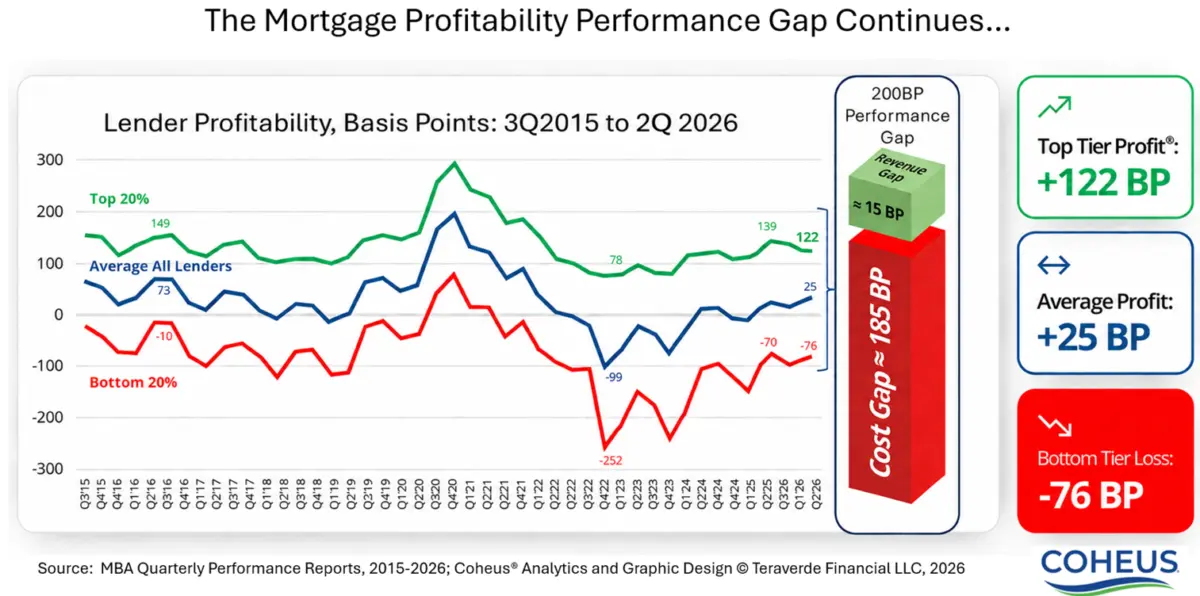
The proliferation of technology, specifically generative and agentic AI, has reached levels not seen since the period preceding the 2008 financial crisis. Vendors are promising dramatic reductions in origination costs and exponential increases in productivity. However, seasoned industry analysts note a persistent paradox: despite decades of investment in technology and recurring promises of a "zero-cost" origination model, industry costs remain stubbornly high. The current 200-basis-point performance gap between top-tier and bottom-tier lenders suggests that the problem is not a lack of technology, but a lack of measurable results and accountability.
Analyzing the 200-Basis-Point Performance Gap
The performance gap among mortgage lenders has widened significantly, reaching a critical threshold in the second quarter of 2026. This gap translates to a difference of over $7,000 in net production income per loan between high-performing and low-performing organizations. While market conditions affect all players, the variance in profitability is largely attributed to internal factors rather than external pressures.
According to data analyzed by industry experts Jim Deitch of Teraverde and Rick Roque of NFM Lending, the primary drivers of this discrepancy are price exceptions, revenue leakage, and a failure to align operating capacity with realistic production volumes. Their analysis suggests that the performance gap arises from two specific systemic issues:
- Lack of Measurable Results: Many lenders invest in technology based on vendor ROI promises without establishing internal benchmarks to verify if those savings are actually realized in the cash flow.
- Accountability Deficits: There is often a disconnect between C-suite objectives and the ground-level execution of pricing discipline and process management.
To close this gap, lenders are being urged to evaluate technology investments against hard financial outcomes rather than theoretical efficiency gains. If an investment cannot demonstrate a tangible contribution to the company’s economic health, the consensus among analysts is that the funding for such projects should be reassessed.
The Myth of the Refinancing Rescue
A central challenge for the modern mortgage executive is the "lock-in effect." A substantial portion of the current mortgage inventory carries interest rates below 6%, with many homeowners locked into rates as low as 3%. This inventory creates a natural ceiling on transaction volume. Even if mortgage rates were to decline by 100 basis points, the move would likely be insufficient to trigger a refinancing wave comparable to those that rescued the industry during previous downturns.
Predicting interest rate movements—which can fluctuate by 50 basis points in a matter of weeks due to Federal Reserve policy, inflation data, and geopolitical events—is increasingly viewed as a futile business strategy. Instead, CEOs are being encouraged to focus on variables within their control: pricing discipline, operating capacity, capital allocation, and strategic direction.
The Triage Process: Maximizing Cash Flow and Financial Runway
For lenders facing deteriorating financial performance, the immediate priority is "triage." This process is not merely about indiscriminate cost-cutting, which can often damage a company’s core revenue-generating capabilities. Instead, triage involves a surgical examination of the business’s economics to identify what generates cash and what consumes it.

Stopping Revenue Leakage
One of the most immediate opportunities for financial improvement is the elimination of revenue leakage. This includes avoidable costs such as:
- Excessive pricing concessions.
- Unnecessary lock extensions.
- Disclosure cures and uncollected fees.
- Preventable loan fallout and excessive rework.
The financial impact of leakage is staggering. For a lender originating $1 billion annually, just 25 basis points of avoidable leakage represents $2.5 million in lost revenue. Recovering even half of that amount adds $1.25 million to the bottom line without the need to increase loan production. Analysts recommend that leakage be measured at the individual producer, branch, and product level, with specific managers held accountable for improvement targets.
Matching Capacity to Reality
The second priority of the triage phase is adjusting operating capacity. Historically, mortgage companies have maintained high staffing levels during downturns to be ready for the next boom. However, in the current market, maintaining capacity for production that may never materialize is seen as a drain on liquidity.
Lenders are advised to align their processing, underwriting, and corporate infrastructure with realistic, data-driven production expectations. This involves establishing productivity benchmarks based on funded units, loan complexity, and direct labor costs. While high-performing employees are recognized as essential assets, the "wait-and-see" approach to staffing is being replaced by a demand for immediate operational right-sizing.
Strategic Alternatives: Transformation or Combination
Once a business has been stabilized through triage and a financial "runway" has been established, two primary strategic options emerge for the C-suite.
Option One: Rebuilding the Operating Model
Lenders with sufficient capital and strong management may choose to transform their existing business. This involves more than just installing new software; it requires a fundamental redesign of the workflow. The goal is to leverage technology, including agentic AI, to automate repetitive tasks and reduce defects, thereby creating a sustainably lower cost structure. This path is defined as an operating strategy rather than an IT project, with every initiative tied to a specific business case and financial target.
Option Two: Pursuing a Strategic Combination
The second option is to seek a merger or acquisition with a partner that offers complementary strengths. This might include a partner with superior manufacturing efficiency, deeper capital reserves, or a more robust servicing portfolio.
Experts emphasize that a strategic combination is not a sign of failure but a proactive move to preserve shareholder value and employee opportunities. Timing is the most critical factor in this path; a company that negotiates from a position of positive cash flow and operational stability has significantly more leverage than one facing a liquidity crisis.
The Imperative of C-Suite Accountability
The overarching theme of the current industry cycle is the non-delegable nature of leadership decisions. While consultants can provide data and managers can execute tasks, the CEO and the leadership team own the ultimate financial outcomes.
The path forward for mortgage banking executives involves three foundational initiatives:
- Establishing Clear Visibility: Management must have the tools to see exactly where cash is being generated and where it is being leaked across every branch and product line.
- Demanding Measurable ROI: Technology and personnel investments must be held to strict financial standards.
- Decisive Action: The time to act on capacity and pricing is before a liquidity crunch necessitates desperate measures.
As the industry concludes this "Into the Crucible" period, the divide between winners and losers will likely be determined by who accepted the reality of the market first. Waiting for a drop in mortgage rates is no longer considered a viable strategy; it is a forecast that may never come to fruition. For the modern mortgage lender, survival and eventual success depend on the ability to transform volatility into a disciplined, accountable, and highly efficient operational machine.
