

The United States housing market witnessed a further contraction in activity last week as mortgage rates extended their upward trajectory, prompting a notable retreat from both prospective homebuyers and existing homeowners looking to refinance. This persistent climb in borrowing costs has created significant headwinds, particularly impacting first-time buyers who are already grappling with an increasingly challenging affordability landscape. According to the latest data released by the Mortgage Bankers Association (MBA), the total volume of mortgage applications, adjusted for seasonal variations, registered a 4.4% decline compared to the preceding week, signaling a cooling trend in an otherwise anticipated vibrant season.
Detailed Analysis of Mortgage Application Data
The average contract interest rate for a 30-year fixed-rate mortgage, specifically for conforming loan balances (those at or below $832,750), rose to 6.45%. This marks an increase from the previous week’s 6.37%, with associated points—including the origination fee for loans with a 20% down payment—also ticking up from 0.61 to 0.66. This incremental yet steady rise in rates translates directly into higher monthly payments for borrowers, eroding purchasing power and contributing to the observed market hesitancy.
Delving deeper into the MBA’s weekly survey, applications for a mortgage to purchase a home experienced a 4% dip for the week. While this figure still represents a modest 5% increase when compared to the same week one year ago, the year-over-year growth has been considerably muted in recent months, reflecting sustained challenges in the housing sector. The spring housing market of 2025, contrary to seasonal expectations for robust activity, has proven to be a particularly turbulent period. It commenced with a pronounced slowdown as rates escalated sharply in March, creating a cautious environment. A brief respite seemed to emerge more recently, characterized by a slight easing of rates and an incremental increase in housing supply. However, this nascent recovery appears to have been short-lived, with buyers once again confronting significant affordability hurdles.
Joel Kan, Vice President and Deputy Chief Economist at the MBA, articulated the prevailing sentiment in a recent statement: "The ongoing conflict in the Middle East continues to exert upward pressure on rates. Mortgage rates last week increased to their highest level in a month, reflecting heightened global economic uncertainty and its direct impact on financial markets." Kan’s assessment underscores the intricate link between geopolitical events and domestic economic indicators, particularly in a globalized financial ecosystem where investor sentiment can swiftly shift, influencing bond yields and, consequently, mortgage rates.
The Deepening Affordability Crisis and Shifting Buyer Dynamics
A key indicator of the evolving challenges facing prospective homeowners is the average loan size for purchase applications, which has now reached an unprecedented $467,300. This figure marks the highest in the MBA’s survey history, a comprehensive dataset extending back to 1990. This significant increase in average loan size, rather than signaling a boom in high-value transactions, likely reflects the escalating cost of even modestly priced homes, pushing buyers to borrow more to secure a property.
Kan further elaborated on this trend, suggesting, "This increase could indicate that potential first-time buyers, and buyers looking for homes at lower price points, might be the most hesitant to move forward given the economic uncertainty and higher rates." This observation highlights a critical demographic shift: first-time buyers, often operating with tighter budgets and less accumulated equity, are disproportionately affected by rising rates and home prices. They represent a crucial segment for a healthy housing market, and their retreat can signal broader systemic issues in accessibility to homeownership. The dream of homeownership, particularly for younger generations and those in lower-income brackets, is becoming increasingly elusive in an environment where wage growth struggles to keep pace with housing cost inflation.
The "Lock-In" Effect and Homeowner Dilemmas
The impact of rising rates is not confined solely to potential homebuyers; it also profoundly influences existing homeowners. Applications to refinance a home loan experienced the steepest decline last week, falling 5% for the period. While demand for refinancing still registered 29% higher than the same week one year ago, this annual comparison has been steadily shrinking. This contraction indicates that fewer homeowners are finding it financially advantageous to refinance their existing mortgages. A year prior, the 30-year fixed rate stood only 39 basis points higher than the current rate, making the incentive for refinancing much more pronounced at that time.
The refinance share of total mortgage activity has decreased to 42%, marking its lowest level since August 2025. This pronounced drop underscores the emerging "lock-in" effect, a phenomenon where homeowners who secured significantly lower interest rates in prior years are now reluctant to sell their current homes. Moving to a new property would necessitate taking on a new mortgage at substantially higher rates, effectively erasing any financial advantage they currently hold. This inertia among existing homeowners contributes to a constrained housing supply, further exacerbating price pressures in a market already struggling with inventory levels. The decision to refinance, once a relatively straightforward financial optimization, has become a complex calculation weighed against the opportunity cost of abandoning a historically low interest rate.
Macroeconomic Forces: The Federal Reserve’s Role and Inflation Battle
The overarching macroeconomic environment plays a pivotal role in shaping mortgage rate trajectories. The Federal Reserve, as the nation’s central bank, has been on an aggressive campaign to combat persistent inflation throughout 2023 and 2024, continuing into 2025. By raising the federal funds rate, the Fed aims to cool down the economy, thereby curbing demand and ultimately bringing inflation back to its target rate of 2%. While the federal funds rate does not directly dictate mortgage rates, it influences the broader bond market, particularly the yield on the 10-year Treasury note, which serves as a benchmark for long-term borrowing costs like mortgages.
When the Fed signals a hawkish stance or when economic data suggests inflation remains stubbornly high, investors demand higher returns on Treasury bonds, pushing yields up. This, in turn, translates into higher mortgage rates. Conversely, expectations of a Fed pause or pivot, or signs of economic weakness, can lead to falling bond yields and, consequently, lower mortgage rates. The current elevated rates reflect a market grappling with ongoing inflationary pressures and the anticipation of the Fed maintaining a restrictive monetary policy for longer than initially expected. Energy prices, supply chain dynamics, and robust labor market data have all contributed to the Fed’s cautious approach, directly impacting the housing market through the conduit of mortgage rates.
Geopolitical Undercurrents: The Middle East Conflict’s Market Impact
Beyond domestic economic policy, geopolitical events are increasingly demonstrating their capacity to sway global financial markets. As Joel Kan highlighted, the ongoing conflict in the Middle East is a significant factor contributing to the upward pressure on mortgage rates. Geopolitical instability often leads to a "flight to safety," where investors move capital into traditionally safer assets like U.S. Treasury bonds. While this initial demand might push bond prices up and yields down, prolonged conflict, particularly in oil-producing regions, can trigger fears of energy supply disruptions and commodity price spikes. This, in turn, fuels inflationary expectations, prompting investors to demand higher yields on bonds to compensate for anticipated erosion of purchasing power.
Moreover, heightened global uncertainty can lead to increased volatility in financial markets, making lenders more cautious and factoring in higher risk premiums into their lending rates. The interconnectedness of global economies means that conflicts in one region can have ripple effects across continents, impacting everything from consumer confidence to the cost of borrowing for a home in Fontana, California. The psychological impact of such events on investor and consumer sentiment should not be underestimated, often leading to a more conservative approach to major financial commitments.
A Chronology of Market Turbulence: The 2025 Housing Landscape
The year 2025 has unfolded as a period of significant volatility for the housing market. Beginning the year with cautious optimism, many analysts predicted a gradual stabilization of rates and a potential rebound in transactions. However, these expectations were quickly challenged.
- January-February 2025: Rates showed some initial fluctuations but remained relatively stable, fostering a glimmer of hope for buyers.
- March 2025: A sharp and unexpected rise in inflation data, coupled with hawkish signals from the Federal Reserve, sent bond yields soaring. This translated into a significant spike in mortgage rates, effectively stalling early spring market activity and leading to a noticeable drop in purchase applications. Many prospective buyers who had started their search in anticipation of lower rates found themselves priced out overnight.
- April-Early September 2025: A period of seesawing rates followed. There were brief moments where rates eased, providing temporary relief and prompting some buyers to re-enter the market. This coincided with a modest increase in housing inventory in some areas, offering a wider selection. However, these periods of reprieve were often short-lived, with rates resuming their upward climb in response to resilient economic data or renewed inflationary concerns.
- August 2025: The reference point for the lowest refinance share, indicating a significant downturn in refinancing activity, possibly due to a sustained period of elevated rates making such moves uneconomical for most.
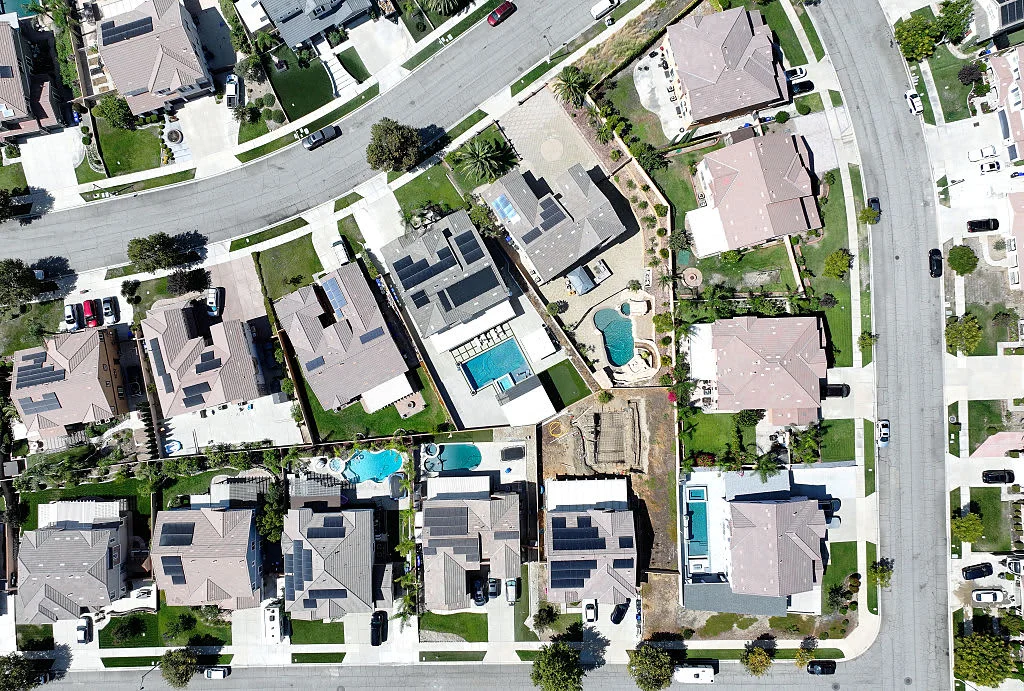
- September 2025 (mid-month): The image of Fontana, California, with solar-paneled homes, captures a snapshot of a market grappling with these conditions. Despite the environmental consciousness and investment in sustainable living, the underlying financial strains on homeowners and buyers remain paramount.
- Late September/Early October 2025 (current reporting period): The current escalation, pushing rates to their highest level in a month, marks a continuation of this "bumpy" trajectory, reaffirming the challenges faced by the market.
This chronology highlights a market consistently reacting to, and often struggling with, external economic and geopolitical forces, making long-term planning difficult for all participants.
Broader Economic Implications and Regional Variances
The slowdown in the housing market, driven by elevated mortgage rates and affordability issues, has far-reaching implications for the broader economy. The housing sector is a significant contributor to GDP, encompassing everything from construction and renovation to home furnishings and landscaping. A sustained downturn can lead to reduced activity in these related industries, potentially impacting employment and investment. Local economies that are heavily reliant on real estate transactions, such as many communities in California, can experience a more pronounced slowdown.
Furthermore, the "wealth effect" associated with rising home equity can diminish. While existing homeowners may still see their property values appreciate, the slower pace of sales and the reduced liquidity from refinancing can curb consumer spending and investment in other areas of the economy.
It is also crucial to acknowledge the regional disparities in housing market performance. While national trends provide an overarching picture, individual markets across the U.S. can exhibit varying degrees of resilience or vulnerability. High-cost coastal markets, like parts of California, tend to be more sensitive to rate fluctuations due to already exorbitant home prices, making affordability even more acute. Conversely, some more affordable inland markets might experience a relatively softer landing, though they are not immune to the national trend of rising rates. The image of Fontana, California, a suburban area within the broader Southern California megalopolis, serves as a poignant illustration of a region where homeownership is a significant aspiration but also a substantial financial undertaking.
Looking Ahead: Key Economic Indicators and Future Trajectories
The immediate future of mortgage rates remains highly dependent on several key economic indicators and geopolitical developments. According to a separate survey from Mortgage News Daily, rates have continued their upward climb even further as the current week commenced, signaling persistent market pressures.
A crucial data release looming on the horizon is the government’s monthly employment report, scheduled for Friday. This report is meticulously scrutinized by investors and policymakers alike, as strong job growth can signal a robust economy that might fuel inflation, potentially prompting the Federal Reserve to maintain or even further tighten its monetary policy. Conversely, signs of a softening labor market could suggest that the Fed’s rate hikes are having their intended effect, potentially leading to a more dovish stance and a subsequent easing of bond yields and mortgage rates.
Beyond the employment report, market participants will continue to monitor inflation data (such as the Consumer Price Index and Producer Price Index), retail sales figures, and manufacturing output. Any significant shifts in these indicators, coupled with developments in the Middle East or other geopolitical flashpoints, will dictate the next major moves in mortgage rates. The Federal Reserve’s upcoming policy meetings and accompanying statements will also be critical in shaping market expectations and providing forward guidance on the trajectory of interest rates.
Conclusion: Navigating Continued Uncertainty
In conclusion, the current landscape of the U.S. housing market is defined by elevated mortgage rates, diminishing affordability, and a discernible retreat from both potential homebuyers and refinancing homeowners. The convergence of domestic monetary policy aimed at taming inflation and global geopolitical instabilities has created a challenging environment. While the market has shown flickers of resilience, particularly with some modest increases in supply, the persistent upward pressure on borrowing costs continues to dampen activity. For first-time buyers, the dream of homeownership appears to be moving further out of reach, while existing homeowners are increasingly locked into their current rates. As the market awaits crucial economic data and observes global events, uncertainty remains the prevailing sentiment, underscoring the complex interplay of factors that will ultimately determine the future trajectory of the nation’s housing sector.
