

The U.S. mortgage market experienced a period of remarkable stasis last week, with interest rates holding firm and overall application volumes remaining largely unchanged. This sustained plateau in rates offered minimal incentive for both prospective homebuyers and existing homeowners contemplating refinancing, underscoring the ongoing challenges within a housing sector grappling with elevated financing costs. The Mortgage Bankers Association (MBA) reported a negligible dip of 0.4% in total mortgage application volume on a seasonally adjusted basis from the preceding week, signaling a market caught in a delicate balance between persistent demand and prohibitive affordability.
Detailed Application Trends and Rate Analysis
According to the MBA’s weekly survey, the average contract interest rate for 30-year fixed-rate mortgages, specifically for conforming loan balances of $832,750 or less, remained steadfast at 6.77%. This stability marked a notable pause after weeks of subtle fluctuations. The associated points, including the origination fee for loans with a 20% down payment, slightly decreased to 0.65 from 0.67, indicating a minor adjustment in upfront costs but not enough to significantly sway borrower behavior.
A closer examination of the application segments reveals divergent trends. Applications to refinance a home loan saw a modest increase of 2% for the week. However, this uptick was overshadowed by a more significant year-over-year decline, with refinance activity standing 18% lower than the same week a year ago, a period when mortgage rates were marginally more favorable. This stark comparison highlights how the current rate environment continues to constrain the refinancing market, primarily limiting it to a niche segment of borrowers.
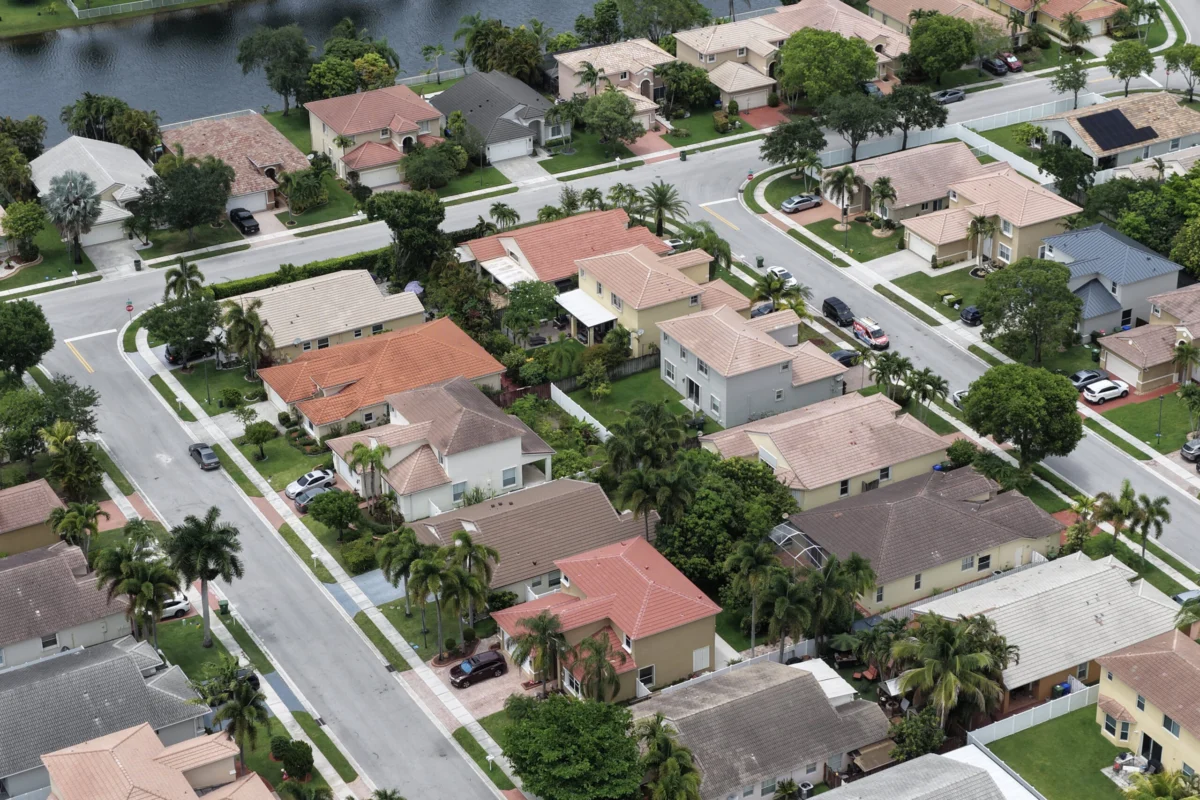
Conversely, applications for mortgages to purchase a home registered a 2% decrease for the week. This decline was mirrored in the year-over-year comparison, with purchase applications falling 3% from the same period last year. While rates held steady last week, their lingering presence at the higher end of recent ranges has clearly exerted downward pressure on homebuying intentions, contributing to a broader slowdown in transaction volumes across various housing markets, including bustling residential areas like Pembroke Pines, Florida, as observed in aerial views on June 4, 2026.
Expert Commentary on Current Market Dynamics
Joel Kan, Vice President and Deputy Chief Economist at the MBA, provided crucial insights into these trends. "Mortgage rates and applications changed little last week, with just a slight increase in refinances for conventional and VA loans, while FHA refinances were lower," Kan noted in a recent release. His analysis underscored that the marginal increase in refinances was not broad-based, suggesting a selective pool of eligible borrowers rather than a widespread return to the refinancing market.
Kan further elaborated on the demographic impact of the current rate environment. "Borrowers with larger loan sizes remain less likely to refinance with rates at these higher levels," he stated. This observation is corroborated by the continued shrinkage in the average loan size for refinances, which dipped to $282,200 last week – the lowest level recorded since June 2025. This trend suggests that the few homeowners who are refinancing are likely those with smaller outstanding balances, perhaps seeking to consolidate debt, adjust terms on adjustable-rate mortgages, or tap into accumulated equity for specific purposes, rather than a broad-based move to secure lower rates.
The affordability crisis, a recurring theme in the current housing cycle, also featured prominently in Kan’s assessment of the purchase market. "In addition to the economic uncertainty, affordability difficulties have reemerged as a reason for homebuyers to delay purchase decisions given the impact of higher mortgage rates on monthly mortgage payments," Kan added. This statement encapsulates the core dilemma facing many prospective buyers: even if home prices moderate in some areas, the elevated cost of borrowing significantly inflates monthly housing expenses, pushing homeownership out of reach for a substantial portion of the population.
The Economic Underpinnings of Mortgage Rates
The stability in mortgage rates last week can be attributed to a complex interplay of macroeconomic factors, primarily concerning inflation, Federal Reserve policy, and the bond market. Mortgage rates, particularly for 30-year fixed loans, are closely tied to the yields on the 10-year Treasury bond. When Treasury yields rise, mortgage rates typically follow suit, and vice versa.
The Federal Reserve’s ongoing battle against inflation remains the dominant force shaping the broader interest rate environment. For much of the preceding year, the Fed implemented an aggressive series of interest rate hikes to cool down an overheating economy and bring inflation back to its 2% target. While the pace of inflation has shown signs of moderation, it has proven to be more persistent than initially anticipated. This persistence has led the Fed to maintain a cautious, "higher for longer" stance on its benchmark federal funds rate. Although the federal funds rate does not directly dictate mortgage rates, it influences the cost of borrowing for banks and, consequently, impacts bond yields and the broader credit market.
Market expectations regarding future Fed actions play a critical role. Investors constantly evaluate economic data—such as inflation reports, employment figures, and consumer spending—to anticipate the Fed’s next moves. If the data suggests that inflation remains stubbornly high, or that the economy is stronger than expected, it can lead to an increase in Treasury yields as investors demand higher returns for holding government debt, fearing that the Fed will either delay rate cuts or even consider further hikes. Conversely, signs of economic weakening or rapid disinflation could prompt a decrease in yields. The observed stability in mortgage rates last week suggests that the market may have been digesting a mixed bag of economic signals, leading to a temporary equilibrium in investor sentiment.
A Historical Perspective on Rate Fluctuations
To fully appreciate the current rate environment, it is crucial to consider its historical context. The current average of 6.77% for a 30-year fixed mortgage stands in stark contrast to the historically low rates witnessed during the peak of the COVID-19 pandemic. In late 2020 and early 2021, rates dipped below 3%, creating an unprecedented surge in both purchase and refinance activity. This "golden era" of ultra-low borrowing costs enabled millions of homeowners to significantly reduce their monthly payments and spurred a frenzied housing market characterized by bidding wars and rapid price appreciation.
The dramatic shift began in early 2022, as inflation concerns mounted and the Federal Reserve initiated its aggressive tightening cycle. Mortgage rates climbed steadily throughout 2022 and 2023, eventually peaking in late 2023, touching levels close to 8% for the 30-year fixed rate. While rates have retreated from those multi-decade highs, the current 6.77% remains significantly higher than the pre-2022 average and nearly double the pandemic lows. This sharp increase has effectively "locked in" many existing homeowners with mortgages at 3-4%, making them reluctant to sell and take on a new loan at current rates.
The year-over-year decline of 18% in refinance applications directly reflects this historical comparison. A year ago, rates were slightly lower, offering a window for some homeowners to refinance. Today, with rates firmly entrenched above 6.5%, the pool of eligible borrowers who could benefit from refinancing has drastically shrunk, largely limited to those with significantly higher rates from previous periods or those seeking specific financial adjustments.
Affordability Crisis Deepens and "Lock-In" Effect
The sustained high mortgage rates exacerbate the existing housing affordability crisis, particularly for first-time homebuyers. Even if home prices were to flatten or decline marginally in certain markets, the increased cost of borrowing means that the total cost of homeownership, measured by monthly mortgage payments, remains elevated. For instance, a $400,000 home purchased with a 20% down payment at 3% interest results in a monthly principal and interest payment of approximately $1,349. The same home at 6.77% interest pushes that payment to around $2,084—a difference of over $700 per month, or more than $8,400 per year. This substantial increase places immense financial strain on household budgets, forcing many to delay their homeownership dreams or scale back their expectations regarding property size, location, or amenities.
The "lock-in" effect on existing homeowners is another critical implication of the current rate environment. Homeowners who secured historically low mortgage rates in 2020-2021 are now holding what are colloquially termed "golden handcuffs." The prospect of selling their current home, which would necessitate taking on a new mortgage at significantly higher rates, is a powerful disincentive. This phenomenon contributes directly to the persistent shortage of housing inventory on the market. Fewer existing homes are listed for sale, further complicating the supply-demand dynamics and indirectly supporting current home price levels, even as buyer demand wanes due to affordability concerns. This creates a challenging cycle where high rates deter buyers, but also deter sellers, leading to a stagnant market with limited options.
Regional Market Observations and Broader Economic Impact
While the MBA data provides a national snapshot, the impacts of these trends are felt acutely at the local level. In regions like Pembroke Pines, Florida, where residential neighborhoods continue to expand, the stability of high rates can mean a slowdown in new construction projects as developers face reduced buyer demand. Real estate agents in such markets report increased hesitancy among potential buyers, longer listing times for homes, and a more pronounced focus on price negotiations compared to the frenzied markets of recent years. The overall economic impact extends beyond the housing sector, affecting related industries such as construction, home furnishings, landscaping, and financial services, which all experience a ripple effect from reduced housing transactions.
The slight increase in mortgage rates observed at the start of the current week, as reported by Mortgage News Daily, serves as a fresh reminder of the ongoing volatility and the sensitivity of the market to incoming economic data and shifting investor sentiment. This immediate uptick suggests that the brief period of stability might be short-lived, with rates continuing to respond to the underlying economic pressures.
Looking Ahead: Factors Influencing Future Rates
The trajectory of mortgage rates in the coming months will largely depend on several key factors:
- Federal Reserve Policy: Any signals from the Fed regarding the timing and magnitude of potential interest rate cuts will be paramount. If inflation shows consistent signs of decelerating towards the 2% target, the Fed might begin to ease its monetary policy, which could lead to lower Treasury yields and, consequently, lower mortgage rates.
- Inflation Data: Core inflation metrics, such as the Consumer Price Index (CPI) and Personal Consumption Expenditures (PCE) price index, will be closely watched. A sustained downtrend in these indicators is essential for the Fed to consider a more dovish stance.
- Economic Growth and Employment: A significant weakening of the labor market or a broader economic slowdown could also prompt the Fed to cut rates to stimulate economic activity, potentially driving mortgage rates down. Conversely, robust economic growth might give the Fed reason to keep rates higher for longer.
- Global Economic Conditions: International economic events, geopolitical tensions, and actions by other central banks can also influence U.S. bond yields and, by extension, mortgage rates.
In conclusion, the U.S. mortgage market finds itself in a challenging equilibrium. While rates remained steady last week, their elevated level continues to be a significant barrier to entry for many prospective buyers and a strong disincentive for existing homeowners to move. The slight increase observed at the start of this week signals that this period of stagnation may be prone to renewed upward pressure. As the Federal Reserve continues its delicate balancing act between controlling inflation and supporting economic stability, the housing market remains acutely sensitive to every economic data point and policy decision, with affordability continuing to be the primary concern for a vast segment of the population. The market awaits a clear signal for a sustained downward trend in rates, which could finally unlock pent-up demand and supply, reinvigorating a currently subdued housing sector.
