

The landscape of corporate governance research, a field that meticulously examines the systems and practices by which companies are directed and controlled, is on the cusp of a significant transformation. For decades, empirical studies in this domain have heavily relied on commercially aggregated datasets, which distill vast amounts of information from public filings into a format amenable to quantitative analysis. While these datasets have been instrumental in shaping our understanding of corporate behavior, they have also inadvertently created blind spots, limiting the scope of inquiry and potentially skewing research findings. Now, a groundbreaking development, spearheaded by Professor Jens Frankenreiter of Washington University in St. Louis, promises to democratize access to rich governance data and broaden the horizons of academic inquiry.
Professor Frankenreiter’s recent paper, "Measuring Corporate Governance with Large Language Models," published on SSRN, argues that the advent of advanced artificial intelligence, specifically Large Language Models (LLMs), offers an unprecedented opportunity to overcome the limitations of existing data sources. His research demonstrates that LLMs can accurately and efficiently extract complex governance information directly from source documents, such as corporate charters and bylaws, at a fraction of the cost and scale previously imaginable. This breakthrough has the potential to not only enhance the accuracy and comprehensiveness of corporate governance research but also to illuminate previously overlooked aspects of corporate behavior and regulatory environments.
The Data Dilemma: Limitations of Commercial Datasets
The bedrock of empirical corporate governance research has long been the availability of structured data. Publicly traded companies are required to file extensive information with regulatory bodies like the U.S. Securities and Exchange Commission (SEC) through its EDGAR database. However, the raw data on EDGAR, while comprehensive, is often unstructured and requires significant effort to process for analytical purposes. Commercial data providers emerged to fill this gap, meticulously collecting, cleaning, and organizing this information into readily usable datasets. These curated collections have empowered countless influential studies over the past several decades, enabling researchers to identify trends, test hypotheses, and draw conclusions about corporate practices and their outcomes.
However, this reliance on commercial datasets has also imposed certain constraints. The very process of data aggregation and the economic realities of data production mean that certain types of companies and governance arrangements are more likely to be included and thoroughly studied than others. Typically, datasets focus on larger, more prominent companies, often those within major stock indices like the S&P 500. This creates a "data spotlight" effect, where research tends to gravitate towards areas where data is abundant and easily accessible, potentially leaving other equally significant areas in the shadows.
This inherent bias in data coverage has been a growing concern within the academic community. Professor Frankenreiter highlights several recent studies that underscore these limitations:
- The "Corporate Governance Gap": A 2022 study by Kobi Kastiel and Yaron Nili revealed that companies at the lower end of the Russell 3000 index, often excluded from major commercial datasets, exhibit markedly different corporate governance regimes. This suggests that current research may not fully represent the diversity of governance practices across the entire corporate landscape.
- Nuance in Governance Provisions: Emiliano Catan and Marcel Kahan’s 2019 paper illustrated how the specific provisions measured can significantly impact research outcomes, even for well-covered firms. While common datasets track rights like calling special meetings or acting by written consent, their research showed that other, less commonly tracked provisions could effectively neutralize these shareholder rights, limiting their real-world impact on board composition changes between annual meetings.
- Unseen Regulatory Shifts: Professor Frankenreiter’s own prior work has demonstrated how the adoption of fee-shifting provisions, which determine who pays legal costs in certain disputes, collapsed nationwide following a legislative ban in Delaware. This significant regulatory shift may have gone unnoticed in broader studies because fee-shifting provisions are not typically tracked in standard governance datasets.
These examples collectively illustrate how the availability and structure of commercial data can shape the questions researchers ask and the conclusions they draw, potentially overlooking critical aspects of corporate governance that fall outside the scope of these curated datasets.
The LLM Revolution: A New Era of Data Extraction
The paradigm shift proposed by Professor Frankenreiter’s latest research lies in the application of Large Language Models (LLMs) to the task of corporate governance data extraction. Unlike earlier natural language processing (NLP) tools, LLMs possess a far greater capacity to understand context, nuance, and the semantic meaning embedded within unstructured text. This advanced capability allows them to process legal documents like charters and bylaws, which are rich in legally relevant information but traditionally require expert human interpretation.
LLMs can, in essence, translate the dense legal prose of these documents into the structured, quantifiable data that has made commercial datasets so valuable. The core of Professor Frankenreiter’s paper is a rigorous empirical test of this proposition. He developed a comprehensive benchmark dataset by combining 300 corporate charters and 150 bylaws obtained from EDGAR with approximately 25 meticulously hand-coded, binary (yes/no) labels per document. These labels capture crucial governance information, such as the presence of a staggered board, shareholder authority to call special meetings, and the board’s unconditional power to adjourn meetings. This benchmark dataset comprises a total of 11,550 individual data extraction tasks.
To evaluate the efficacy of LLMs, Professor Frankenreiter constructed several data extraction pipelines utilizing cutting-edge LLM models available earlier this year from three prominent AI research labs. The results of these experiments were remarkably promising.
Striking Accuracy: LLMs Outperform Human Coders
The most significant finding of the study is the exceptional performance of the tested LLM pipelines. Measured against the meticulously curated ground truth labels, these pipelines achieved an average accuracy of approximately 98%. This means that across the 11,550 extraction tasks, each pipeline correctly identified the governance provision in at least 11,300 instances.

Further enhancing this accuracy, the research found that combining the outputs of individual LLM coding routines through a simple majority vote – an ensemble approach – yielded even superior results. This technique leverages the fact that different LLM pipelines tend to make distinct types of errors. The resulting ensemble labels agreed with the reference labels an impressive 98.8% of the time.
While a 98% accuracy rate might seem high, Professor Frankenreiter emphasizes the importance of contextualizing this figure. To provide a more robust evaluation, he compared the LLM’s performance against that of human coders who helped construct the benchmark dataset. This comparison is crucial because human coders, despite their expertise, are also prone to errors, as evidenced by previous research on the accuracy of historical datasets like the IRRC, which were compiled through manual coding.
In a blind recoding process, where cases of disagreement between LLMs and original human coders were re-evaluated, the original human labels were found to be correct 97.1% of the time. This translates to approximately 337 errors made by human coders compared to 142 errors from the LLM ensemble. Moreover, in instances where the LLM and human coders disagreed, the blind recoding process sided with the LLM ensemble approximately three-quarters of the time. Statistical analyses confirmed that this superior performance of the LLM ensemble is systematic and not attributable to chance.
However, the study also acknowledges that LLMs do not exhibit uniform performance across all variables. This variability underscores the necessity for researchers to validate LLM-generated extraction routines before deploying them in large-scale research projects.
Broadening the Research Horizon: Unlocking New Avenues
The ability to generate corporate governance data at an unprecedented scale and accuracy has profound implications for the types of questions that can be investigated. This new capability allows researchers to:
- Extend Analysis Beyond Existing Samples: Studies can now include companies that have historically been omitted from commercial datasets, offering a more representative view of the corporate landscape. This means shedding light on segments of the market that have been largely invisible to empirical research.
- Investigate Less Common Governance Arrangements: Researchers can now conduct large-scale analyses of governance provisions that are less frequently adopted or are simply not captured by current commercial datasets.
- Deepen Understanding of Governance Mechanisms: The nuanced data generated by LLMs can provide a more granular understanding of what specific governance provisions actually entail and how they function in practice, moving beyond simplified "coarse dummy variables."
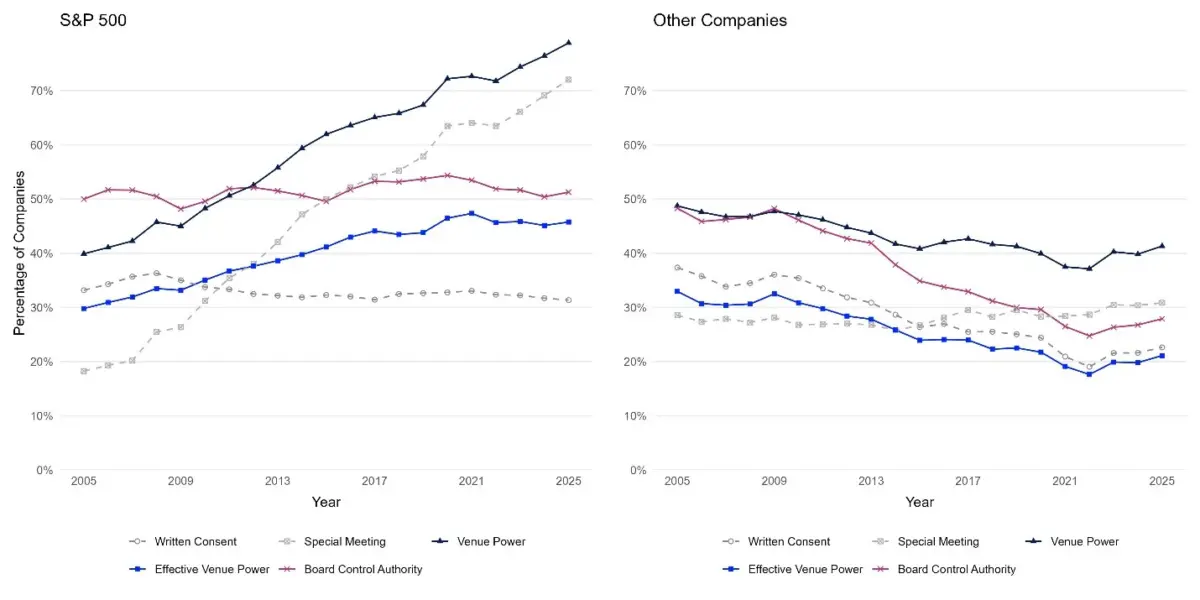
To illustrate these possibilities, Professor Frankenreiter replicated and extended the 2019 study by Catan and Kahan on shareholder venue rights. By utilizing automatically generated governance data, he examined whether the trends documented in the S&P 500 held true for a broader universe of companies. His findings revealed a starkly different picture outside the S&P 500. While special meeting rights saw a slight increase and written consent rights declined substantially among Delaware-incorporated companies outside the S&P 500 between 2005 and 2025, effective venue rights declined even more sharply. This undocumented trend highlights how research constrained by traditional datasets can miss significant shifts in corporate governance.
Figure: Shareholder venue rights among Delaware-incorporated companies, 2005–2025
(Note: The image file provided in the original prompt would be inserted here, with a caption detailing its content and relevance to the discussion.)
Addressing Future Challenges and Implications
Despite the promising results, Professor Frankenreiter acknowledges that challenges remain on the path to widespread adoption of LLM-generated governance data. A primary obstacle is the current lack of easily accessible, comprehensive samples of corporate charters and bylaws for researchers to process. While previous work by Professor Frankenreiter and others has demonstrated the feasibility of assembling such collections, making these datasets publicly available remains a critical step. He expresses his intention to make a similar collection of charters and bylaws publicly accessible, mirroring efforts by other researchers who have compiled collections of other EDGAR documents, such as merger agreements.
The long-term impact of this research extends beyond academic circles. The ability to scrutinize the accuracy and reliability of commercial datasets by recreating governance variables from source documents at scale could prompt a re-evaluation of existing research and data products. If LLM-generated data can match or even surpass the accuracy of commercially available datasets, it will significantly influence how researchers acquire data for new studies and how existing findings are interpreted.
In conclusion, Professor Jens Frankenreiter’s work represents a significant leap forward in the field of corporate governance research. By harnessing the power of Large Language Models, his research not only offers a more accurate, comprehensive, and cost-effective method for data extraction but also promises to unlock new avenues of inquiry, enabling a more complete and nuanced understanding of how corporations are governed. As LLM technology continues to evolve, its integration into academic research is poised to redefine the boundaries of what is knowable in the complex world of corporate governance.
