

Private companies frequently leverage ownership incentives to attract and retain their most crucial executives. However, emerging research indicates a significant oversight: many are failing to ensure these incentives are genuinely impactful. This deficiency, according to new findings from Chief Executive Group, can diminish the effectiveness of a core motivational tool, leaving substantial value on the table.
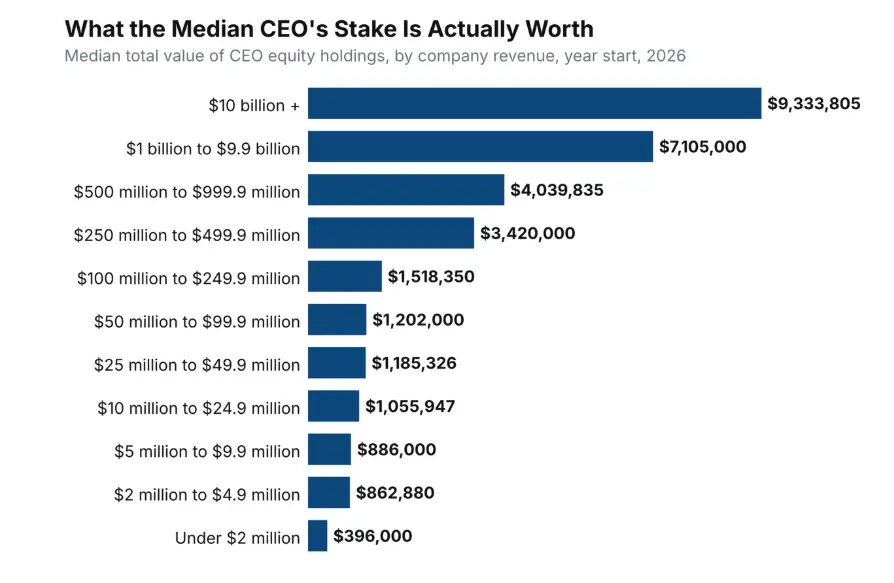
The fundamental purpose of granting senior executives a stake in their company is twofold: to foster a deep-seated investment in the organization’s future prosperity and to encourage strategic decision-making that cultivates long-term value. Yet, a critical question arises: what happens when these executives lack a clear understanding of what their ownership stake is actually worth? This lack of clarity, the research suggests, is a pervasive weakness in the compensation structures of many private enterprises. While equity or phantom equity incentives are commonly offered to senior leadership, a surprisingly small proportion of businesses consistently measure and communicate the gains accrued from these awards. This oversight can significantly dilute their power as a motivator, especially considering the wide variance in the value of equity stakes for CEOs. Depending on company size, a CEO’s median stake can range from a modest $396,000 for companies with revenues under $2 million to an impressive $7.1 million for those generating between $1 billion and $9.9 billion.
The Invisible Value of Executive Ownership
The disparity in understanding the value of ownership stakes is stark when comparing private companies to their publicly traded counterparts. Executives in public companies benefit from readily accessible stock prices, providing a continuous and transparent measure of their ownership’s worth. In contrast, executives within private firms often operate with limited visibility into the year-over-year fluctuations in the value of their equity awards.
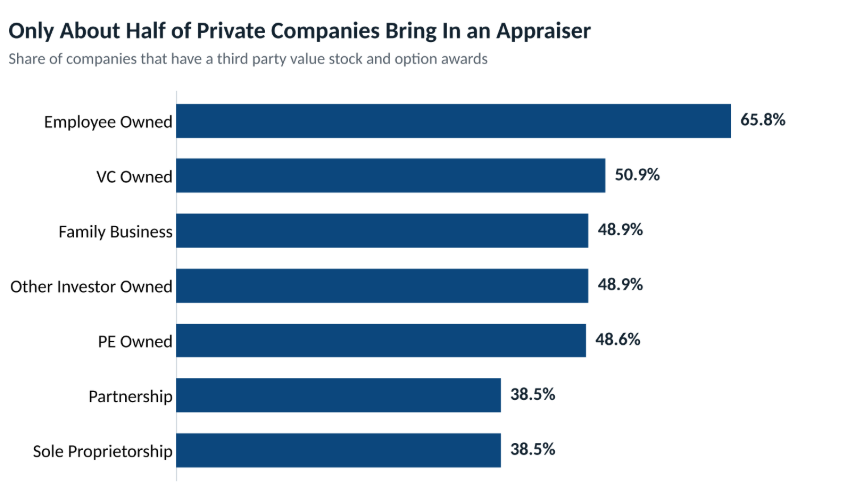
The Chief Executive Group’s report highlights that only approximately half of private companies engage external professionals for the valuation of stock and option awards. Employee-owned companies demonstrate the highest propensity for such valuations, with 66 percent utilizing outside expertise. Conversely, sole proprietorships and partnerships lag significantly, with only 39 percent seeking independent valuations. The remaining companies typically rely on internal assessments from their Chief Financial Officer or other staff members, or employ formulas tied to financial metrics like profits or sales.
Interestingly, private equity- and venture capital-backed companies generally exhibit a more robust practice of regularly valuing and communicating equity gains compared to other privately held businesses. However, even within this group, the engagement of independent appraisers places them in the middle tier. This distinction is crucial because the perceived value of an equity incentive extends beyond the ultimate payout. It encompasses the financial stake executives feel they are actively building over time. Without consistent valuations and clear communication, executives may struggle to connect their daily decisions and the company’s performance directly to their potential rewards. This disconnect can result in a compensation program that, while designed for long-term commitment, ultimately delivers less motivational impact than intended.
Benchmarking Effective Valuation Practices
To understand what regular, meaningful valuation looks like in practice, examining specific company approaches offers valuable insights. Pete Ensch, CEO of Sani-Matic, a private equity-backed manufacturing firm, exemplifies a proactive strategy. His company collaborates with its sponsor to monitor value on a quarterly basis, complemented by a formal, comprehensive valuation conducted annually. This year, Sani-Matic took a significant step forward by initiating the practice of providing each equity holder with a personalized statement detailing the current worth of their stake, alongside projections of potential outcomes should the business be sold at that juncture.
"Everybody was doing the same thing, just doing their own math," Ensch remarked, underscoring the need for a standardized and transparent approach. He candidly acknowledged that this transparency can have dual effects. In previous roles at more challenging businesses, valuations sometimes brought disappointment rather than motivation. "It comes down to the numbers," he stated, emphasizing the importance of objective financial realities.
Another case in point is Parr Instrument Company, a venerable manufacturer with over a century of history. Based in Moline, Illinois, Parr Instrument Company has maintained its independent status and operates under a distinctive ownership structure. Jim Nelson, President and CEO, explained that an independent appraiser assesses the company’s value annually. Periodically, the company offers key employees the opportunity to acquire shares at a discount of approximately 40% relative to this appraised value. This discount is precisely why the annual valuation is indispensable. The difference between what an employee pays and the fair market value is recognized as taxable income in the year of acquisition, necessitating accurate and timely valuations.
Both Sani-Matic and Parr Instrument Company also require their executives to invest their own capital into equity incentives. This practice, while demonstrating strong commitment, is not widespread. The research indicates that only 22 percent of companies mandate that employees contribute personal funds to acquire equity incentives. This requirement is significant because it aligns executives’ financial interests with the company’s performance, exposing them to both potential gains and losses.
Beyond a Simple Ownership Stake: The Growing Importance of Equity
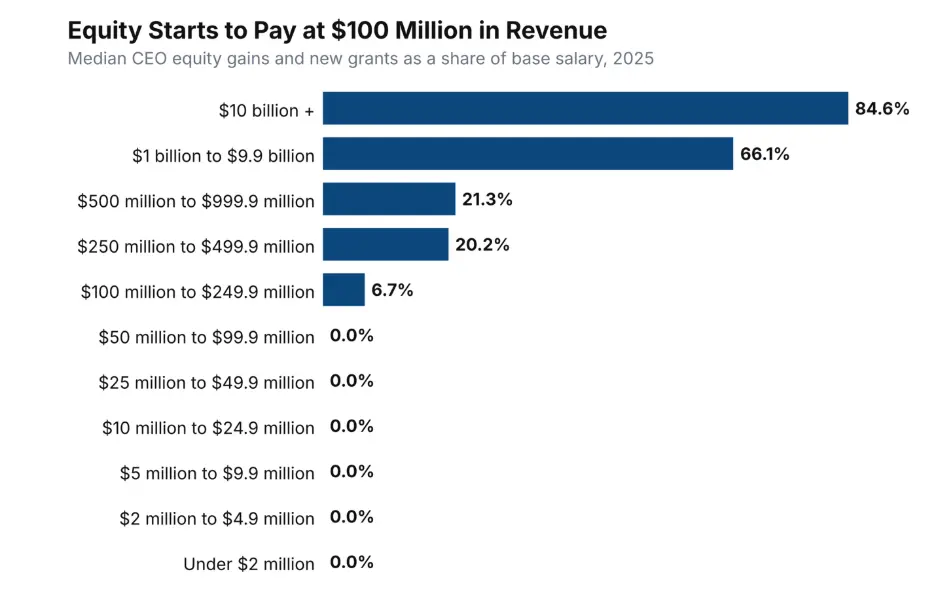
As private companies continue to mature and expand, the strategic importance of equity incentives grows in tandem. The Chief Executive Group’s report provides compelling data on this trend. In 2025, the median CEO at companies generating between $100 million and $249.9 million in annual revenue saw equity gains and new grants equivalent to roughly 7 percent of their base salary. This figure escalated to 20 percent for companies with revenues between $250 million and $499.9 million. For the largest segment surveyed, companies with revenues ranging from $1 billion to $9.9 billion, equity incentives represented a substantial 66 percent of base salary. Conversely, for companies with revenues below $100 million, the median CEO reported no equity gains or new grants whatsoever, highlighting a significant gap in incentive structures across different scales of private enterprise.
The mechanics of how equity shares vest also present a division among private companies. Time-based vesting is contingent solely on the passage of time, offering a predictable, albeit potentially less performance-driven, reward. Performance-based vesting, on the other hand, requires quantifiable metrics and a commitment to verifying these achievements. The majority of private companies appear to favor time-based vesting, with nearly half structuring equity to vest purely on time. Performance-based vesting alone accounts for 19 percent of companies, while a combined approach of both time and performance is utilized by 34 percent.
This structural approach can lead to situations where an ownership stake is held for years without a clearly defined financial figure attached to it. This is particularly noteworthy given that the median CEO’s equity holding is valued at a minimum of twice their base salary across all company sizes included in the survey. The fundamental question for private company owners is not merely whether an award incentivizes the desired behaviors, but whether anyone within the organization can definitively state its current worth.
Practical Steps to Maximize Incentive Impact
For private company CEOs reviewing their executive compensation strategies in anticipation of the coming years, the Chief Executive Group’s research offers several actionable recommendations. These steps are designed not necessarily to increase equity grants or inflate compensation expenses, but rather to ensure that existing incentives are fully understood and effectively aligned with the company’s long-term strategic objectives.
-
Implement Regular, Independent Valuations: Engage external, qualified appraisers to conduct periodic valuations of equity awards. This ensures objectivity and provides a credible basis for understanding the true worth of these incentives. The frequency can be adjusted based on company growth and market conditions, with annual valuations being a minimum standard.
-
Prioritize Clear and Consistent Communication: Beyond simply conducting valuations, it is imperative to communicate the results effectively to executives. Personalized statements detailing the current value of their stakes, along with potential future scenarios, can significantly enhance understanding and motivation. This communication should be clear, concise, and delivered in a manner that executives can readily comprehend.
-
Explore Performance-Based Vesting Triggers: While time-based vesting has its place, incorporating performance metrics can more directly link executive rewards to the company’s success. This requires careful definition of achievable yet challenging performance goals that align with long-term strategic ambitions. A hybrid approach, combining elements of both time and performance, can offer a balanced structure.
-
Consider Executive Investment Requirements: Encouraging executives to invest their own capital in equity incentives, even through structured programs, fosters a deeper sense of ownership and shared risk. This aligns their personal financial interests more closely with the company’s performance and can lead to more prudent decision-making.
-
Benchmark Against Industry Standards: Utilize comprehensive compensation reports, such as the Chief Executive Group’s annual survey, to understand how equity incentive practices and valuations compare across similar companies. This provides valuable context for refining internal strategies and ensuring competitiveness.
The ultimate goal is to transform ownership incentives from mere line items on a balance sheet into dynamic, powerful drivers of executive engagement and long-term value creation. For private company owners, the distinction between offering a theoretical stake and providing a clearly understood and quantifiable one is paramount. A potentially valuable reward that executives cannot readily evaluate is likely to be far less effective than one whose worth and direct connection to performance are transparently articulated.
The Chief Executive Group’s 2026-2027 CEO & Senior Executive Compensation Report offers in-depth benchmarks for executive compensation, including detailed insights into equity incentives, pay practices, and variations across company size, industry, and ownership structures. This report serves as a critical resource for private companies seeking to optimize their compensation strategies and ensure their ownership incentives are truly meaningful and impactful.
