

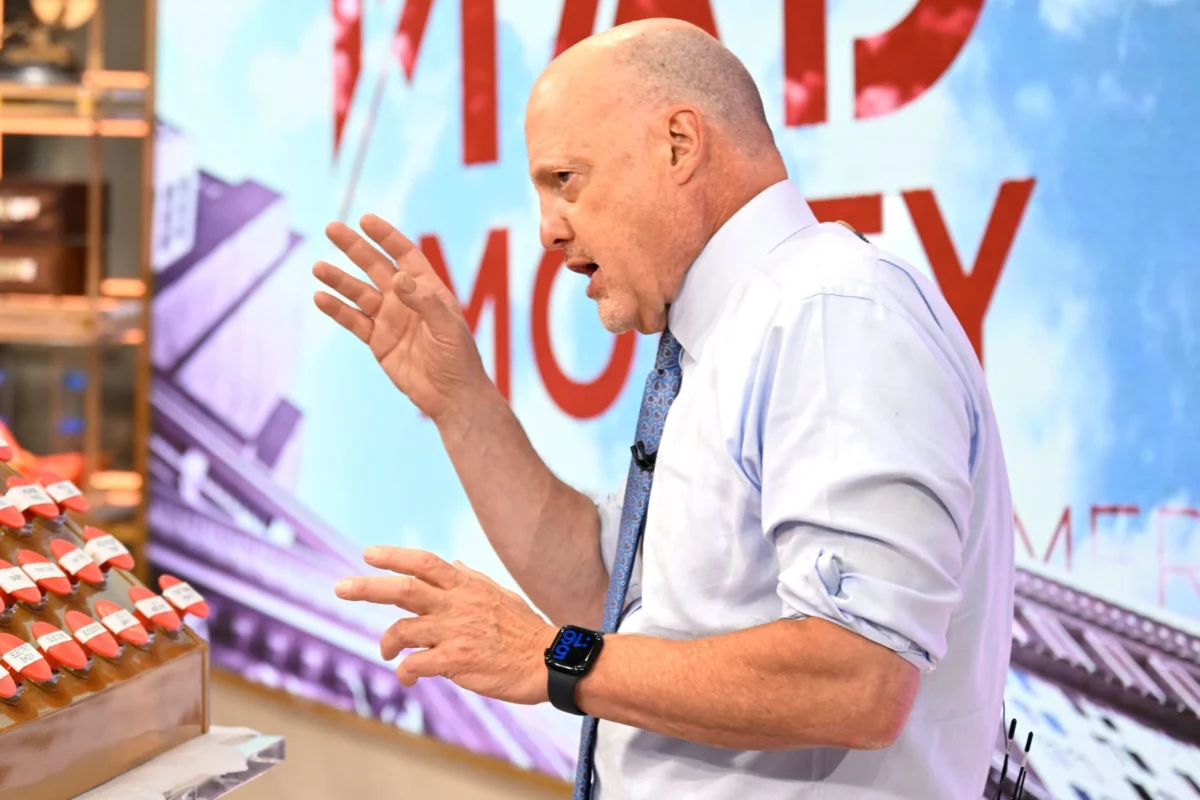
The traditional hierarchy of the financial markets underwent a significant shift this week as the bond market asserted its dominance over equity valuations, prompting CNBC’s Jim Cramer to issue a stern warning to investors. As the benchmark 10-year Treasury yield reached one-year highs and oil prices surged toward triple digits, the "Mad Money" host emphasized that the trajectory of stocks is currently being dictated by fixed-income trends and geopolitical instability. This shift comes at a critical juncture, as the market prepares for a high-stakes week of corporate earnings featuring industry bellwethers such as Nvidia, Walmart, and Home Depot. Cramer’s central thesis remains that while the underlying economy shows pockets of robustness, the "bond market’s wrath" possesses the inherent power to derail even the most resilient equity rallies.
The current market environment is characterized by a "higher-for-longer" interest rate sentiment, which was exacerbated on Friday by rising energy costs and hawkish geopolitical rhetoric. Crude oil prices saw a marked uptick following comments from former President Donald Trump regarding the United States’ decreasing patience with Iran. In an interview with Fox News, Trump suggested that the Iranian government needs to "make a deal," a statement that traders interpreted as a signal of potential future escalations in the Middle East. Geopolitical tensions in oil-producing regions historically lead to a "risk-on" premium in energy markets, which in turn fuels inflationary fears. When oil prices rise, the cost of transportation and manufacturing follows, making it increasingly difficult for the Federal Reserve to justify interest rate cuts. Cramer noted that without a "tame" bond market—which requires a stabilization or decline in oil prices—equities will face a persistent headwind.
The Macroeconomic Landscape and Speculative Risks
Beyond the immediate pressure of yields and energy, Cramer identified a growing concern regarding market discipline. He pointed to signs of speculative excess, specifically citing the recent wave of Initial Public Offerings (IPOs) and the fervor surrounding private valuations, such as those associated with SpaceX. While Cramer clarified that he has not transitioned into a "bear" or a "doomer," he stressed that a disciplined investor must acknowledge when fundamental facts change. The current influx of new issues often mirrors historical periods of "market froth," where a flood of supply eventually overwhelms demand, leading to a correction. He cautioned that the market might be approaching a "reckless flood" of IPOs, a phenomenon that has historically preceded significant downturns and "heartbreak" for retail investors. To navigate this, he urged market participants to protect their recent gains and maintain a defensive posture.
This cautious outlook sets the stage for a busy five-day stretch where corporate performance will be tested against the backdrop of high borrowing costs and shifting consumer behavior. The following is a detailed chronological breakdown of the upcoming week’s key market events and their broader implications for the economy.
Monday: Industrial Valuations and the Data Center Boom
The week begins with a focus on the industrial sector as Jason Kaiser, the head of Caterpillar’s power and energy business, prepares to meet with Wall Street analysts at a Bank of America virtual investor event. Caterpillar, traditionally viewed as a cyclical heavy-machinery play, has recently been re-rated by the market as a beneficiary of the massive build-out in data centers. The infrastructure required to house artificial intelligence (AI) servers requires immense power generation and cooling systems, areas where Caterpillar excels.

However, Cramer expressed concern regarding the stock’s current valuation. Having experienced a significant rally, Caterpillar is now trading at multiples more commonly associated with high-growth technology firms rather than traditional manufacturers. The primary risk for investors on Monday is whether the stock has "overheated," leaving little room for error if the company’s guidance does not exceed the already lofty expectations of the "AI-adjacent" investment community.
Tuesday: The Interest Rate Sensitivity Test
Tuesday will serve as a referendum on the health of the American housing market and the infrastructure supporting the digital economy. Home Depot is scheduled to report its quarterly results, a report that will be closely scrutinized for the impact of high mortgage rates. As the 10-year Treasury yield hovers at elevated levels, the cost of home equity lines of credit (HELOCs) and general consumer borrowing has surged, discouraging homeowners from embarking on large-scale renovation projects. While expectations for Home Depot are relatively low, Cramer suggested that any result that is "not terrible" could be enough to spark a relief rally, given how much negativity is already priced into the shares.
Simultaneously, Vertiv Holdings, a critical player in data center thermal management and power equipment, will be in the spotlight. Like Caterpillar, Vertiv has seen its stock price soar due to its indispensable role in the AI ecosystem. The challenge for Vertiv is the "whisper number"—the unofficial earnings expectation held by traders that often exceeds official analyst estimates. Even a strong report could lead to a "sell the news" event if the growth trajectory does not appear exponential.
In the evening, the focus shifts to Toll Brothers, a leading builder of luxury homes. While luxury buyers are often less sensitive to interest rate fluctuations than entry-level buyers, the broader trend of rising mortgage rates remains a significant barrier. Cramer noted that while Toll Brothers is a premier operator in the space, the macro environment makes it difficult to maintain a long-term bullish stance on homebuilders until the bond market stabilizes.
Wednesday: The AI Superbowl and Retail Divergence
Wednesday is arguably the most anticipated day of the earnings season, dominated by the financial results of Nvidia. Cramer reiterated his long-standing mantra for Nvidia: "Own it, don’t trade it." Since the CNBC Investing Club’s Charitable Trust initiated a position in 2019, the stock has become the primary engine of the S&P 500’s growth. Nvidia sits at the epicenter of the global shift toward accelerated computing, providing the H100 and Blackwell chips that power large language models.
Despite his long-term conviction, Cramer warned that Nvidia likely requires a "perfect quarter" to sustain its upward momentum. The market will be looking for not just a beat on the top and bottom lines, but also significant upward revisions for future quarters and reassurance that the supply chain can keep up with unyielding demand.

Earlier on Wednesday, Lowe’s will report its earnings. Cramer expects Lowe’s to potentially outperform its rival Home Depot. This expectation is based on Lowe’s larger exposure to the "do-it-yourself" (DIY) consumer. In a stagnant housing market where people are staying in their current homes rather than selling, smaller maintenance and aesthetic projects—the bread and butter of the DIY segment—tend to be more resilient than the professional-grade renovations that drive Home Depot’s revenue.
Thursday: Consumer Resilience and Software Skepticism
Thursday brings a critical update on the state of the American consumer from Walmart. Cramer remains highly bullish on the retail giant, describing it as "one of the greatest companies of the era." Walmart’s ability to leverage its scale to offer lower prices has allowed it to gain market share among higher-income households who are increasingly "trading down" to manage inflationary pressures. The company’s investments in e-commerce and its high-margin advertising business (Walmart Connect) provide additional layers of growth that distinguish it from traditional brick-and-mortar retailers.
In the technology sector, Workday will report its results. The software-as-a-service (SaaS) company is currently at the center of a debate regarding whether AI will augment or disrupt traditional enterprise software. There is a growing skepticism among investors that AI might automate the very tasks that Workday’s software is designed to manage, or that IT budgets are being diverted away from SaaS toward AI hardware. Cramer noted that while he does not anticipate a fundamental breakdown in Workday’s business, the "software-as-a-service" label currently carries a stigma that requires the company to prove its AI relevance to skeptical investors.
Friday: The Wholesale Battle
The week concludes with results from BJ’s Wholesale Club. While Cramer views BJ’s as a solid operator with a potential "catch-up" opportunity for its stock price, he reaffirmed his preference for Costco. Costco, which is also a holding in the Charitable Trust, remains the gold standard in the warehouse club space due to its high renewal rates and unmatched membership loyalty. The comparison between BJ’s and Costco will provide further insight into whether the "membership model" of retail continues to provide a safe haven for investors during times of economic uncertainty.
Conclusion and Broader Market Implications
The upcoming week represents a significant test for the "Goldilocks" narrative that has supported equity prices for much of the year. The convergence of high interest rates, geopolitical tension in the energy sector, and a heavy schedule of earnings reports means that volatility is likely to remain elevated. Cramer’s emphasis on the bond market serves as a reminder that equity valuations do not exist in a vacuum. As long as the 10-year Treasury yield remains a competitive alternative to stocks and oil prices threaten to reignite inflation, the "path of least resistance" for the market may be sideways or lower.
For investors, the takeaway from Cramer’s analysis is one of selective participation. The "data center boom" continues to be the most powerful secular trend, benefiting companies from Caterpillar to Nvidia. However, the price paid for that growth matters more than ever. As the "bond market’s wrath" looms, the era of "buying every dip" may be giving way to a more disciplined period where only companies with "perfect" quarters and essential value propositions can thrive. Investors are encouraged to monitor the 10-year yield as closely as any earnings report, as it remains the ultimate arbiter of market direction in the current economic cycle.
