

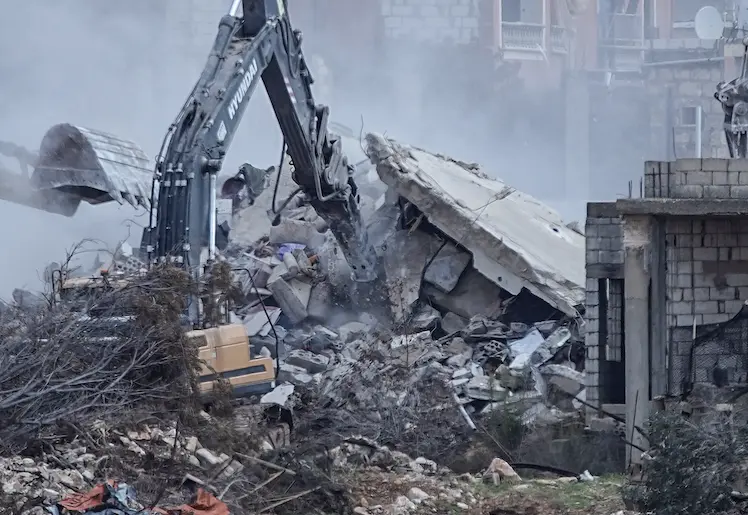
The destruction of residential infrastructure in the southern Lebanese village of Zawtar al-Sharqiye by Israeli military excavators has signaled a significant escalation in the border region, threatening the viability of a diplomatic framework established earlier this year. On November 18, 2026, reports emerged detailing the systematic demolition of several housing units in the village, which had been designated as one of the primary "pilot zones" for the deployment of the Lebanese Armed Forces (LAF). This deployment was a cornerstone of the June 2026 framework agreement, an international effort brokered to stabilize the volatile frontier and prevent a full-scale regional conflagration. The recent actions by Israeli forces have not only displaced more civilians but have also cast a shadow over the sustainability of the security arrangements intended to restore Lebanese sovereignty to the south while addressing Israeli security concerns.
Zawtar al-Sharqiye, situated on a ridge overlooking the Litani River, occupies a strategic position that has long been a flashpoint for cross-border tensions. Under the June agreement, the village was intended to serve as a model for the gradual withdrawal of non-state actors and the re-establishment of formal state authority. However, the arrival of heavy machinery and the subsequent leveling of civilian structures suggest a shift in tactical priorities on the ground. Military analysts suggest that these demolitions are part of a broader Israeli strategy to create a "sterile zone" or a buffer area devoid of structures that could potentially be used for tactical cover, even as diplomatic channels remain officially open.
The Strategic Significance of Zawtar al-Sharqiye
Zawtar al-Sharqiye is more than just a rural settlement; it is a symbol of the "pilot zone" initiative. When the June 2026 agreement was signed, the village was selected specifically because of its geographic prominence and its history of stability compared to other border towns. The plan involved the deployment of two specialized LAF brigades, supported by international funding and logistical aid, to ensure that the area remained free of unauthorized weapons and personnel.
The demolition of homes in this specific location is particularly damaging to the credibility of the framework. For the Lebanese government, the pilot zones were proof that the state could manage its own security and protect its citizens. For the residents, the agreement was a promise of a return to normalcy. The recent incursions by Israeli excavators, supported by armored units, have effectively rendered parts of the village uninhabitable, mirroring a pattern of destruction seen in other border communities such as Ayta ash-Shab and Meiss el-Jabal.
The June 2026 Framework Agreement: A Fragile Peace
To understand the gravity of the current situation, it is necessary to examine the June 2026 framework. Following a period of intense hostilities in late 2025 and early 2026, a coalition of international mediators, led by the United States and France, facilitated a series of indirect talks. The resulting agreement focused on three primary pillars:
- The Strengthening of the LAF: An international donor fund was established to provide the Lebanese Army with the equipment and salaries necessary to maintain a permanent presence south of the Litani River.
- The Delineation of a Security Buffer: While not a formal border treaty, the agreement established "zones of transparency" where both sides agreed to limit certain types of military activity.
- The Return of Displaced Persons: A phased plan was introduced to allow civilians to return to their homes, supported by international reconstruction aid.
For the first few months, the agreement appeared to hold. The LAF began patrolling Zawtar al-Sharqiye in August 2026, and some families began the arduous process of rebuilding. However, Israeli officials repeatedly raised concerns that the "pilot zones" were being used as a screen for the re-infiltration of armed groups. By October, the frequency of Israeli drone incursions and "preemptive" strikes had increased, culminating in the current demolition campaign.
Chronology of the 2026 Border Crisis
The events leading to the demolition in Zawtar al-Sharqiye followed a distinct timeline of deteriorating security:
- January – March 2026: High-intensity exchanges of fire result in the displacement of over 150,000 civilians on both sides of the Blue Line.
- June 12, 2026: The Framework Agreement for Southern Lebanon is signed in Paris, establishing the "pilot zones" starting with Zawtar al-Sharqiye and neighboring Zawtar al-Gharbiye.
- August 1, 2026: The Lebanese Army officially takes over security posts in the pilot zones, monitored by UNIFIL (United Nations Interim Force in Lebanon).
- September 15, 2026: Israel submits a formal complaint to the UN, alleging that "infrastructure of a hostile nature" remains embedded within civilian areas of the pilot zones.
- October 20, 2026: Small-scale Israeli ground incursions are reported; the IDF describes these as "localized engineering operations" to neutralize threats.
- November 18, 2026: Large-scale demolition begins in Zawtar al-Sharqiye, with Israeli excavators destroying at least 12 residential buildings and several agricultural facilities.
Humanitarian Data and the Displacement Crisis
The human cost of the ongoing operations in southern Lebanon is staggering. According to data compiled by the United Nations Office for the Coordination of Humanitarian Affairs (OCHA), as of mid-November 2026, approximately 45% of the housing stock in the immediate border region has been either damaged or completely destroyed. In Zawtar al-Sharqiye specifically, the recent demolitions have added another 200 people to the list of the internally displaced.
Data from satellite imagery and ground reports indicate that the "uninhabitable zone" now extends nearly 5 kilometers deep into Lebanese territory in some sectors. This "scorched earth" approach has significant economic implications. Southern Lebanon’s economy is heavily reliant on tobacco and olive farming. The destruction of agricultural infrastructure, combined with the presence of unexploded ordnance and the physical removal of topsoil by heavy machinery, has led to an estimated 60% loss in agricultural output for the 2026 season in the Nabatieh Governorate.
Furthermore, the Lebanese Ministry of Public Health reported that the destruction of local clinics and the disruption of water supplies in the Zawtar region have led to a 15% increase in waterborne illnesses among the remaining elderly population who refused to evacuate.
Official Reactions and Diplomatic Fallout
The reaction to the demolitions in Zawtar al-Sharqiye has been one of sharp condemnation from Beirut and cautious concern from the international community.
The Lebanese Government:
In a statement released via the National News Agency, the Lebanese caretaker Prime Minister denounced the demolitions as a "flagrant violation of the June framework and an assault on Lebanese sovereignty." The Ministry of Foreign Affairs has reportedly instructed its mission at the United Nations to file an urgent complaint with the Security Council, arguing that the destruction of homes in a designated pilot zone undermines the very essence of the diplomatic process.
The Israeli Defense Forces (IDF):
The Israeli military has maintained a factual, albeit firm, stance. A spokesperson for the IDF stated that the operations are "purely defensive" and aimed at "dismantling infrastructure that poses a direct threat to Israeli communities." The IDF claims that despite the presence of the LAF, certain structures in Zawtar al-Sharqiye were being utilized for surveillance and as staging points for cross-border raids. "We will not allow the framework agreement to become a shield for further aggression," the statement concluded.
UNIFIL and International Mediators:
UNIFIL, which has faced its own challenges in maintaining access to the border regions, confirmed the presence of Israeli heavy machinery in the area. A UNIFIL spokesperson emphasized that "any entry into Lebanon and the destruction of property is a violation of Resolution 1701 and the spirit of the June 2026 agreement." Meanwhile, officials in Washington and Paris are reportedly working behind the scenes to prevent the total collapse of the framework, urging both sides to return to the "Joint Monitoring Committee" established in June.
Analysis: The Creation of an Uninhabitable Buffer Zone
The systematic nature of the demolitions suggests a strategic objective that goes beyond immediate tactical threats. By rendering villages like Zawtar al-Sharqiye uninhabitable, a de facto buffer zone is created. This strategy appears to be based on the premise that if there is no civilian population and no standing infrastructure, there is no cover for irregular forces to operate.
However, this "security through depopulation" model carries immense risks. First, it alienates the very population whose cooperation is needed for long-term stability. Second, it places the Lebanese Army in an impossible position; if the LAF cannot protect the "pilot zones" from Israeli incursions, its credibility as a national security force is eroded, potentially leading to increased domestic pressure for non-state actors to resume "defensive" operations.
The broader implication for the region is a shift from a "border of contact" to a "border of exclusion." If the June 2026 framework fails, the alternative is not a return to the status quo, but a permanent state of low-level attrition characterized by drone warfare, long-range strikes, and the gradual erasure of civilian life along the frontier.
Prospects for Stability and Reconstruction
As the winter of 2026 approaches, the prospects for the residents of Zawtar al-Sharqiye remain bleak. The international community’s willingness to fund reconstruction is predicated on a stable ceasefire—a condition that currently does not exist. The "pilot zone" experiment, once hailed as a breakthrough in Middle Eastern diplomacy, now sits on the verge of collapse.
For the framework agreement to be salvaged, analysts argue that there must be a more robust verification mechanism that addresses Israeli security fears without resorting to the demolition of Lebanese homes. This would require an unprecedented level of transparency and perhaps a larger, more empowered international monitoring force. Without such measures, the images of excavators leveling homes in Zawtar al-Sharqiye may well become the defining legacy of the 2026 border crisis, marking the end of a short-lived hope for peace in southern Lebanon.
