

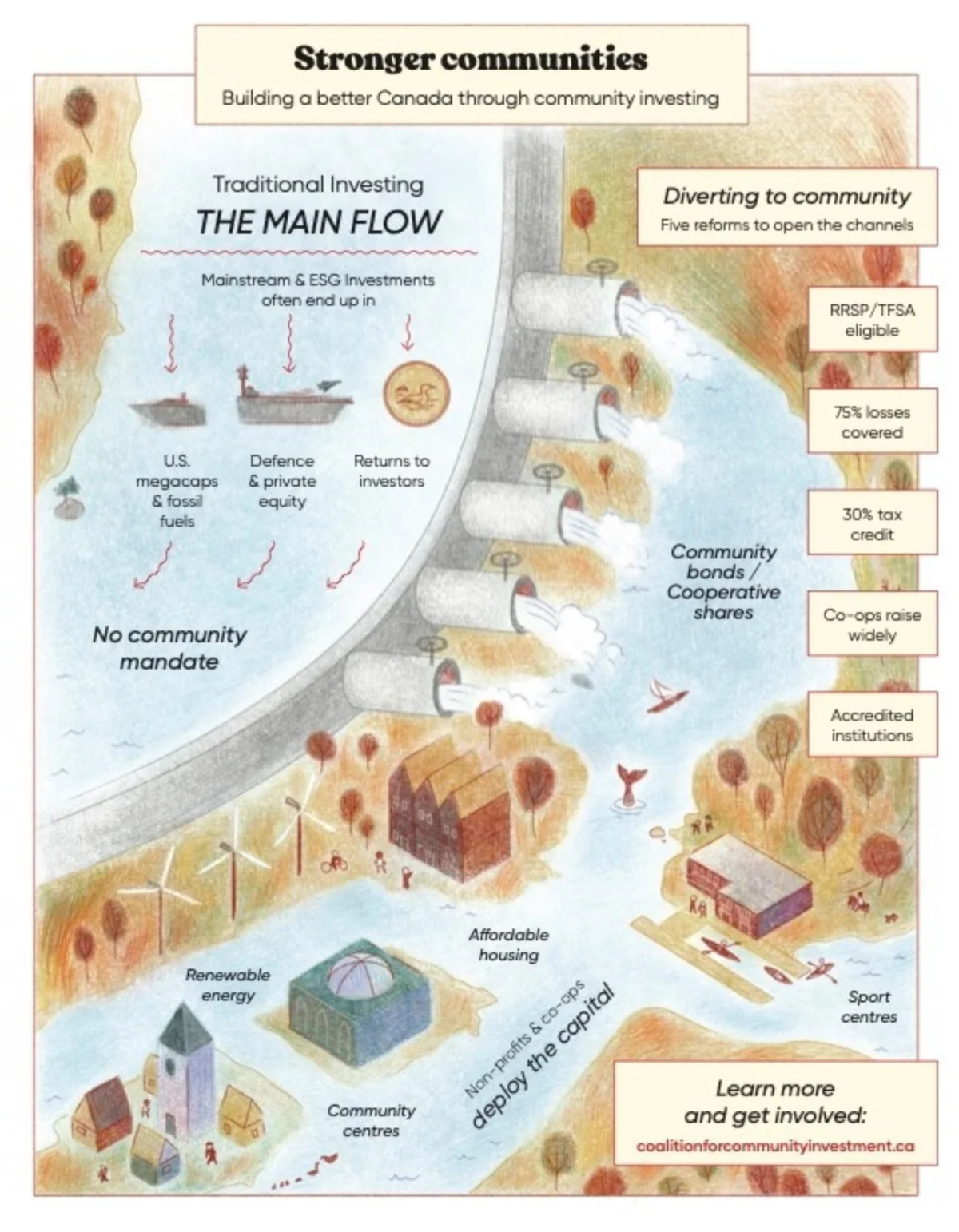
In an era defined by global volatility and shifting geopolitical alliances, the Canadian economic landscape is undergoing a profound transformation led by strategic revaluations of national interest and community resilience. Mark Carney, the former Governor of the Bank of Canada and the Bank of England, has emerged as a central figure in this transition, advocating for an economic model that prioritizes "value" over mere "valuation." As the federal government seeks to fortify the nation’s economic sovereignty against external pressures—most notably the protectionist leanings of the United States and the concentration of capital in global markets—a new movement is gaining momentum: the democratization of investment through community capital.
The current strategy, supported by the Prime Minister’s office and various economic advocacy groups, aims to bridge the gap between Canada’s immense private wealth and its domestic infrastructure needs. By incentivizing "community bonds" and cooperative shares, policymakers believe they can unlock billions of dollars currently flowing into foreign securities, redirecting those funds toward affordable housing, renewable energy, and regional development. This shift represents not just a financial adjustment, but a fundamental move toward an economy where citizens have a direct ownership stake in the infrastructure of their own lives.
A Chronology of Economic Philosophy: From Crisis to Community
The intellectual foundation for this current shift can be traced back to November 2020. During the height of the COVID-19 pandemic, Mark Carney delivered the prestigious BBC Reith Lectures, titled "How to Get What We Value." In these lectures, Carney diagnosed a systemic failure in modern capitalism: a tendency to "privatize profits but socialize losses." He argued that the global financial system had become ethically fragile, prioritizing short-term market gains over long-term social stability.
Following the publication of his book, Value(s): Building a Better World for All, in 2021, Carney’s influence on Canadian policy grew. By 2024, as the geopolitical climate hardened, Carney was increasingly called upon to help steer the Canadian economy through a period of intense competition. The United States, through massive subsidies like the Inflation Reduction Act and a renewed focus on domestic manufacturing, began to present a challenge to Canadian economic sovereignty.
In response, the federal government has focused on "nation-building" projects. This includes the development of the Canada Strong Fund, a vehicle designed to allow Canadians to participate in the financing of large-scale national projects. However, the emerging consensus among economic advocates is that national funds are only one part of the equation; the real "economic strength" lies in the ability of regional economies to self-finance through community-led investment.
The Capital Leakage Crisis: Analyzing the Data
The scale of the opportunity for community investment is best understood through the lens of current asset allocation. According to recent data from Statistics Canada, the nation sits on a massive mountain of wealth, yet very little of it remains at home to build productive capacity.
Total Canadian financial assets are currently valued at approximately $11.95 trillion. Of this total, roughly 35%—or $4.18 trillion—is held in personal investments, including stocks, bonds, mutual funds, and exchange-traded funds (ETFs). However, a staggering $3.04 trillion of Canadian capital was held in U.S. securities at the end of 2024. This represents a significant "capital leakage," where Canadian savings are used to fuel the growth of American corporate giants rather than Canadian communities.
Furthermore, this capital is increasingly concentrated. The 10 largest companies on the S&P 500 now account for nearly 41% of that index’s total value. For the average Canadian investor, this means their retirement savings are often tied to the performance of a handful of global tech giants, providing little to no benefit to the local economy or the essential services they rely on daily.
Research conducted by Corporate Knights suggests that even a minor shift in behavior could have a transformative impact. If just 1% of current Canadian personal investments were redirected into community bonds and cooperative shares, the community-finance market would surge from its current $150 million to approximately $42 billion. This influx of capital would be sufficient to solve major portions of the national housing crisis and accelerate the transition to a low-carbon grid.
Five Policy Pillars for Unleashing Community Capital
To bridge the gap between retail investors and local projects, the Canadian Coalition for Community Capital—an advocacy network comprising more than 30 organizations—has outlined five critical policy reforms for the federal government. These measures are designed to make community investing as simple and tax-efficient as buying a global mutual fund.

1. Modernizing Tax-Advantaged Savings Accounts
Currently, Canadians utilize Registered Retirement Savings Plans (RRSPs), Tax-Free Savings Accounts (TFSAs), and First-Home Savings Accounts (FHSAs) to build long-term wealth. However, community bonds are often ineligible for these accounts due to complex administrative hurdles and rigid definitions of "qualified investments." By streamlining the process for these accounts to hold community-based securities, the government would allow everyday investors to support local non-profits without sacrificing their tax benefits.
2. Implementing a Risk-Sharing Mechanism
Risk is the primary deterrent for retail investors considering local projects. While global stocks are perceived as "safe" due to their liquidity, local projects provide tangible social returns that aren’t captured in a share price. Advocacy groups propose that the federal government allow investors to deduct 75% of losses on eligible community securities. This "downside protection" would instill confidence in the market, encouraging a broader segment of the population to diversify into community assets.
3. Establishing a Community-Capital Tax Credit
The federal government already uses targeted tax credits to stimulate specific sectors, such as clean technology, film production, and mineral exploration. Advocates argue that community bonds deserve a similar incentive. A proposed 30% community-capital tax credit (comprising a 20% non-refundable and 10% refundable portion) with a $10,000 annual cap per investor would provide a powerful nudge for Canadians to "buy local" with their investment dollars.
4. Expanding the Reach of Cooperatives
Cooperatives are a vital part of the Canadian economy, particularly in the agricultural and energy sectors. However, current regulations often prevent co-ops from selling investment shares to anyone outside their immediate membership base. Lifting these restrictions would allow a co-op in Atlantic Canada to raise funds from an investor in British Columbia, creating a national network of cooperative finance that supports local food systems and renewable energy grids.
5. Building an Accredited Ecosystem
For community finance to scale, it requires a robust infrastructure. This includes the development of accredited institutions and intermediaries—organizations like Tapestry Community Capital—that can facilitate bond issuances, conduct due diligence, and provide the transparency that investors expect. A federal investment in this "market plumbing" would ensure that community bonds are viewed as a credible and professional asset class.
Official Responses and Economic Implications
Suzanne Faiza, coordinator for the Canadian Coalition for Community Capital, emphasizes that this movement aligns with existing Canadian values. "Canadians want their money to stay here," Faiza stated. "They’re checking labels at the grocery store, prioritizing Canadian products in their day-to-day lives. The government has an opportunity now to channel that sentiment into investment, too."
The economic argument for these reforms extends beyond social sentiment. Independent economic modelling suggests that the fiscal return on these tax incentives would be substantial. Under a conservative scenario, every dollar of federal tax expenditure on community capital is estimated to generate $17 in Canadian Gross Domestic Product (GDP). This "multiplier effect" occurs because community investments tend to stay within the local economy, creating jobs, improving infrastructure, and ultimately returning more in federal tax revenue than the initial cost of the incentives.
Furthermore, these investments address "market failures" that traditional banks often overlook. Small-scale affordable housing projects or community-owned solar farms often struggle to secure traditional financing because they do not meet the scale requirements of major financial institutions. Community capital fills this gap, providing the "patient capital" necessary for long-term social infrastructure.
Broader Impact: Security and Sovereignty
The push for community capital is ultimately a push for economic sovereignty. As Mark Carney continues to advise the government on national growth strategies, the focus remains on resilience. In an era where trade wars and tariffs can destabilize national economies overnight, a country that is financed by its own citizens is inherently more stable.
By empowering Canadians to invest in the "productive capacity" of their own neighborhoods, the federal government can achieve two goals simultaneously: strengthening the national economy and rebuilding the social contract. When a citizen invests in a local community bond that funds a neighborhood health clinic or a low-income housing complex, they are doing more than seeking a financial return; they are participating in the act of nation-building.
As the Canada Strong Fund and other community-focused initiatives move toward implementation, the success of these programs will depend on the government’s willingness to remove the bureaucratic barriers that currently keep Canadian wealth locked in foreign markets. If the proposed reforms are adopted, Canada could see a historic shift in how wealth is generated and distributed, moving away from "amoral" global markets and toward a system that reflects the values of its people. The path forward, as envisioned by Carney and community advocates alike, is one where economic strength is measured not just by the height of a stock market index, but by the resilience and ownership of the communities that sustain it.
