

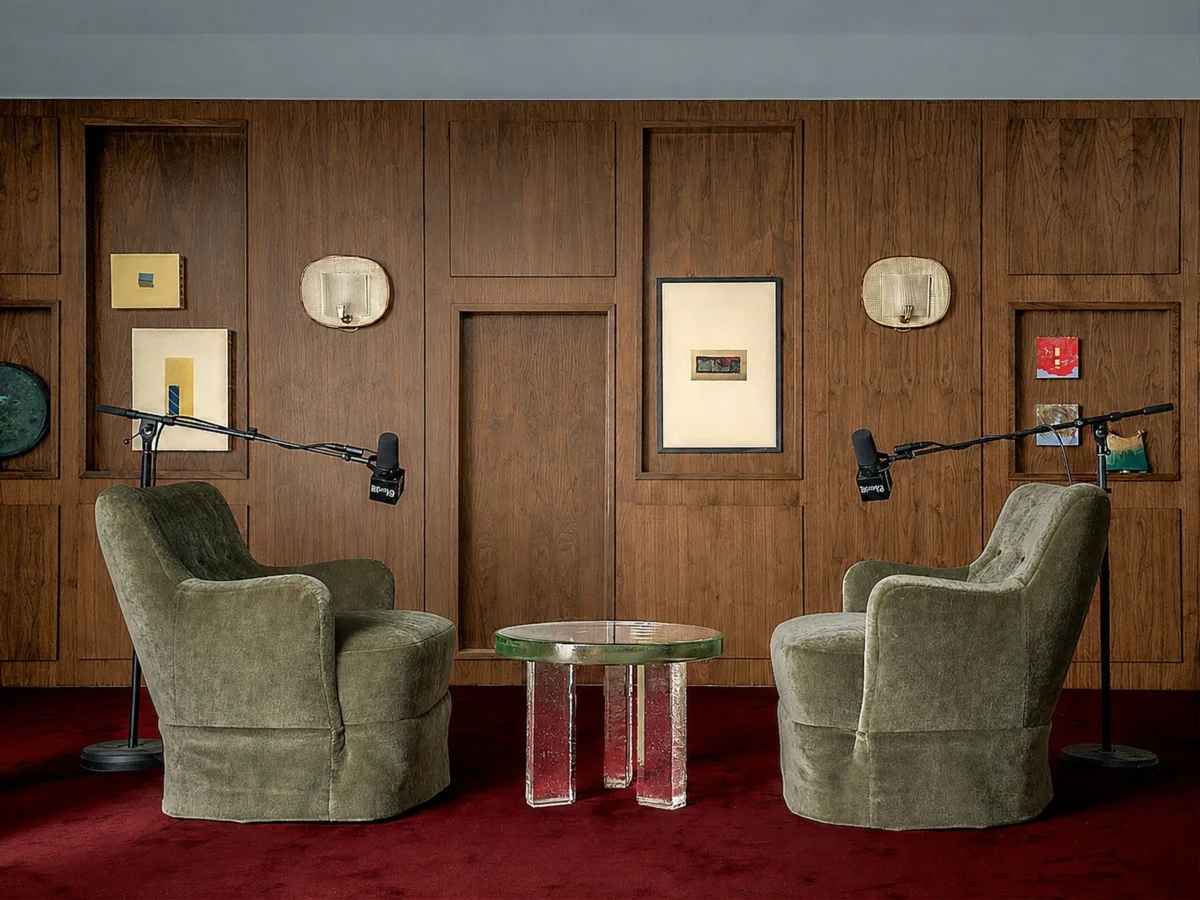
The global media landscape witnessed a significant shift this summer as Jay Shetty’s acclaimed podcast, On Purpose, transitioned to Netflix, marking a new era for one of the world’s most influential wellness platforms. With a digital footprint exceeding 65 million followers, Shetty has long been a titan of the "mindset" industry, but the move to a major streaming service necessitated a visual evolution that matched the gravity of his conversations. To meet this challenge, Shetty partnered with Los Angeles-based designer Mike Moser to create a bespoke, at-home podcast studio that defies the conventions of traditional broadcast sets. The resulting 800-square-foot space, located within Shetty’s own residence, serves as a sophisticated intersection of high-end residential design, curated art gallery, and professional film environment.
A Vision for Intimacy and Authenticity
The primary directive for the project was to create an environment that felt like a "natural extension" of Shetty’s home rather than a cold, technical soundstage. Shetty, who spends a significant portion of his professional life within this space, required a sanctuary that remained aesthetically pleasing day after day while providing a "safe harbor" for his high-profile guests. The design brief drew heavily from the hushed, intentional atmospheres of boutique hotels and private libraries—spaces designed to encourage a physiological "slowing down."
For Mike Moser, whose portfolio is predominantly rooted in luxury residential projects, the task required a delicate balancing act. Every design choice had to satisfy three distinct criteria: it had to align with Shetty’s personal aesthetic, it had to provide unparalleled comfort for guests, and it had to be optimized for the unforgiving eye of 4K cinema cameras. Shetty’s goal was to foster an atmosphere where guests—ranging from former First Lady Michelle Obama to pop icons like Selena Gomez—felt comfortable enough to reveal aspects of their lives they typically keep guarded.

Chronology of a High-Stakes Transformation
The project moved at a pace that mirrored the fast-moving world of digital media. The collaboration between Shetty and Moser began in March, with the initial conceptualization focusing on the psychological impact of the environment. Following a month of intensive planning and sourcing, physical construction commenced at the end of April.
The transformation of the space was an industrial feat; what began as a raw, dry-walled 800-square-foot room was completely overhauled in just three weeks. Moser’s team worked around the clock to meet the deadline, ensuring the studio was ready for the summer Netflix premiere. This rapid turnaround included the installation of custom architectural elements, specialized lighting, and the integration of acoustic treatments that remain invisible to the viewer but essential for broadcast-quality audio.
Architectural Depth and Materiality
One of the most striking features of the new studio is the custom wall paneling, designed by Moser himself. Crafted from bleached walnut, the walls provide a warm, organic backdrop that avoids the sterile look of many modern studios. Moser took inspiration from Villa Borsani, the famed Italian residence known for its mid-century elegance, to create protrusions in the woodwork. These architectural "fins" add physical depth and definition to the room, preventing the background from appearing flat on camera while doubling as functional shelving for a rotating collection of art and artifacts.
The color palette of the studio is a study in sophisticated contrast. A deep wine-colored rug from Nordic Knots anchors the room, providing a rich, grounded foundation. This is offset by a blue replastered ceiling, a choice that adds an unexpected layer of "sky-like" expansiveness to the indoor setting. To balance these primary tones, Moser introduced significant elements of green, which he describes as a "friendly, warm color" that counteracts the seriousness of the topics discussed on the show. The use of verdigris and patinated copper in various fixtures adds what Moser calls a "soulful" quality, suggesting a space that has aged gracefully rather than one that was assembled overnight.

The Curated Environment: Furniture and Fine Art
The centerpiece of the studio—the interview area—is defined by two vintage Danish armchairs. Reupholstered in mohair velvet by Designs of the Time, these chairs offer both the tactile comfort necessary for long-form interviews and a luxurious texture that catches the light beautifully on film. Between the host and guest sits a round glass table by Courtney Applebaum, featuring three jagged slabs for legs. The transparency of the glass ensures that the visual flow of the room is not interrupted, while the rugged stone legs provide an element of raw, natural energy.
Art plays a "provocative voice" in the studio, with Moser and Shetty selecting pieces that offer diverse perspectives. Among the most notable works is Rosie Clements’s Calyx 2026, a photograph transformed into bubble wrap via a UV printer, which hangs to Shetty’s left. Behind the guest’s chair, two contrasting works create a sophisticated backdrop: a large-scale acrylic on linen by Liam Stevens titled Untitled XXV and a layered oil painting by J. Grant titled Black and Blue.
These selections were not merely decorative; they were chosen for their ability to be "flattering to guests without flattening into a neutral backdrop." By using art with texture and depth, the design ensures that the camera always has something interesting to focus on in the soft-focus background, enhancing the cinematic quality of the production.
The Intersection of Wellness and Visual Media
The redesign of the On Purpose studio reflects a broader trend in the podcasting industry. As the medium moves from purely audio platforms to visual-heavy distributors like YouTube and Netflix, the "set" has become as important as the microphone. In 2024, podcasting is no longer just about the conversation; it is about the "vibe" and the brand identity conveyed through the environment.

Data from the podcasting industry suggests that visual podcasts (video podcasts) see significantly higher engagement rates on social media platforms. For a show like On Purpose, which focuses on mental health and personal growth, the environment must reinforce the message of the content. A cluttered or poorly lit room can create a sense of anxiety in the viewer, whereas a curated, harmonious space like the one designed by Moser reinforces the themes of balance and intentionality that Shetty promotes.
Broader Implications for Residential Design
The Shetty-Moser collaboration also highlights the rising demand for professional-grade "content hubs" within private residences. As more creators and public figures move their production in-house, the boundaries between commercial and residential design are blurring. This project demonstrates that a home studio does not have to look like a workspace; it can be a "lavish yet hushed" sanctuary that serves both the occupant’s lifestyle and their professional output.
Moser’s work on the studio has been praised for its ability to make the host look "swaggy as hell" while maintaining the dignity of a serious interview space. The use of a vintage Fortuny lamp and a Just Andersen lamp provides a warm, directional glow that mimics the "golden hour" of natural light, a technique used in high-end portrait photography to ensure subjects look their best.
Conclusion: A New Standard for Digital Discourse
The debut of the new On Purpose studio marks a milestone in Jay Shetty’s career and a benchmark for the podcasting industry at large. By prioritizing the environment, Shetty and Moser have acknowledged a fundamental truth of human interaction: the space where a conversation happens dictates the quality of the conversation itself.

"The environment matters," Shetty noted reflecting on the first sessions in the new space. "Before a single question is asked, the space can set the tone for a conversation." As the first season of On Purpose on Netflix continues to feature high-profile guests like Karl-Anthony Towns and Camila Mendes, the studio stands as a testament to the power of intentional design. It is a space where the "dead serious" topics of mental health and personal evolution are given the beautiful, respectful stage they deserve, proving that in the modern media landscape, the medium—and the room—is indeed the message.
