

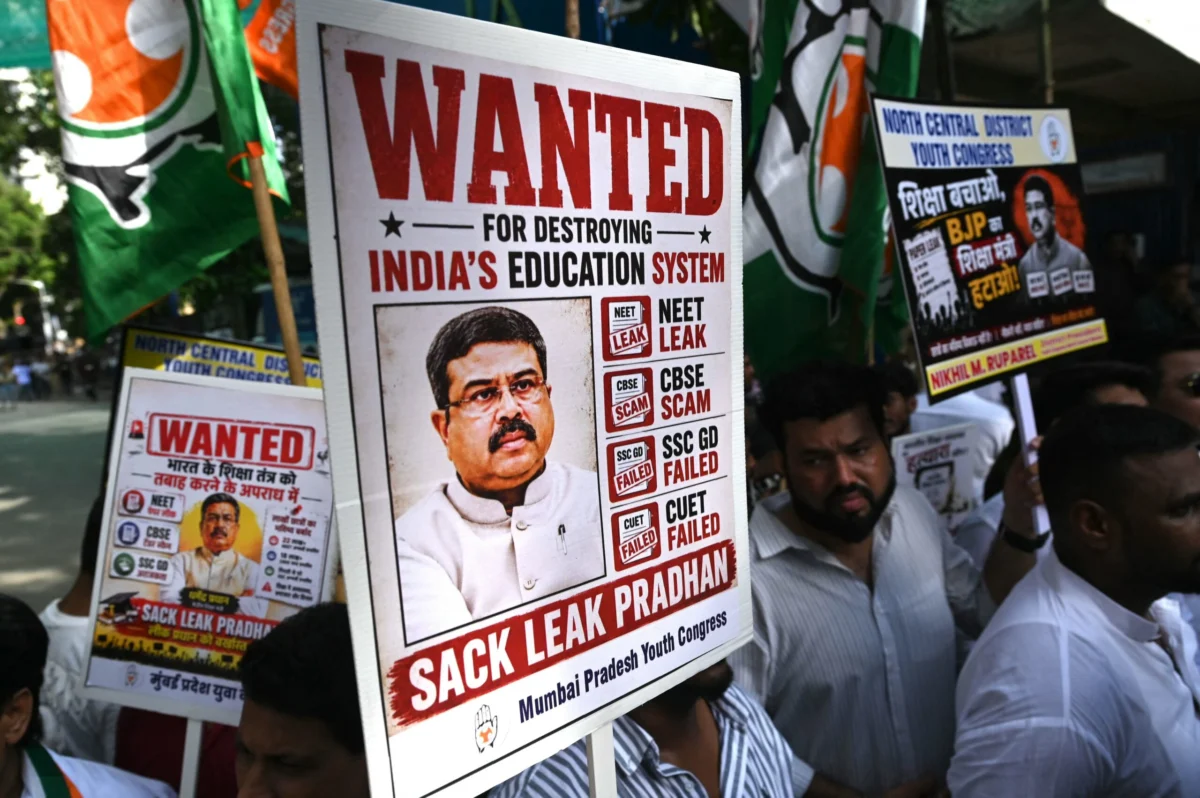
Thousands of supporters of India’s burgeoning youth-led "cockroach" movement have been encamped in the capital, New Delhi, for over a month, galvanised by a singular demand: the resignation of Education Minister Dharmendra Pradhan. Their sustained agitation stems from a series of high-profile examination paper leaks that have cast a shadow over the integrity of India’s competitive examination system, a crucial gateway for millions of students aspiring to higher education and government jobs. These Gen Z-led protests, marked by significant clashes with authorities, including incidents on Monday where more than 100 individuals were severely wounded in baton and tear gas attacks by police, represent the most substantial public challenge to Hindu majoritarian Prime Minister Narendra Modi’s rule so far in his third consecutive term.
The Genesis of Discontent: A Crisis of Examination Integrity
The current wave of protests erupted following widespread allegations of irregularities and paper leaks in two of India’s most critical national examinations: the National Eligibility cum Entrance Test (NEET-UG) for undergraduate medical courses and the University Grants Commission-National Eligibility Test (UGC-NET) for junior research fellowships and assistant professorships. The NEET-UG 2024, taken by over 2.4 million students, saw unprecedented score inflation, with 67 candidates achieving a perfect score, raising immediate suspicions. Furthermore, reports emerged of question papers being leaked and sold for exorbitant sums on the black market in states like Bihar, Gujarat, and Rajasthan, even before the examination date.
The situation escalated dramatically with the cancellation of the UGC-NET 2024 examination just a day after it was conducted, following inputs from the National Cybercrime Threat Analytics Unit of the Indian Cyber Crime Coordination Centre (I4C) suggesting the integrity of the examination had been compromised. This abrupt cancellation, affecting over 900,000 candidates, was a profound blow, leading to widespread anger and disillusionment among students who had invested years in preparation. For millions of Indian youth, these competitive examinations are not merely academic hurdles but represent their sole pathway to upward mobility and a secure future in a highly competitive job market. The perceived systemic corruption threatens to derail their aspirations, fueling a deep sense of injustice.
The "Cockroach" Movement: A Symbol of Resilience and Resistance
The "cockroach" moniker, adopted by the protesting youth, symbolises their resilience and ubiquitous presence, much like cockroaches that survive despite attempts to eradicate them. It reflects a sentiment that despite facing baton charges, tear gas, and official indifference, their movement will persist and multiply. This metaphor resonates deeply with a generation that feels repeatedly sidelined and disenfranchised by a system perceived as corrupt and unresponsive. The movement, largely self-organised through social media and grassroots efforts, represents a new wave of youth activism, distinct from traditional political mobilisation, focusing squarely on issues of meritocracy and systemic fairness.
Chronology of Escalation: From Allegations to Nationwide Uprising
- May 5, 2024: NEET-UG 2024 examination conducted across the country. Initial reports of paper leaks surface from various centres, particularly in Bihar.
- June 4, 2024: Results for NEET-UG 2024 are declared, coinciding with the Lok Sabha election results. The unusually high number of perfect scores and other discrepancies immediately raise red flags.
- June 8, 2024: The National Testing Agency (NTA), responsible for conducting the exams, denies any paper leak and attributes high scores to increased competition and a simplified paper.
- June 13, 2024: The Supreme Court acknowledges the seriousness of the allegations and issues notices to the NTA and the Union government, stating that "the sanctity of the examination has been affected."
- June 18, 2024: UGC-NET 2024 examination is conducted.
- June 19, 2024: The Union Education Ministry announces the cancellation of UGC-NET 2024, citing compromised integrity based on I4C reports. The case is handed over to the Central Bureau of Investigation (CBI).
- June 20, 2024 onwards: Student protests intensify across major cities, particularly in New Delhi. The "cockroach" movement gains traction. Demands for Education Minister Dharmendra Pradhan’s resignation become central.
- Late June – July 2024: Sustained demonstrations in New Delhi. Opposition parties, led by the Indian National Congress, join the protests, amplifying the call for Pradhan’s sacking. Several opposition leaders, including Rahul Gandhi, are detained during these protests.
- Mid-July 2024: Police crackdowns on protesters become more frequent and severe, leading to dozens of injuries and arrests, further fueling public anger and international scrutiny. The encampment in New Delhi grows, becoming a symbol of enduring dissent.
Official Responses and Political Standoff
Education Minister Dharmendra Pradhan initially dismissed the allegations of widespread leaks, attributing isolated incidents to "localised malpractices." However, following the cancellation of UGC-NET and mounting pressure, he adopted a more conciliatory tone, acknowledging "some irregularities" and promising swift action. The government has launched a high-level inquiry by the CBI into the NEET-UG and UGC-NET cases, arresting several individuals suspected of involvement in the paper leak syndicates. A committee of experts has also been formed to review the functioning of the NTA and recommend reforms to ensure transparency and fairness in future examinations.
Despite these measures, the government has steadfastly refused to concede to the demand for Pradhan’s resignation. Prime Minister Modi’s administration has largely defended the minister, characterising the protests as politically motivated attempts to destabilise the government. This stance, however, has failed to assuage the agitated youth and opposition parties, who view the minister’s continued presence as an affront to accountability and a symptom of deeper systemic issues.
India’s main opposition parties, most notably the Indian National Congress, have seized upon the examination scandal as a potent political weapon. Leaders like Rahul Gandhi have actively participated in street demonstrations, courted arrests, and vociferously demanded Pradhan’s immediate dismissal. They argue that the crisis is not merely an administrative lapse but a failure of governance and a direct consequence of the Modi government’s alleged negligence and cronyism. This collaboration between a grassroots youth movement and established political forces has given the protests a broader national resonance, transforming them from a student grievance into a significant political challenge.
A Pattern of Defiance: Modi’s Unyielding Stance on Ministerial Accountability
The current standoff over Education Minister Dharmendra Pradhan’s resignation is, for many followers of Indian politics, no anomaly. Rather, it aligns perfectly with a discernible pattern observed throughout Prime Minister Narendra Modi’s 12 years in power, where he has consistently defied widespread calls for the resignation of his ministers, even amidst major controversies that would typically lead to their ouster in other democratic nations. This resilience, or perceived obstinacy, sets a distinct tone for accountability within his administration.
In many robust democracies, public outcry, significant policy failures, or ethical breaches by ministers often lead to their resignation or dismissal, upholding the principle of ministerial responsibility. For instance, the reference to Britain’s Andy Burnham becoming the seventh prime minister in a decade, while a fictional example, underscores a political culture where leaders and ministers can be held directly accountable through public and parliamentary pressure. In contrast, Modi’s tenure has been characterised by a steadfast refusal to yield to such demands, cultivating an image of an unshakeable leadership that protects its own.
Mahesh Sharma and the Shadow of Cow Vigilantism
One of the earliest and most chilling examples of this pattern emerged just a year into Modi’s first term. In September 2015, Mohammad Akhlaq, a 50-year-old Muslim ironsmith, was brutally lynched by a Hindu mob in Bishada village, Uttar Pradesh, over false suspicions of cow slaughter and beef consumption. This incident, the first in a tragic series of cow-related lynchings that plagued India during Modi’s initial years, sent shockwaves across the nation and triggered widespread protests against rising intolerance.
The then-Minister of Culture and Tourism, Mahesh Sharma, who represented the Gautam Budh Nagar constituency (under which Dadri falls), made matters significantly worse by controversially dismissing Akhlaq’s killing as "an accident." This statement drew immediate condemnation from Muslim groups, opposition parties, and civil society, who demanded his resignation for downplaying a heinous hate crime. Yet, Sharma refused to step down and remained a part of Modi’s council of ministers.
A year later, Sharma further inflamed public sentiment by visiting Bishada to meet the family of Ravi Sisodia, one of the 18 accused in the Akhlaq lynching case, who had died in judicial custody. Images of Sharma bowing before Sisodia’s coffin, draped in the national flag – a honour usually reserved for martyrs or state officials – shocked the nation and renewed fervent calls for his sacking. Critics argued that Sharma’s actions not only legitimised the perpetrators but also signalled a tacit endorsement of majoritarian vigilantism. Despite the outrage, Sharma retained his ministerial position until Modi’s second term began in 2019, when he was eventually dropped from the cabinet but continued as a BJP parliamentarian for a third term. His case highlighted the government’s apparent unwillingness to penalise ministers, even when their actions appeared to condone communal violence or disregard minority sentiments.

The Rohith Vemula Tragedy: Caste, Discrimination, and Ministerial Influence
The academic year 2016 was scarred by the tragic suicide of Rohith Chakravarthi Vemula, a 26-year-old Dalit doctoral student at the University of Hyderabad. Vemula’s death on January 17, 2016, ignited a nationwide student movement, exposing the deep-seated issues of caste discrimination within Indian academic institutions and sparking a powerful discourse on social justice.
Earlier that month, Vemula and four other Dalit students had been expelled from their hostel accommodation and their monthly stipends withheld. This administrative action was allegedly taken after they were accused of assaulting a leader of a student group affiliated with the Rashtriya Swayamsevak Sangh (RSS), the far-right ideological mentor of the BJP. As Dalits, formerly known as "untouchables," these students occupied the lowest rung of India’s caste hierarchy and had historically faced systemic persecution.
Lacking affordable housing, the five students resorted to pitching a tent on the university campus and initiating a hunger strike. They contended that the university’s punitive measures were heavily influenced by a series of letters from then-federal ministers Smriti Irani (Human Resource Development, later Education) and Bandaru Dattatreya (Labour and Employment), who had reportedly pressured the university administration to take action against the students, labelling them as "anti-national."
Vemula’s poignant suicide note, a powerful reflection on his identity and the systemic barriers he faced, resonated deeply across the country. It galvanised student protests and led to widespread demands for the resignations of Irani and Dattatreya. Smriti Irani, a former TV actress, faced particular scrutiny for allegedly misrepresenting facts in Parliament regarding the circumstances of Vemula’s death and for staunchly defending the university administration. Despite the intense public pressure, both ministers remained in Modi’s cabinet. Irani was later moved to the Textiles Ministry in July 2016 and subsequently awarded the crucial Information and Broadcasting Ministry. Dattatreya resigned as Labour Minister in September 2017 but was later appointed governor of Himachal Pradesh in 2019 and Haryana in 2021, indicating that his political career remained robust despite the controversy. This case underscored the government’s steadfast support for its ministers, even when implicated in incidents of profound social injustice and alleged political interference.
Ajay Mishra Teni and the Lakhimpur Kheri Violence
The year 2021 witnessed another significant controversy involving a Modi minister, Ajay Mishra Teni, the junior Home Minister. His son, Ashish Mishra, was accused of running his car over a group of farmers protesting against the controversial farm laws in Uttar Pradesh’s Lakhimpur Kheri district. The incident, which occurred amidst the widespread farmer protests that had gripped the nation for over a year, resulted in the deaths of four farmers and a journalist. In retaliatory violence, three BJP members and one of Mishra’s drivers were also killed.
The direct involvement of a Union minister’s son in such a violent incident, especially one related to the highly sensitive farmer protests, triggered massive calls for Ajay Mishra Teni’s resignation. Critics argued that his continued presence in the Home Ministry, which oversees law enforcement, would compromise the impartiality of the investigation into his son’s alleged crimes. The opposition mounted a relentless campaign, demanding accountability and justice for the victims. Yet, Teni remained in his office for three years, defying all demands for his ouster, until he eventually lost the 2024 general election. His retention was widely seen as a testament to Modi’s strategy of protecting loyalists and projecting unwavering strength, even in the face of grave accusations.
The Exception: Harsh Vardhan’s Resignation During the Pandemic
The only notable instance of a Modi minister resigning in direct response to public pressure for accountability occurred in the immediate aftermath of the devastating second wave of the COVID-19 pandemic in 2021. As India grappled with an unprecedented health crisis, marked by a severe oxygen shortage, overwhelmed hospitals, and a tragic death toll, criticisms of the government’s pandemic response mounted sharply. Health Minister Harsh Vardhan, himself a medical doctor, quit his position as part of a cabinet reshuffle. While his resignation was framed as a strategic move to address public discontent and signal a fresh approach to the pandemic, it was widely interpreted as an acknowledgment of the government’s perceived failures in handling the crisis. However, even in this case, Vardhan retired from active politics after the BJP did not field him as a candidate in the 2024 general election, suggesting a gentle exit rather than a punitive sacking. This stands out as an exception to the broader pattern, likely driven by the sheer scale of the national catastrophe and the overwhelming public outcry against the health system’s collapse.
A Stark Contrast: Ministerial Accountability in Preceding Governments
Modi’s critics frequently highlight the stark contrast between his administration’s approach to ministerial accountability and that of preceding governments, particularly those led by the Indian National Congress. During the Congress-led United Progressive Alliance (UPA) governments (2004-2014), several ministers, including those holding key portfolios, resigned or were sacked in response to calls for accountability.
For example, A. Raja, the Telecom Minister, resigned in 2010 amidst the massive 2G spectrum allocation scam, following intense media scrutiny and opposition demands. Shashi Tharoor, a Minister of State for External Affairs, resigned in 2010 over allegations of impropriety linked to the Indian Premier League (IPL) cricket franchise. More significantly, Shivraj Patil, the then Home Minister, resigned in 2008 following widespread criticism of the government’s security apparatus after the devastating Mumbai terror attacks. Even P. Chidambaram, as Finance Minister, offered to resign after the 2008 Mumbai attacks, though his resignation was not accepted for that specific reason. These instances, irrespective of the political motivations behind them, demonstrated a willingness to yield to public and political pressure, upholding a certain standard of ministerial responsibility that appears to have diminished under the Modi administration.
Broader Impact and Implications: The Erosion of Accountability
The sustained pattern of Prime Minister Modi shielding his ministers from calls for resignation, even in the face of grave allegations or significant public outrage, has profound implications for India’s democratic fabric.
Firstly, it raises serious questions about democratic accountability. When ministers are perceived as immune to public and parliamentary demands for their removal, it can erode public trust in governance and institutions. The principle of ministerial responsibility, a cornerstone of parliamentary democracy, suggests that ministers should be held accountable for the actions and failures within their portfolios. Modi’s approach appears to challenge this conventional understanding, potentially setting a precedent where political loyalty trumps accountability.
Secondly, it contributes to youth disillusionment. For millions of young Indians, who invest years of their lives preparing for competitive exams or seeking justice for social injustices, the government’s apparent imperviousness to demands for ministerial resignations can foster a deep sense of frustration and cynicism. The current "cockroach" movement exemplifies this disillusionment, where youth feel compelled to take to the streets when traditional channels of redress appear ineffective. This could have long-term consequences for political engagement and social cohesion.
Thirdly, from a political strategy perspective, Modi’s consistent defiance can be interpreted as a deliberate move to project an image of strength and an unwillingness to succumb to pressure. By protecting his loyalists, he reinforces internal party cohesion and signals that his administration will not be swayed by opposition or public outcry. This strategy, while potentially consolidating power, also risks alienating significant sections of the electorate who value transparency and accountability. It suggests a centralised decision-making process where the Prime Minister’s will largely dictates the fate of his cabinet members.
Finally, the future outlook suggests that the current protests over examination leaks, while focused on Education Minister Pradhan, are emblematic of a larger struggle for accountability in India. The youth-led "cockroach" movement is not merely about a single minister but about the integrity of the system and the responsiveness of the government to its citizens. How the Modi government navigates this challenge – whether it continues its pattern of defiance or makes an exception under unprecedented youth pressure – will undoubtedly shape the future of democratic discourse and public trust in India. The unwavering stance of the protesting youth, coupled with the determined resistance of the government, sets the stage for a prolonged political battle that transcends the immediate issue of examination leaks, touching upon the very essence of governance and accountability in the world’s largest democracy.
