

The Indian equity benchmarks, the Nifty 50 and the S&P BSE Sensex, exhibited significant volatility during Tuesday’s trading session, struggling to sustain early gains as a cocktail of global macroeconomic headwinds dampened investor enthusiasm. While the session began on a positive note, the momentum quickly fizzled out, leading both indices to slip into the red. The primary catalysts for this cautious atmosphere include the persistent elevation of global crude oil prices, rising sovereign bond yields in the United States, and the looming uncertainty surrounding the upcoming Federal Reserve policy meeting. Despite localized pockets of strength—most notably in the Information Technology (IT) sector and within the heavyweight HDFC Bank—the broader market sentiment remained tethered to international developments and geopolitical tensions in the Middle East.
Macroeconomic Pressures and the Global Backdrop
The volatility in the Indian domestic market is not an isolated event but rather a reflection of broader global anxieties. Investors are currently laser-focused on the U.S. Federal Reserve, which is scheduled to meet later this week. The central bank’s stance on interest rates remains the most significant variable for emerging markets. High global bond yields have historically led to capital outflows from riskier assets in developing economies as investors seek safer, high-yielding returns in U.S. Treasuries.
Compounding the anxiety over interest rates is the volatile energy market. Brent crude, the global benchmark, hovered around the $107 per barrel mark on Tuesday. This surge was exacerbated by fresh geopolitical instability in the Middle East. Reports emerged of Houthi rebels in Yemen launching a new wave of attacks on Saudi Arabian infrastructure, specifically targeting the Saudi East-West oil pipeline. Yemeni officials confirmed that Iran-aligned Houthi forces have been fortifying their positions along the Red Sea coast, raising fears of prolonged disruptions to one of the world’s most critical oil transit routes. For an oil-importing nation like India, sustained prices above $100 per barrel pose a direct threat to the fiscal deficit, inflation targets, and the value of the Indian Rupee.
Banking Sector and Large-Cap Performance
In a market characterized by selling pressure, HDFC Bank emerged as a notable outperformer. As India’s largest private-sector lender and the stock with the highest weightage in both the Nifty and Sensex, its movement often dictates the direction of the benchmarks. HDFC Bank shares rose by approximately 2.1% following reports that the bank had submitted the names of two potential candidates to the Reserve Bank of India (RBI) for the position of Chief Executive Officer. This development provided a semblance of clarity regarding the bank’s leadership succession plan, a factor that usually reassures institutional investors.
However, the gains in HDFC Bank and selective IT stocks were insufficient to offset the broader sell-off. The "higher-for-longer" interest rate narrative coming out of the U.S. continues to weigh heavily on high-growth sectors, leading to a rotation out of mid-cap and small-cap stocks, which have seen intense selling pressure over the last few sessions.
Solar Industries India: Strategic Acquisition Amidst Market Volatility
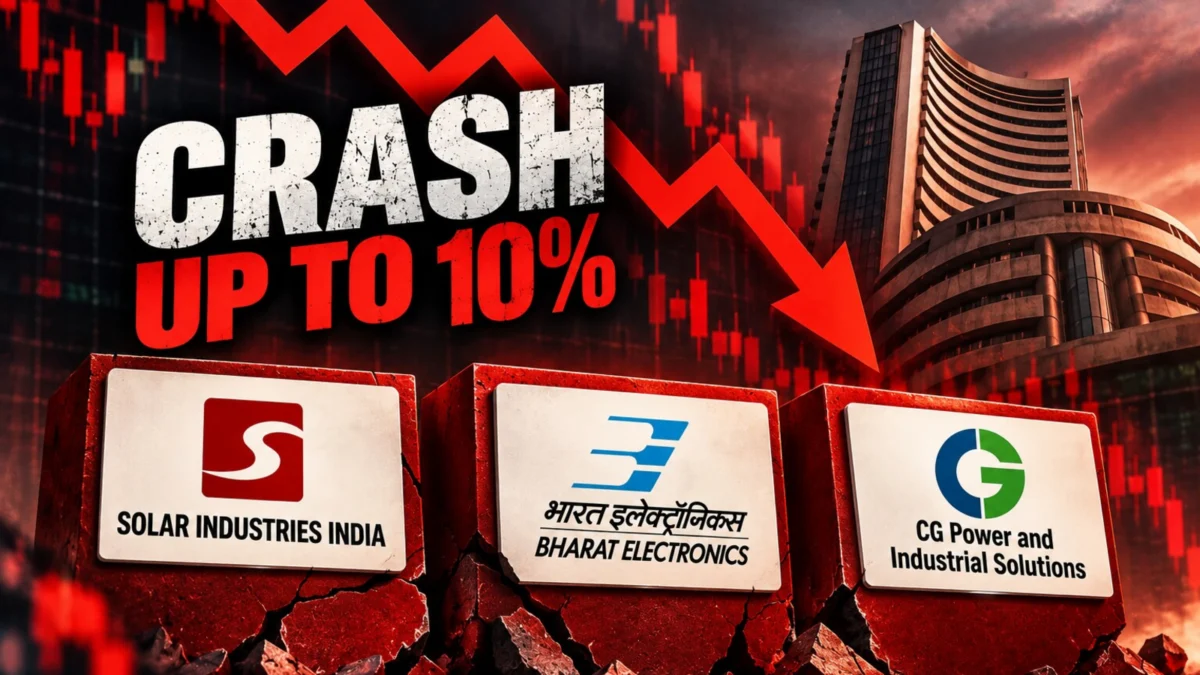
One of the most talked-about stocks in Tuesday’s session was Solar Industries India. The stock experienced a "rollercoaster" ride, initially surging to a new 52-week high of ₹22,700 before reversing sharply to hit a low of ₹20,025—a plunge of over 10% from its peak. This volatility came on the heels of a massive corporate announcement.
Solar Industries revealed it has entered into a definitive agreement to acquire South Africa-based Omnia Holdings Ltd in an all-cash transaction valued at approximately $1.355 billion (roughly ₹12,951 crore). The acquisition is being executed through Solar SA Investments Proprietary, a wholly owned step-down subsidiary. While the deal represents a significant expansion of the company’s global footprint, the sheer size of the cash outlay appears to have triggered profit-booking and concerns over the short-term impact on the company’s balance sheet.
Omnia Holdings, a 73-year-old entity listed on the Johannesburg Stock Exchange (JSE), provides Solar Industries with deep roots in the African mining and chemicals sector. Solar Industries has been methodically expanding its presence in the Southern African Development Community (SADC) region since 2010, starting with manufacturing facilities in Zambia. By 2015, the company had established a distribution platform in South Africa, followed by the commissioning of the Middelburg manufacturing plant in 2017. This latest acquisition is seen as a crowning achievement in its African strategy, though investors remain cautious about the regulatory hurdles and shareholder approvals required to close the deal. Despite the day’s dip, the stock remains a long-term multi-bagger, having delivered returns exceeding 900% over a five-year horizon.
Defense Sector Trends: Bharat Electronics Faces Correction
The defense sector, which has been a darling of the Indian markets over the past year, saw a notable correction on Tuesday. Bharat Electronics Limited (BEL) shares declined by 4.2%, touching a daily low of ₹388.20. The decline is particularly interesting given the strong fundamental news surrounding the sector.
The Defence Acquisition Council (DAC) recently cleared a massive ₹1.1 lakh crore in new defense deals. In a significant boost for the "Atmanirbhar Bharat" (Self-Reliant India) initiative, 98% of these orders are earmarked for domestic companies. This brings the total approvals for the fiscal year 2027 to over ₹1.62 lakh crore. As a market leader in defense electronics, BEL is positioned as a primary beneficiary of this indigenization drive.
Market analysts, including those from Jefferies, have noted that BEL’s current order book is robust, standing at approximately 2.6 times its projected FY26 revenue. Motilal Oswal has maintained a "BUY" rating on the stock with a target price of ₹530, citing its leadership position and favorable valuation at 42.2x FY27E earnings per share. The recent dip in the stock price is viewed by many technical analysts as a necessary correction following a period of rapid ascent, rather than a reflection of deteriorating fundamentals. Additionally, the company recently confirmed the payment of a final dividend of ₹0.55 per share, further cementing its status as a stable pick for long-term portfolios.
Industrial Infrastructure: CG Power’s Greenfield Expansion
CG Power and Industrial Solutions also found itself under selling pressure, dropping 4.2% to ₹870.90. This decline occurred despite the company reaching a major operational milestone. On September 4, 2026, CG Power rolled out the first transformer from its new greenfield manufacturing facility in Sehore, Madhya Pradesh.
The Sehore plant is a cornerstone of CG Power’s growth strategy. It is currently India’s largest single-location power transformer manufacturing facility, spanning 50 acres. Once fully operational, the plant will be capable of producing 35 transformers per month, ranging from 220 kV to 1200 kV classes. The project involves a total investment of ₹792 crore, funded through a combination of Qualified Institutional Placement (QIP) and internal accruals.
The facility is designed to meet the surging global demand for power infrastructure, driven by the expansion of renewable energy grids, the proliferation of data centers, and the modernization of railway and oil and gas infrastructure. While the stock has seen a 7% decline over the last three months, its five-year performance remains staggering, with a surge of 879%. The current market weakness is being attributed to broader sectoral rotation and the general "risk-off" sentiment prevailing in the industrial sector.
Chronology of Key Market Events
To understand the current market position, a look at the timeline of events is essential:
- August 28, 2026: BEL holds its 72nd Annual General Meeting, declaring a final dividend.
- September 4, 2026: CG Power rolls out the first transformer from its Sehore greenfield facility.
- September 9, 2026: BEL eligible shareholders receive dividend payments.
- September 14, 2026: Indian markets remain closed for Ganesh Chaturthi; Solar Industries announces the $1.355 billion Omnia Holdings acquisition.
- September 15, 2026 (Morning): Sensex and Nifty open higher; Solar Industries hits a 52-week high.
- September 15, 2026 (Mid-day): Crude oil spikes to $107; benchmarks turn red; Solar Industries and BEL see sharp declines.
Analyst Perspectives and Future Outlook
Market experts suggest that the Indian indices are currently in a "wait-and-watch" mode. The confluence of high oil prices and the Fed’s interest rate trajectory has created a ceiling for the markets in the short term. However, the underlying story of domestic growth remains intact. The massive capital expenditure in defense and power infrastructure, as evidenced by the moves of BEL and CG Power, suggests that the industrial backbone of the economy is strengthening.
The acquisition by Solar Industries India, while causing immediate stock price volatility, highlights the growing ambition of Indian corporations to become global multinational entities. Analysts believe that once the initial shock of the acquisition cost is absorbed, the long-term synergies of the South African deal will become more apparent.
For the remainder of the week, the Nifty 50 is expected to find support around the 24,800–25,000 levels, while the Sensex will look to defend its psychological support marks. Investors are advised to remain cautious, focusing on quality stocks with strong order book visibility and manageable debt levels. The volatility triggered by geopolitical events in the Middle Sea and the Red Sea is expected to persist, making energy-sensitive stocks a high-risk area for the foreseeable future.
In conclusion, while Tuesday’s session was marked by a retreat from opening highs, the activity within individual stocks like HDFC Bank, Solar Industries, and BEL demonstrates a market that is actively repricing itself based on new corporate realities and shifting global dynamics. The focus now shifts entirely to the Federal Reserve’s commentary, which will likely dictate the trend for the final quarter of the calendar year.
