


The scale of Canada’s commitment to achieving net-zero emissions by 2050 is often framed through the lens of massive, centralized engineering feats. National discourse frequently centers on the construction of inter-provincial transmission lines, the deployment of small modular reactors, and the development of sprawling, multi-billion-dollar hydroelectric facilities. However, a significant portion of the energy transition will not occur on remote frontiers or through centralized utilities. Instead, it will take place within the fabric of Canada’s urban and rural communities, manifesting as heat pumps in residential basements, solar arrays on community centers, and the electrification of local delivery fleets.
Recent modeling by Corporate Knights, specifically the Climate Dollars analysis, suggests that a deep-decarbonization pathway for Canada requires a staggering $2.17 trillion in capital investment between now and 2050. This represents an average annual investment of $86 billion. Crucially, the analysis reveals that 42% of this capital is destined for technologies that consume energy—within buildings, vehicles, and industrial processes—while the remainder must support the electricity systems that power them. This decentralized nature of the transition presents a unique opportunity for community finance to act as a bridge between high-level climate targets and local economic prosperity.
The Financial Architecture of Decarbonization
The $2.17 trillion price tag, while intimidating, represents a fundamental shift in how the Canadian economy functions. Historically, the energy economy has been extractive and consumable; households and businesses spend billions of dollars annually on fuels that are burned and must be replaced the following day. The transition to clean energy flips this script, moving from a model of continuous fuel expenditure to one of upfront capital investment in durable assets.
Currently, Canadians spend approximately $235 billion annually on energy, with $179 billion of that directed toward natural gas and petroleum products. In a low-carbon scenario, this spending does not disappear; it is redirected. For instance, Canadian households currently spend over $41 billion a year on fuel for personal vehicles. When including local commercial and service fleets, that total rises to $65 billion. For a mid-sized Canadian city of 50,000 people, this equates to a community energy bill of roughly $83 million every year.
Under an electrified, high-efficiency scenario, that same community’s energy bill could drop to approximately $19 million. The "missing" $64 million does not simply vanish; it represents the financial capacity to service the debt and equity required to install the chargers, upgrade the grids, and purchase the electric vehicles that made the savings possible. This is the essence of the "income-to-capital" shift: turning a perpetual expense into a local asset.
A Bottom-Up Chronology of Transition
The evolution of Canada’s energy system can be viewed through three distinct eras. The first was the era of localized, unregulated burning of wood and coal. The second, which defined the 20th century, was the era of centralized "Big Power"—large dams and fossil-fuel plants owned by provincial monopolies or multinational corporations. The third era, which Canada is currently entering, is the era of Distributed Energy Resources (DERs).

In this new era, the geography of energy is inherently more dispersed. Wind and solar power harvest energy across vast landscapes rather than at single points of combustion. Buildings are no longer just passive consumers; they become energy assets through rooftop solar and thermal storage. Vehicles are no longer just transportation; through vehicle-to-grid (V2G) technology, they become mobile batteries that stabilize the local grid.
Corporate Knights identifies more than $1.2 trillion of the required $2.17 trillion as being "community-compatible." This includes asset classes where local participation, ownership, or financing is not only possible but often preferable. These include:
- Building Retrofits: Approximately $374 billion required for residential and commercial decarbonization.
- Renewable Generation: Small-to-medium scale wind and solar projects.
- Grid Infrastructure: Localized electricity distribution and microgrids.
- Electric Vehicle Infrastructure: Community charging networks and fleet electrification.
Overcoming the Transaction Cost Barrier
One of the primary reasons community finance is essential is the limitation of conventional banking. Large institutional lenders—such as Canada’s "Big Five" banks—are optimized for large-scale, standardized transactions. A $500 million wind farm is an attractive prospect because the transaction costs (legal, due diligence, and administration) are small relative to the loan size.
Conversely, a $50,000 deep-energy retrofit for a single home or a $200,000 solar installation for a local non-profit is often seen as "inefficient" by centralized institutions. The sheer volume of these small, diverse projects creates a "transaction cost wall." Community finance institutions, such as credit unions, community bond issuers, and Indigenous investment funds, are uniquely positioned to hurdle this wall.
By aggregating dozens or hundreds of local projects, community finance can create the scale necessary to attract larger tranches of capital while maintaining the local knowledge required to assess risk accurately. For example, a community bond might fund 50 different heat pump installations across a housing co-operative. This diversifies the risk for investors and provides a streamlined financing vehicle for the residents.
The Role of Indigenous Ownership and Social License
A critical component of the $1.2 trillion community-compatible investment universe is the burgeoning field of Indigenous-led energy projects. Across Canada, First Nations, Métis, and Inuit communities are increasingly taking equity stakes in the infrastructure that powers the country. This shift is not only a matter of economic reconciliation but also a practical necessity for project viability.
Research consistently shows that renewable energy projects with high levels of local or Indigenous ownership face fewer legal challenges and enjoy higher rates of social acceptance. When a community sees itself as a partner and owner rather than a "host," the perception of fairness increases. Ownership ensures that the returns on investment—the dividends from a wind farm or the lease payments from a solar array—remain in the community to fund social services, education, and further local development.
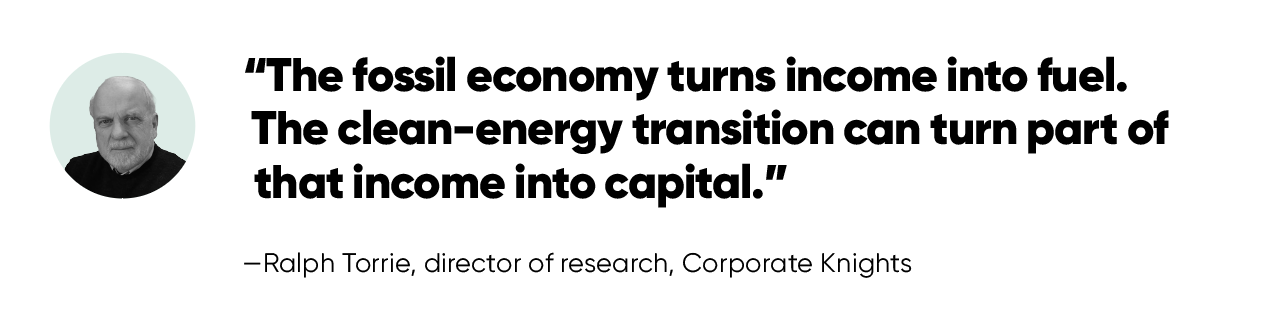
As Ralph Torrie, director of research at Corporate Knights, notes, a wind farm produces the same electricity regardless of who owns it. However, the economic impact is vastly different if the profits flow to a local cooperative or an Indigenous nation rather than to an offshore private equity firm.
Implications for the Domestic Labor Market
The distributed nature of the energy transition also serves as a powerful engine for domestic job creation. Unlike the manufacturing of specialized components, which may occur in international hubs like Shenzhen or Silicon Valley, the actual implementation of the energy transition is inherently local.
A building envelope in Sudbury cannot be insulated remotely. A heat pump in Regina requires a local HVAC technician for installation and a local electrician for the panel upgrade. Project management for a municipal microgrid requires people on the ground who understand local zoning and grid constraints. By financing these projects through community-led structures, Canada ensures that the economic stimulus of the transition stays within its borders.
The "Climate Dollars" analysis estimates that the $374 billion required for building decarbonization represents millions of individual work orders. This creates a long-term, stable demand for skilled trades and professional services in every municipality across the country, shielding local economies from the boom-and-bust cycles typical of the fossil fuel industry.
Strategic Outlook: Integrating Community and Conventional Capital
It is important to view community finance not as a total replacement for traditional banking, but as a vital complement. In many cases, community capital can serve as "first-loss" equity or subordinated debt, which de-risks a project enough to bring in larger institutional lenders or government agencies like the Canada Infrastructure Bank (CIB).
The federal government’s introduction of Investment Tax Credits (ITCs) for clean energy and the expansion of Green Bond frameworks are steps toward this integration. However, the missing link remains the "financial architecture" capable of reaching the household and neighborhood level.
To meet the 2050 targets, Canada must bridge the gap between its macro-economic goals and its micro-economic realities. The $2.17 trillion transition is not a single project to be managed from Ottawa or Toronto; it is a collective undertaking of millions of projects. By empowering community finance, Canada can ensure that the transition to a low-carbon future is not just something that happens to its citizens, but something they own, build, and profit from. The result would be a more resilient, equitable, and capitalized nation, where the wealth generated by the wind and the sun stays exactly where it is harvested: at home.
