

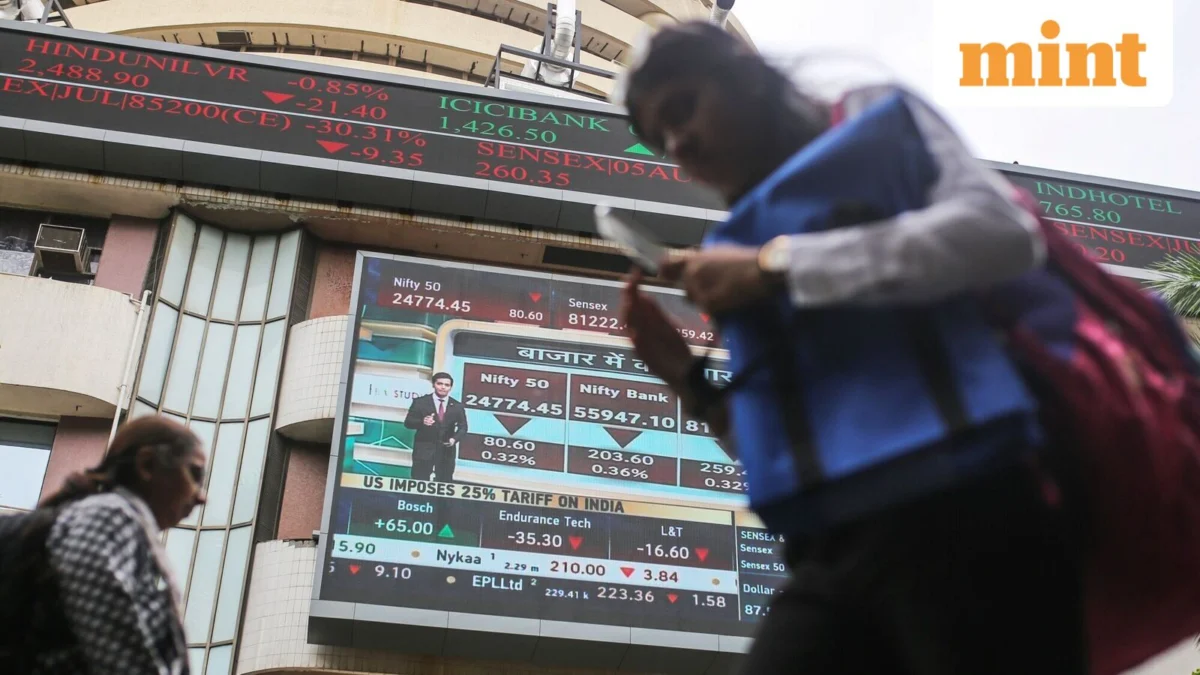
The Indian equity market concluded the final trading session of the week on a positive note, as major banking institutions provided the necessary momentum to keep the benchmark indices in the green. On Friday, the Sensex and the Nifty 50 demonstrated resilience, navigating a landscape characterized by fluctuating global cues and persistent domestic concerns regarding inflation. While the indices remained in positive territory throughout the day, the overall upside was capped by a combination of elevated crude oil prices and the looming threat of tighter monetary policies from central banks.
At the close of trade, the S&P BSE Sensex stood at 75,415.35, marking an increase of 232 points, or 0.31%. Similarly, the NSE Nifty 50 index settled at 23,719.30, gaining 65 points, or 0.27%. The primary drivers for this upward movement were the heavyweight banking stocks, including ICICI Bank, HDFC Bank, and Axis Bank, which attracted significant buying interest. Despite this localized strength, market participants remained cautious, reflecting a broader hesitation to commit to aggressive long positions amidst an uncertain global geopolitical climate.
Intraday Market Dynamics and Sectoral Performance
The trading session on Friday was marked by a steady, albeit cautious, climb. The indices opened with a mild positive bias and maintained their trajectory despite occasional bouts of profit-booking at higher levels. The banking sector, often considered the backbone of the Indian equity market, performed the heavy lifting. ICICI Bank and HDFC Bank, two of the largest private sector lenders, saw renewed interest as investors looked for value in large-cap financials following recent periods of consolidation.
Beyond the banking sector, the market witnessed mixed performance across other verticals. The energy and metal sectors saw selective buying, while the information technology (IT) sector faced headwinds. The IT index remained under pressure as investors weighed the implications of high interest rates in the United States and their potential impact on discretionary spending by global clients. This divergence in sectoral performance highlights the current "stock-picker’s market," where broader index gains are often driven by a handful of high-weightage sectors while others remain stagnant or undergo correction.
Macroeconomic Headwinds: The Crude Oil and Inflation Nexus
A significant factor tempering the enthusiasm of Indian investors is the sustained elevation of crude oil prices. As India imports more than 80% of its oil requirements, any spike in global Brent crude prices has a direct and detrimental impact on the country’s trade deficit and domestic inflation. During the week, oil prices remained volatile, influenced by production cuts from major exporters and the potential for supply chain disruptions in the Middle East.
Elevated energy costs feed directly into wholesale and consumer price indices, complicating the Reserve Bank of India’s (RBI) efforts to manage inflation within its target range. Analysts have noted that if crude oil continues to trade at high levels, the possibility of an early interest rate cut by the RBI diminishes. Instead, the central bank may be forced to maintain a "higher-for-longer" stance on interest rates, or even consider tightening measures if inflationary pressures become entrenched. This macroeconomic backdrop has kept the equity markets on edge, as higher borrowing costs typically compress corporate margins and reduce consumer spending power.
Geopolitical Tensions and Global Sentiment
The upcoming week is expected to be dominated by headlines concerning the diplomatic and military situation in the Middle East, specifically the tensions involving the United States and Iran. According to Ponmudi R, CEO of Enrich Money, markets are likely to remain highly sensitive to these developments. Any escalation in conflict could lead to a "risk-off" environment, where investors pull capital away from emerging markets like India in favor of safe-haven assets such as gold and the U.S. dollar.
Conversely, expectations of a diplomatic resolution have provided a floor for market sentiment. "Although expectations of a diplomatic resolution and easing geopolitical tensions have provided some support to sentiment, caution continues to prevail due to persistent uncertainty over the eventual outcome of the negotiations," Ponmudi noted. He emphasized that a sustained decline in crude oil prices, triggered by a cooling of geopolitical heat, could lead to significant short-covering rallies. However, until such a resolution is reached, the market is expected to trade with a high degree of volatility.
Technical Outlook: Support and Resistance Levels
From a technical perspective, the Indian benchmarks are currently navigating through critical zones. For the Sensex, Ponmudi R identified the 75,400–75,600 range as a pivotal area. He noted that immediate resistance is placed around the 75,800–76,000 zone. Should the index break above this level with strong volume, it could open the door for a move toward the 77,000 mark. On the downside, support is firmly established near the 74,400–74,600 region. A breach below this support could signal a deeper correction.
For the Nifty 50, Ajit Mishra, Senior Vice President of Research at Religare Broking, observed a downward shift in the trading range, reflecting a sense of indecisiveness among traders. He placed immediate support for the Nifty in the 23,150–23,250 zone, with a secondary floor at the 22,900 mark. On the upside, the 23,800–24,000 zone remains a formidable hurdle. Mishra suggested that a decisive breakout above 24,000 is necessary to trigger fresh momentum that could carry the index toward the 24,500–24,650 zone.
The Bank Nifty, which has shown relative outperformance, is also at a crossroads. The index has filled a crucial gap at the 52,700 level and is now looking to sustain above its 20-day Exponential Moving Average (20-DEMA), currently positioned near 54,400. A successful move above this average could see the Bank Nifty testing 55,100, followed by a major resistance at 56,300.
Strategic Recommendations for Investors
Given the prevailing uncertainty, market experts are advising a disciplined and selective approach for the upcoming trading week. Ajit Mishra of Religare Broking emphasized the importance of risk management, particularly in light of currency volatility and uncertain foreign institutional investor (FII) flows. He recommended that traders avoid aggressive leverage and focus on hedged positions.
Mishra’s sector preferences include energy, pharmaceuticals, and metals. The pharmaceutical sector, in particular, is viewed as a defensive play that can provide stability during periods of market turbulence. Additionally, themes related to capital markets and defense continue to show promise, driven by domestic policy support and long-term structural growth.
In contrast, a cautious stance is recommended for the IT sector. While some stocks in this space have seen a recovery bounce, the sustainability of this move is questioned. Experts suggest using any further strength in IT stocks to reduce trading positions rather than building new ones, at least until there is more clarity on global tech spending and the U.S. economic trajectory.
The Role of Institutional Flows and Currency Volatility
The movement of the Indian Rupee and the behavior of foreign and domestic institutions remain critical variables for the market. The Rupee has been under pressure against the U.S. Dollar, influenced by the strength of the greenback and the outflow of capital from emerging markets. A weaker Rupee makes imports more expensive, further exacerbating the inflation problem, although it does provide some relief to export-oriented sectors like IT and textiles.
Foreign Institutional Investors (FIIs) have been net sellers in the Indian market over several recent sessions, citing high valuations and more attractive yields in the U.S. Treasury market. However, Domestic Institutional Investors (DIIs) have largely offset this selling pressure, providing a liquidity cushion that has prevented a sharper decline in the indices. The tug-of-war between FII selling and DII buying is likely to continue, with the direction of the market being determined by which group exerts more influence in the coming days.
Conclusion and Future Implications
As the Indian stock market heads into a new week, the interplay between domestic growth stories and global macroeconomic risks will remain the primary focus. While the strength of the banking sector and the resilience of domestic institutions provide a sense of stability, the external environment remains fraught with challenges. Investors are navigating a "wall of worry," ranging from geopolitical skirmishes in the Middle East to the fiscal policies of the world’s major economies.
The upcoming week will be a test of the market’s ability to hold onto its recent gains. Participants will be looking for signs of a peak in inflation and a stabilization of crude oil prices. Until a clear trend emerges, the strategy of "buying on dips" in quality stocks, particularly in the banking, defense, and pharma sectors, appears to be the most prudent path for those looking to navigate the current volatility. The market’s ability to cross the immediate technical hurdles will be the litmus test for whether the current "green" streak is a temporary relief rally or the start of a new leg in the broader bull market.
