

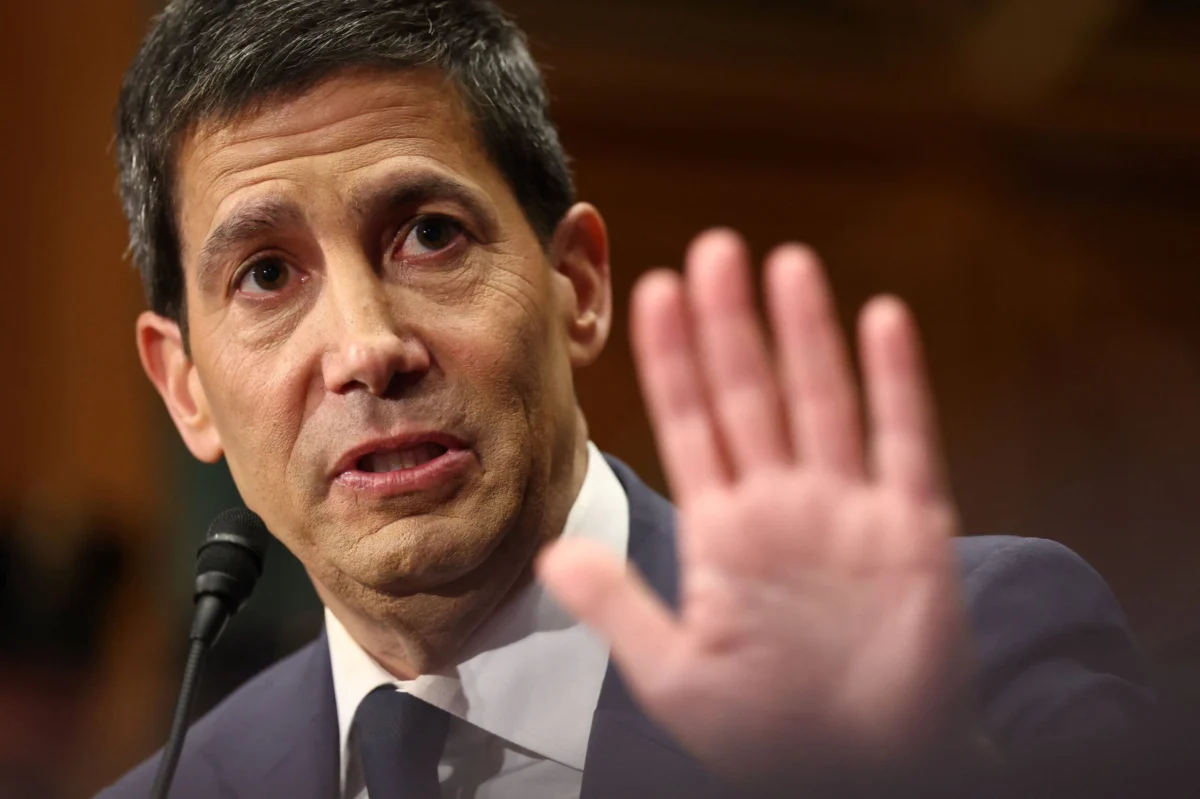
As Kevin Warsh prepares to assume the helm of the Federal Reserve, he finds himself in a delicate position, facing a market increasingly wary of inflationary pressures and a divergence between his stated dovish inclinations and the urgent demands of the financial landscape. Market veteran Ed Yardeni, who famously coined the term "bond vigilantes" to describe investors who punish central banks for perceived inflationary policies, suggests that Warsh may need to adopt a more hawkish stance than initially anticipated to establish credibility and quell market anxieties.
The Federal Reserve, under the leadership of its incoming Chair, is at a critical juncture. Warsh, nominated by President Donald Trump, has publicly expressed a belief that the central bank has room to lower its benchmark interest rate, currently positioned within a target range of 3.5% to 3.75%. This dovish outlook, however, is increasingly at odds with a rapidly evolving economic environment. A recent surge in inflation, exacerbated by geopolitical tensions including the ongoing conflict in Iran and other underlying economic factors, has prompted a significant repricing of rate expectations across financial markets.
This inflationary environment presents a complex challenge for the new Fed chair. Instead of signaling a path toward lower borrowing costs, Warsh may find himself compelled to advocate for interest rate hikes to demonstrate the Federal Reserve’s commitment to price stability. Failure to adequately address inflation concerns could, according to Yardeni, invite further market retribution in the form of escalating Treasury yields, a phenomenon he aptly describes as the "bond vigilantes" asserting their influence.
The Bond Market’s Verdict: A Shifting Landscape
The tremors of this sentiment shift were palpable in the bond markets. On Friday, Treasury yields experienced a notable surge, with the 30-year bond breaching the 5% mark, reaching its highest level in nearly a year. While the long bond saw a slight moderation on Monday morning, trading at 5.138%, the 2-year Treasury, a bellwether for Federal Reserve rate expectations, edged lower to 4.07%. These movements indicate a market that is actively anticipating a tightening monetary policy, a stark contrast to the dovish signals that Warsh has historically conveyed.
Ed Yardeni, President of Yardeni Research, articulated this sentiment in a recent commentary, stating, "Warsh is set to chair the June Federal Open Market Committee (FOMC) meeting, but who’s actually in the monetary-policy driver’s seat? We’d argue that it’s the Bond Vigilantes." He further observed, "Warsh is going to be the odd man out. But he is the new Fed chair, and the bond market is reacting badly to his dovish stance."
Warsh’s Challenge: Reconciling Dovish Rhetoric with Hawkish Realities
The core of the challenge lies in Warsh’s pre-confirmation statements, which have emphasized his belief in the Fed’s capacity to lower interest rates. This perspective, while potentially appealing to those seeking stimulus, is now being tested by concrete economic data. The April inflation figures, for instance, revealed a more persistent inflationary trend than many had anticipated. This has led to a reassessment of the Federal Reserve’s likely trajectory.
The market’s expectations have become increasingly complex. Not only does the market doubt the likelihood of an imminent rate cut, but there is a growing probability of a rate hike. According to the CME Group’s FedWatch tool, current market pricing suggests a 42% chance of an interest rate increase by the end of the year. This represents a significant recalibration from earlier expectations and underscores the market’s concern about inflation.
Yardeni, however, believes that a policy shift could occur sooner rather than later. While he anticipates the Federal Reserve holding rates steady at the June meeting, he posits that a quarter-percentage-point rate increase is "likely" in July. More immediately, he suggests that the Warsh-led Fed could initiate a tightening bias in June by removing the so-called "forward guidance" language from its post-meeting statement. This language has been interpreted as a signal that the central bank’s next move would be a rate cut.
The Strategy: Appeasing the Bond Vigilantes for Economic Stability
The rationale behind Yardeni’s assessment is rooted in the need for the Federal Reserve to regain the confidence of the bond market. "The Fed must catch up to the bond market to avoid losing control of borrowing costs and to appease the Bond Vigilantes," he argued. "By now, they might need to see a tightening stance rather than a neutral stance. A surprise FFR rate hike might actually please them!"
Yardeni’s thesis suggests that an early adoption of a hawkish stance by the Warsh Fed could serve multiple purposes. Firstly, it would help to allay concerns within the bond market, thereby putting a lid on rising yields. This, in turn, would provide the Federal Reserve with greater flexibility in its future monetary policy decisions.
Furthermore, Yardeni posits that a hawkish approach could ultimately align with the economic objectives of the White House. "So by acting hawkishly, Warsh might have a chance of delivering what the White House wants: lower real-world borrowing costs," he explained. "Mortgage rates could fall, corporate financing would ease, and Trump can point to declining long-term yields as the economic win." This suggests a potential alignment of interests, where a seemingly counterintuitive hawkish pivot could lead to more favorable borrowing conditions for consumers and businesses, ultimately benefiting the broader economy and providing a political victory for the administration.
The Consensus View and the Path Ahead
It is important to note that Yardeni’s call for a July rate hike is outside the current consensus view. While market-implied probabilities for rate increases have been trending upwards throughout the year, the current implied probability for a July hike stands at a mere 4.2%, according to FedWatch. This significant divergence highlights the speculative nature of Yardeni’s forecast and the prevailing market expectation for a more measured approach from the Federal Reserve.
However, the underlying sentiment remains clear: the market is attuned to inflation risks, and any perceived complacency from the central bank is likely to be met with a swift and potentially punitive response. The coming months will be crucial for Kevin Warsh as he navigates these complex economic currents. His ability to strike a balance between his own policy inclinations and the urgent demands of the financial markets will be paramount in shaping both the trajectory of the U.S. economy and the credibility of the Federal Reserve under his leadership.
Background: The Evolving Inflationary Environment
The current inflationary environment is not an isolated incident. It is the culmination of several factors, including significant fiscal stimulus packages enacted in recent years, supply chain disruptions stemming from the COVID-19 pandemic, and more recently, geopolitical events such as the conflict in Iran. These factors have combined to create a persistent upward pressure on prices across a wide range of goods and services.
For the Federal Reserve, the challenge lies in discerning whether the current inflation is transitory or more deeply entrenched. If it is deemed transitory, a patient approach, as suggested by Warsh’s initial dovish leanings, might be appropriate. However, if inflation proves to be more persistent, a more aggressive monetary policy response, including interest rate hikes, would be necessary to bring it under control.
The Federal Reserve’s dual mandate is to maintain price stability and maximize employment. In the current climate, these two objectives may be in tension. Aggressively raising interest rates to combat inflation could potentially dampen economic growth and lead to higher unemployment, while being too lenient on inflation could erode purchasing power and destabilize the economy in the long run.
Chronology of Key Events
- April 21, 2026: Kevin Warsh testifies before a Senate Banking Committee confirmation hearing, expressing his belief in the Fed’s capacity to lower interest rates.
- May 12, 2026: April Consumer Price Index (CPI) data is released, revealing a significant surge in inflation.
- May 15, 2026: Treasury yields surge, with the 30-year bond yield eclipsing 5% for the first time in nearly a year.
- May 16, 2026: Reports highlight the challenges Warsh faces upon entering the Fed, particularly the family fight over interest rate cuts and the growing market expectation for hikes.
- Early June 2026 (Projected): Warsh is expected to chair the FOMC meeting. Ed Yardeni anticipates the removal of forward guidance language as a potential first step towards tightening.
- July 2026 (Projected): Yardeni forecasts a potential quarter-percentage-point rate hike, a move that is currently outside market consensus.
Broader Impact and Implications
The Federal Reserve’s monetary policy decisions have far-reaching implications for the U.S. economy and global financial markets. Interest rate adjustments by the Fed influence borrowing costs for consumers and businesses, impacting everything from mortgage rates and car loans to corporate investment and hiring decisions.
A sustained period of higher interest rates, as suggested by Yardeni’s analysis, could lead to a slowdown in economic growth. This might manifest as reduced consumer spending, a cooling of the housing market, and potentially lower corporate profits. However, it could also lead to a more stable price environment, which is essential for long-term economic prosperity.
Conversely, if the Federal Reserve fails to adequately address inflation, it could lead to a loss of purchasing power for households, increased uncertainty for businesses, and a potential erosion of the U.S. dollar’s value. This scenario could trigger further market volatility and undermine investor confidence.
The role of the "bond vigilantes" cannot be overstated. Their collective actions can exert significant pressure on central banks, forcing them to adapt their policies to market expectations. Warsh’s tenure will be closely watched to see how he balances his own economic philosophy with the powerful influence of these market participants, and whether he can navigate the delicate tightrope between controlling inflation and fostering economic growth. The decisions made in the coming months will set the tone for the Fed’s policy direction and have a profound impact on the economic landscape for years to come.
