

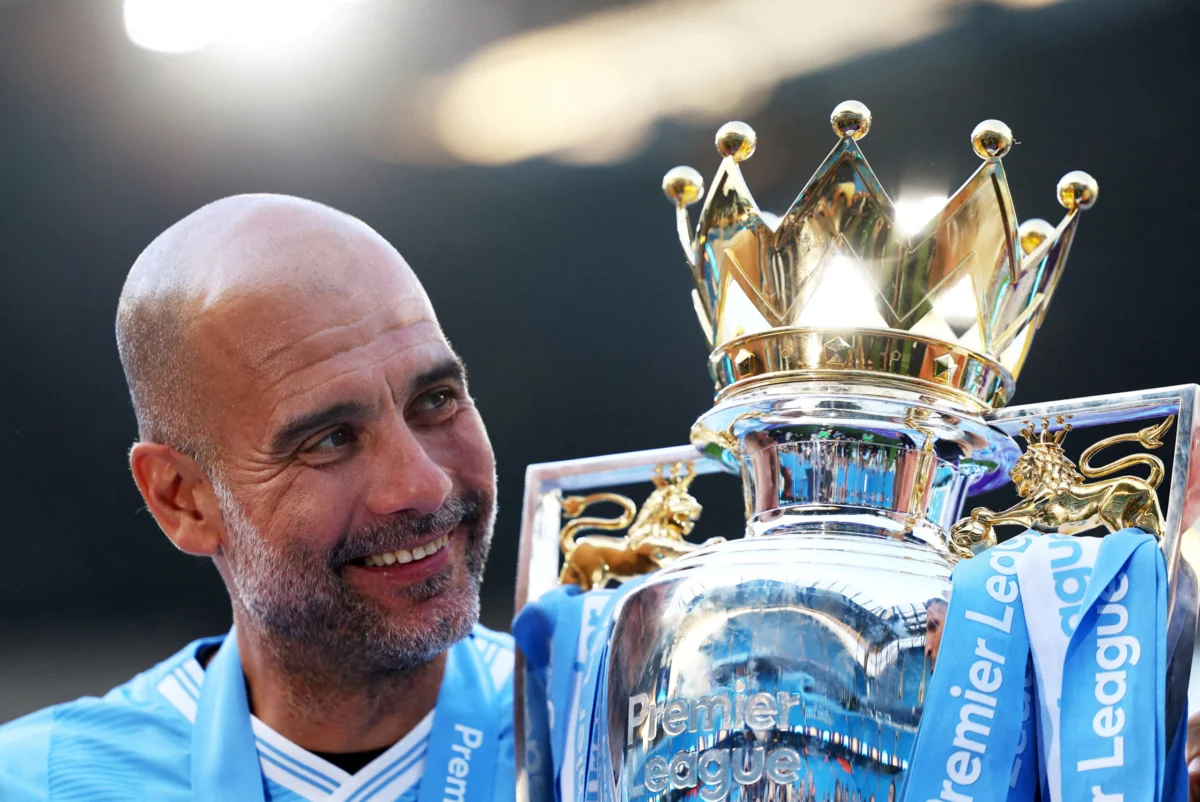
Pep Guardiola is set to depart Manchester City after a transformative 10-year tenure, leaving an indelible mark on English football and accumulating an astonishing 17 major trophies. His departure prompts an essential historical analysis: how does his record stack up against the legendary figures who have graced the touchlines of English football, such as Sir Alex Ferguson, Bob Paisley, and Brian Clough? The raw numbers and the context surrounding them offer a compelling narrative of unparalleled success in the modern era, juxtaposed against the enduring legacies of his predecessors.
Guardiola’s Ascendancy and the Redefinition of Premier League Dominance
Guardiola’s arrival at Manchester City in 2016 was heralded as a new chapter for a club with burgeoning ambitions fueled by significant Abu Dhabi investment. Having previously achieved unparalleled success with Barcelona and Bayern Munich, the Catalan tactician was tasked with translating City’s financial might into consistent domestic and European glory. Over his decade, he fundamentally reshaped the Premier League’s tactical landscape and set new benchmarks for consistency and points accumulation.
His most profound impact was undoubtedly on the Premier League itself. Guardiola consistently prioritized the domestic league, viewing it as the ultimate testament to a team’s enduring quality. In his 10 seasons at the helm, City secured an astonishing six Premier League titles, representing a 60% success rate in England’s top flight. This includes the unprecedented achievement of winning four consecutive titles from 2021 to 2024, a feat never before accomplished in the nearly 140-year history of English top-flight football. These six titles were concentrated within a seven-year span, underscoring a period of sustained excellence. He finished outside the top two on only two occasions, demonstrating remarkable consistency even in seasons where the title eluded them.
When examining title-winning percentages among modern-day managers, only Liverpool’s iconic Bob Paisley surpasses Guardiola. Paisley, who managed Liverpool from 1974 to 1983, won the English league six times in his nine years, boasting an incredible 66.67% title success rate. He finished outside the top two just once, cementing his place as a master of domestic dominance in his era.
Sir Alex Ferguson, widely considered the greatest manager in English football history, offers a different trajectory. Ferguson claimed a staggering 13 league titles in 26 full seasons at Manchester United (1986-2013). However, his initial years were spent rebuilding a sleeping giant. United had not won a championship in 19 years when he took over, starting from a much lower base. From the year of Ferguson’s first league crown in 1993 until his retirement, United’s title-winning percentage stood at 61.9% – marginally higher than Guardiola’s overall but still lower than Paisley’s remarkable consistency. This comparison highlights the distinct challenges and contexts faced by each manager, with Ferguson’s longevity and rebuilding efforts contrasted against Guardiola’s immediate and sustained impact at an already well-resourced club.
The Pursuit of European Glory: An Acknowledged Shortcoming
While Guardiola’s domestic record is almost unblemished, Manchester City’s performance in the UEFA Champions League under his stewardship has, by his own admission, been less dominant relative to the club’s immense resources. The Abu Dhabi ownership group had made European conquest a central tenet of their project, and for a team consistently lauded as one of Europe’s best, the return of one Champions League title (2023), one additional final appearance (losing to Chelsea in 2021), and just one other semi-final appearance (2022) is often viewed as an underwhelming return.
Guardiola himself has often acknowledged the difficulty and unpredictability of the Champions League. His prior success at Barcelona, where he secured two Champions League titles in his four-year spell, often serves as a point of reference, highlighting that European glory is not unfamiliar territory for him. However, the consistent near-misses and early exits with City in the competition remained a recurring point of discussion and, at times, criticism until the historic treble-winning season of 2022-23 finally delivered the coveted trophy.
Comparing this to other English managerial giants, Sir Alex Ferguson also faced scrutiny over his Champions League record. Despite his two triumphs with Manchester United (1999 and 2008), many pundits and fans felt that given United’s sustained domestic dominance and numerous appearances in the competition, a higher number of European crowns might have been expected.
Among British managers, Brian Clough and Bob Paisley hold arguably the most enviable European records. Clough’s achievement with Nottingham Forest, winning the European Cup in back-to-back years (1979 and 1980), remains one of football’s most romantic and remarkable feats. To achieve this with a provincial club, transforming them from a second-tier team to European champions in a few short years, speaks volumes of his unique genius. Paisley, meanwhile, took Liverpool to three European Cup triumphs (1977, 1978, and 1981) in a five-year span, establishing a dynasty that few clubs have ever matched. These achievements underscore the different eras and varying levels of global competition, but firmly place Clough and Paisley at the pinnacle of European success for managers operating from English clubs.
Guardiola’s Total Trophy Haul: Second Only to Ferguson
In terms of overall silverware, Pep Guardiola’s 17 major trophies in his decade at Manchester City position him second only to Sir Alex Ferguson in English football’s all-time managerial list. This tally includes six Premier League titles, four League Cups, two FA Cups, one Champions League, one UEFA Super Cup, and one FIFA Club World Cup. This collection underscores a period of unprecedented success for Manchester City.
Sir Alex Ferguson’s monumental career yielded 28 major trophies, a record that stands as a testament to his longevity and sustained excellence over 26 years at Manchester United. The sheer duration of Ferguson’s tenure, 16 years longer than Guardiola’s at City, provides context for the difference in their total trophy counts. Ferguson’s ability to rebuild teams and maintain competitiveness across multiple generations of players is a unique aspect of his legacy.
Following Ferguson and Guardiola, Bob Paisley comes next with 14 major trophies, all achieved within his relatively short but incredibly impactful nine-year spell at Liverpool. His efficiency in collecting silverware is arguably unmatched. Arsène Wenger, who managed Arsenal for 22 years, secured 10 major trophies, including a record seven FA Cups, alongside three Premier League titles. Brian Clough, with nine major trophies across his spells at Derby County and Nottingham Forest, demonstrated a remarkable ability to deliver success at different clubs. Finally, Sir Matt Busby, another Manchester United legend, captured eight major trophies, laying the foundation for the club’s modern success. Guardiola’s rapid accumulation of silverware places him firmly among these revered figures, showcasing an extraordinary rate of success in the highly competitive landscape of 21st-century English football.
Setting New Statistical Standards: Points Totals and Goal Records
Under Guardiola, Manchester City didn’t just win; they redefined what it meant to dominate statistically in the Premier League era. His teams consistently achieved points totals that shattered previous records, fundamentally raising the bar for championship contenders.
In the 2017-18 season, Guardiola’s second in charge, City became the first team in English top-flight history to reach 100 points, earning them the moniker "Centurions." This remarkable achievement, secured with a last-minute goal on the final day, underscored a season of relentless performance. The following season, 2018-19, saw them accumulate 98 points, another extraordinary haul. These two seasons represent two of the top three points totals ever recorded in English top-flight history, highlighting a period of sustained, record-breaking excellence.
Between 2018 and 2024, City collected over 90 points in four separate league campaigns, a testament to their unwavering consistency. This era of hyper-competitive excellence was, in part, fueled by the intense rivalry with Jürgen Klopp’s Liverpool. Klopp’s team pushed City to their absolute limits, themselves achieving staggering points totals: 99 points in 2019-20 (breaking City’s run) and 97 points in 2018-19, taking the title race down to the wire on the final day. This mutual pushing of boundaries undoubtedly contributed to the record-breaking nature of these seasons.
Historically, the points system was different, with two points for a win before 1981. Liverpool’s 1978-79 team held the record with 68 points in a 42-game season. Adjusting this to the modern three-points-for-a-win system, it equates to approximately 98 points. However, the modern 38-game season makes City’s 100-point haul even more remarkable. Prior to Guardiola’s era, Jose Mourinho’s Chelsea set a then-record of 95 points in the 2004-05 season, showcasing the gradual escalation of points required to win the Premier League, a trend significantly accelerated by Guardiola’s City.
Beyond points, City also set new offensive benchmarks. In the 2017-18 season, they scored 106 goals, the most ever in a single Premier League campaign, showcasing their devastating attacking prowess and adherence to Guardiola’s philosophy of fluid, possession-based football.
Guardiola’s Unique Records and Historical Milestones
Pep Guardiola has consistently highlighted the various records his Manchester City side has established, and indeed, there are many that solidify his place in the annals of English football.
The most prominent is undoubtedly the four consecutive top-flight league titles (2021-2024), a feat unmatched in the 136-year history of English football. This achievement alone places him in an exclusive category of managerial excellence and sustained dominance.
Other significant records include:
- First team to reach 100 points in a top-flight season (2017-18): A numerical benchmark that redefined expectations for Premier League champions.
- Most goals scored in a single Premier League campaign (106 in 2017-18): Demonstrating an attacking philosophy that overwhelmed opponents.
- First team to win the domestic treble of the Premier League, FA Cup, and League Cup in the same season (2018-19): An incredible display of dominance across all national competitions, showcasing depth and tactical flexibility.
Guardiola also emulated Sir Alex Ferguson in achieving the coveted continental treble of the Premier League, FA Cup, and Champions League (City in 2023, United in 1999). This rare accomplishment is often considered the pinnacle of club football success, demanding sustained excellence across an entire season in multiple high-stakes competitions. Furthermore, Guardiola’s City wrapped up a Premier League title with five games still to play in 2018, matching United’s record from 2001. This record was later broken by Liverpool in 2020, who clinched the title with seven games remaining, underscoring the relentless nature of modern Premier League title races.
However, one significant record that eluded Guardiola was Arsène Wenger’s "Invincibles" feat. Wenger’s Arsenal side went an entire Premier League season unbeaten in 2003-04, a unique achievement that remains a benchmark for defensive solidity and unwavering consistency over a full league campaign. While City’s dominance under Guardiola was undeniable, an unbeaten season was one frontier they never conquered.
The Tactical Evolution and Broader Implications
Guardiola’s influence extends beyond mere trophy counts and statistical records. His arrival fundamentally altered the tactical landscape of English football. His brand of possession-based, high-pressing football, with inverted full-backs and intricate positional play, became a blueprint that many clubs attempted to emulate, albeit with varying degrees of success. He elevated the technical demands on players and forced opponents to adapt, pushing the tactical evolution of the Premier League forward.
His tenure at City also sparked considerable debate about the role of financial backing in achieving success. While Guardiola’s genius is undeniable, the unprecedented investment from the Abu Dhabi United Group provided him with resources that few managers in history have commanded. This context is crucial when comparing his achievements to those of managers like Clough, who built dynasties at relatively smaller clubs, or Ferguson, who also benefited from significant investment but built his empire over a longer period. Critics often point to City’s financial might as an enabling factor, while supporters emphasize Guardiola’s ability to consistently extract peak performance from a squad of world-class talents and integrate them into a cohesive, record-breaking unit.
A Lasting Legacy and the Challenge for the Future
Pep Guardiola’s departure marks the end of an era at Manchester City, one that saw the club transform from a perennial contender to an undisputed powerhouse of English and European football. His legacy is defined by an insatiable hunger for innovation, an unwavering commitment to a distinct footballing philosophy, and an extraordinary capacity to win.
His achievements have set new standards, particularly in the Premier League, making the task for any future manager at City, and indeed for rival clubs, incredibly challenging. The expectation for sustained excellence, both domestically and in Europe, has been irrevocably raised. Guardiola leaves behind a tactical blueprint, a winning culture, and a trophy cabinet brimming with silverware, cementing his status as one of the most impactful and successful managers in the history of English football. His decade at City will be remembered as a period of unprecedented dominance, where records were not just broken, but utterly obliterated, forever altering the landscape of the beautiful game in England.
