

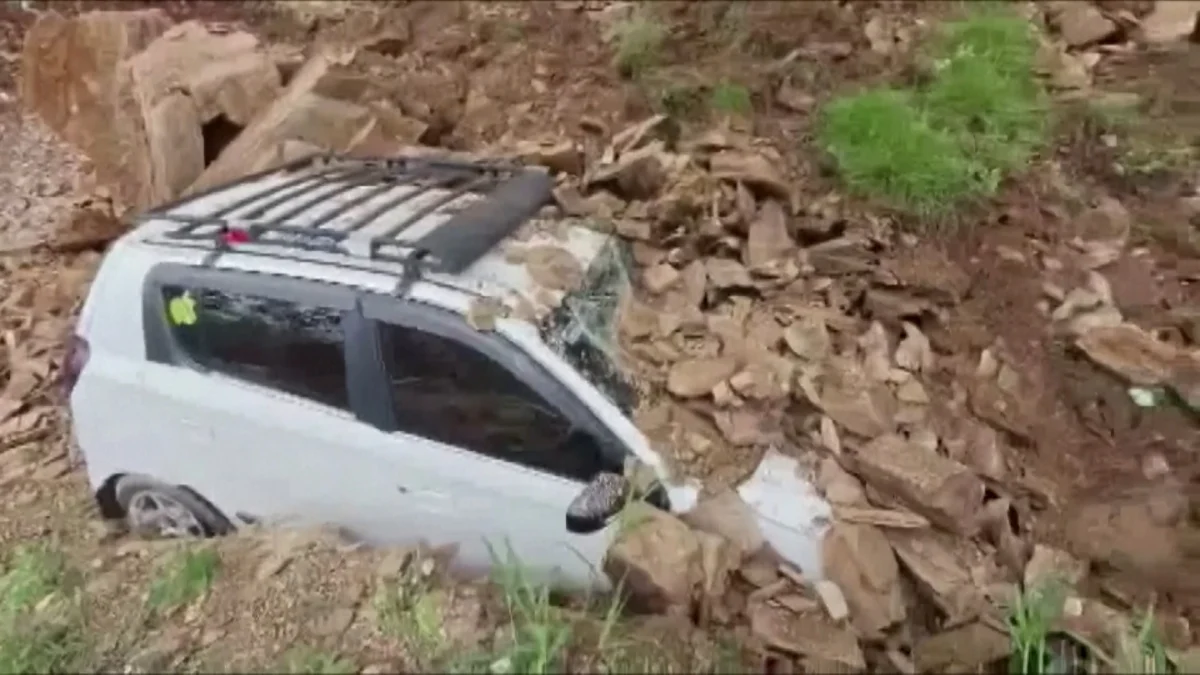
The hill station of Shimla, once the summer capital of British India and a cornerstone of Himalayan tourism, is currently grappling with a severe humanitarian and environmental crisis following a devastating landslide triggered by relentless monsoon downpours. The incident, which occurred in the early hours of the morning, has sent shockwaves through the local community, leading to the urgent evacuation of dozens of families as the stability of the hillside continues to deteriorate. While the region is historically prone to geological instability during the rainy season, this particular event has sparked intense public outrage. Local residents and environmental activists point to a specific cause beyond the natural elements: a blatant violation of a government-mandated construction ban by a private development firm.
As the rain continued to lash the fragile slopes of the Himachal Pradesh capital, a significant portion of a hillside gave way, hurtling debris, mud, and uprooted trees toward residential clusters. The immediate aftermath saw a frantic scramble for safety, with the State Disaster Response Force (SDRF) and local police coordinating a high-stakes evacuation effort. For the residents of the affected wards, the fear is palpable; many have watched their life savings, invested in their homes, literally hang in the balance as cracks widen in the earth beneath their foundations.
The Genesis of the Disaster: A Chronology of Events
The catastrophic failure of the slope did not occur in a vacuum. To understand the scale of the current crisis, one must look at the sequence of events leading up to the collapse.
In late June, the Himachal Pradesh state government, cognizant of the increasing frequency of landslides, issued a comprehensive ban on all major construction and excavation activities across the Shimla municipal limits. This ban is a standard safety protocol designed to prevent the destabilization of slopes during the peak monsoon months of July and August, when the soil becomes saturated and loses its shear strength.
By early July, the region began experiencing "excess" rainfall, with some meteorological stations recording a 40% increase over the long-period average for the first week of the month. Despite these warnings and the standing legal prohibition, residents in the affected neighborhood reported that a private construction company continued to operate heavy machinery. Witnesses claim that for several days preceding the landslide, excavators were seen cutting into the base of the hill to clear land for a new multi-story residential complex.
On the evening of July 10, the intensity of the rain increased significantly. By 3:00 AM on July 11, the first signs of structural failure were noted. Residents reported hearing "loud, rhythmic cracking sounds" and feeling tremors that were initially mistaken for a minor earthquake. By dawn, the primary slope failure occurred, shearing off a massive section of the hillside and leaving several houses perched precariously on the edge of a new precipice.
Allegations of Regulatory Negligence and Illegal Excavation
The core of the current controversy lies in the alleged activities of a local construction firm. According to formal complaints lodged by the local Residents’ Welfare Association (RWA), the company had been warned multiple times by neighbors to cease excavation.
"We told them that the mountain was weeping water and that cutting the toe of the slope would bring the whole thing down on our heads," said one resident whose home was among those evacuated. "They ignored us, claiming they had ‘high-level clearances’ that superseded the monsoon ban. Now, we are homeless, and they are nowhere to be found."
Under the National Green Tribunal (NGT) guidelines and the Himachal Pradesh Town and Country Planning Act, excavation on slopes exceeding a certain gradient is strictly regulated, and during the monsoon, it is categorized as a criminal offense due to the risk to public life. Preliminary reports from local administrative officials suggest that the developer may have bypassed the mandatory "No Objection Certificates" (NOCs) required for such intensive geological work.
Geological Vulnerability and Supporting Data
Shimla’s topography is characterized by fractured sedimentary rocks, primarily phyllites and schists, which are highly susceptible to weathering. When these rocks are saturated with water, the pore-water pressure increases, reducing the friction that holds the slope together.
Supporting data from the Geological Survey of India (GSI) indicates that over 25% of the Shimla urban area falls under a "High to Very High" landslide hazard zone. The city was originally designed by the British to support a population of roughly 25,000 people; today, it anchors a permanent population of over 200,000, with thousands more arriving daily during the tourist season. This "carrying capacity" crisis means that any disruption to the natural drainage or slope stability has an outsized impact on human settlements.
Furthermore, rainfall data for the Himachal Pradesh region has shown a worrying trend of "compacted precipitation." While the total volume of monsoon rain remains somewhat consistent with historical norms, it is now falling in shorter, more intense bursts. In the 24 hours leading up to the Shimla landslide, the area received approximately 120mm of rain—an amount that the saturated soil, already weakened by illegal cutting, could not withstand.
Official Responses and Emergency Measures
The district administration has moved into a state of high alert. The Deputy Commissioner of Shimla has ordered an immediate stay on all construction sites within a five-kilometer radius of the landslide to conduct safety audits.
"Our primary focus is the preservation of life," the Deputy Commissioner stated during a press briefing at the site. "We have moved 45 families to temporary shelters in government schools and community halls. A technical committee comprising geologists and civil engineers has been formed to assess whether the remaining structures are habitable or if a controlled demolition is required to prevent a larger-than-expected secondary slide."
Regarding the allegations against the construction company, the official added, "A First Information Report (FIR) is being registered. If it is found that the developer violated the monsoon construction ban, they will face the full weight of the law, including charges of criminal negligence and endangerment of life. No one, regardless of their influence, is above the safety of our citizens."
The State Disaster Management Authority (SDMA) has also deployed drones to map the "crown" of the landslide, looking for further fissures that could indicate an imminent secondary collapse. The use of geo-synthetic membranes to cover the exposed earth is being considered to prevent further water ingress into the vulnerable soil.
The Broader Impact: Urbanization vs. Ecology
The Shimla landslide is a microcosm of a much larger crisis facing the entire Himalayan belt. From Joshimath in Uttarakhand to the outskirts of Leh, unplanned urbanization is clashing with a fragile ecosystem. The "Shimla Development Plan 2041," which has been a subject of intense legal debate in the Supreme Court of India, seeks to balance the need for housing with environmental preservation. However, critics argue that such plans often come too late to save the "Green Belt" areas that act as natural anchors for the hillsides.
The economic implications are equally staggering. Beyond the immediate destruction of property, landslides severely disrupt the state’s tourism-dependent economy. The closure of roads and the perception of Shimla as a "danger zone" during the monsoon leads to massive cancellations in the hospitality sector, affecting thousands of livelihoods.
Moreover, the cost of restoration is immense. Rebuilding a retaining wall on a steep Himalayan slope can cost ten times more than a similar structure on the plains, and these costs are often borne by the taxpayer rather than the private developers who profit from the initial construction.
Analysis of Implications and Future Outlook
This event serves as a grim reminder of the "man-made" nature of many modern natural disasters. While the monsoon provided the trigger, the "loaded gun" was the illegal excavation. Moving forward, there are three critical areas that require immediate attention:
- Strict Enforcement of the NGT Guidelines: There must be zero tolerance for construction during the monsoon. The use of satellite monitoring and real-time community reporting apps could help authorities catch illegal excavation before it leads to a collapse.
- Re-evaluating the Carrying Capacity: Shimla cannot continue to grow vertically on such unstable foundations. A hard cap on new large-scale developments in high-risk zones is no longer an environmentalist’s dream but a structural necessity.
- Investment in Early Warning Systems: While the SDRF reacted quickly, the technology exists to install tiltmeters and piezometers on vulnerable slopes that can provide hours of warning before a slide occurs, potentially saving property as well as lives.
As the rain continues to fall over the deodar-covered hills, the residents of Shimla remain on edge. The immediate crisis may pass as the weather clears, but the underlying issues of unregulated growth and administrative oversight remain as looming as the mountains themselves. The investigation into the construction company will be a litmus test for the state government’s resolve: will they prioritize the safety of the many, or the profits of the few? For the families now sleeping on floor mats in a school gymnasium, the answer to that question will determine whether they ever feel safe in their homes again.
