

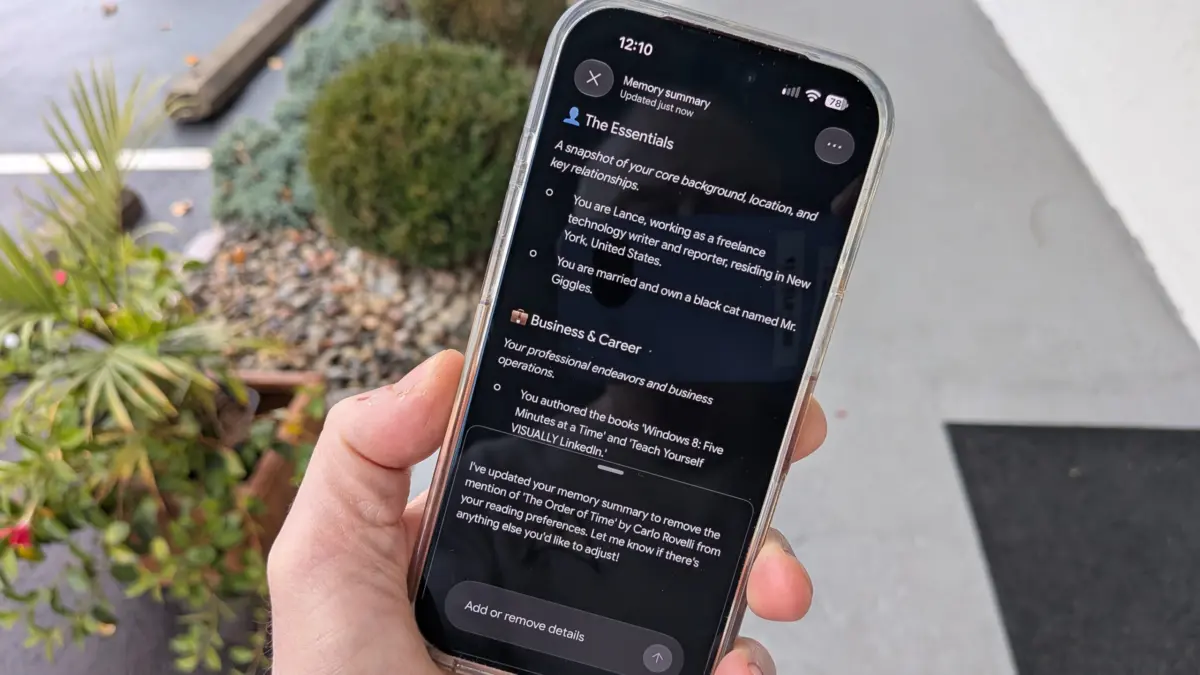
The rollout of the Memory summary feature for Google Gemini marks a pivotal moment in the evolution of generative artificial intelligence, shifting the technology from a transactional tool into a more persistent personal assistant. This new functionality allows Gemini to retain specific details about a user’s life, preferences, and professional requirements across multiple sessions, aiming to create a more seamless and tailored user experience. However, as Google integrates these "long-term memory" capabilities, the tech giant is also introducing granular controls that allow users to view, edit, and delete the information the AI has gathered. This move reflects a broader industry trend where the pursuit of hyper-personalization must be balanced against increasing regulatory and public pressure regarding data privacy and the use of personal information for AI training.
The Evolution of AI Personalization: Understanding Memory Summary
The Memory summary feature is designed to solve one of the primary limitations of early large language models (LLMs): "context window" constraints and the lack of session-to-session continuity. Historically, AI models functioned primarily on a per-conversation basis; once a chat ended, the AI "forgot" the specific nuances of the user’s preferences unless they were manually re-entered in subsequent prompts. With the introduction of Memory summary, Gemini can now store and categorize information derived from previous conversations or direct instructions.
This information is organized into specific categories to help users understand how the AI perceives them. Categories identified in early rollouts include "Essentials," which might cover home locations or family details; "Business & Career," focusing on professional roles and projects; "Reading & Interests," highlighting hobbies and media preferences; and "Culinary Preferences," which tracks dietary restrictions and favorite cuisines. By maintaining this database, Gemini can provide more relevant answers—for example, suggesting recipes that adhere to a user’s known gluten-free diet without being reminded in every prompt.
Navigating the User Interface: Accessing and Managing Gemini’s Memory
Google has integrated the Memory summary controls directly into the Gemini interface, accessible via the web, mobile applications, and desktop versions. To access these settings, users must navigate to the "Settings" icon, typically located at the bottom of the left-hand navigation pane where chat histories are stored. Within the Settings menu, a new section titled "Personal Intelligence" houses the "Memory summary" option.
If the feature is disabled, the option appears grayed out, signifying that the AI is not currently retaining personal details for long-term use. When enabled, the interface presents a structured list of the data points Gemini has saved. A "Memory history" sub-menu, accessible via a three-dot icon, provides a chronological log of when specific memories were added or modified, offering a layer of transparency regarding how the AI’s understanding of the user has evolved over time.
For users on desktop and web platforms, Google has included a direct editing capability. By selecting a pencil icon, users can manually rewrite the text within their memory profile. This allows for the correction of factual errors or the addition of specific details that the AI might have missed. On mobile platforms, while direct text editing is currently limited, users can manage their memory through natural language. By simply telling Gemini to "forget that I live in New York" or "remember that I prefer Python for coding tasks," the AI updates its internal summary in real-time.
Correcting AI Hallucinations and Inaccurate Personal Profiles
The necessity for such granular control is underscored by the AI’s propensity for "hallucinations"—instances where the model generates false information or misinterprets context. In practical applications, users have reported Gemini attributing incorrect biographical details to them based on tangential conversations. For instance, a user discussing a hypothetical business plan for a retail store might find that Gemini has "remembered" them as the owner of that non-existent business.
The Memory summary dashboard serves as a critical checkpoint for these errors. By reviewing the "Business & Career" or "Essentials" tabs, users can identify where the AI has conflated creative writing exercises with factual personal data. The ability to "poof" away these inaccuracies ensures that the AI’s future outputs are grounded in reality rather than digital misunderstandings. This self-correction mechanism is vital for maintaining the utility of the AI, as inaccurate memories can lead to increasingly irrelevant or frustrating responses over time.
The Privacy Paradox: Personalization Versus Data Sovereignty
While the utility of a persistent AI assistant is clear, the privacy implications remain a point of significant debate. Google’s business model has long relied on data collection, and Gemini is no exception. The data stored in Gemini’s memory is not just used to personalize the user’s experience; it may also be used to improve Google’s machine learning models.
Google’s privacy policy for Gemini notes that while some data is "de-identified," human reviewers may read, annotate, and process conversations to improve the service. This raises concerns for users who might inadvertently share sensitive personal or corporate information. Although the Memory summary tool allows users to delete specific items, the question remains as to whether the "learning" derived from that data persists in the underlying model even after the specific memory entry is removed.

Privacy advocates suggest that users should treat AI memory with the same caution as social media profiles or cloud storage. The "opt-out" nature of many AI training features means that users must be proactive in managing their settings. Google has attempted to mitigate these concerns by providing an easy toggle to turn the memory feature off entirely, which clears the stored summary, though it may not retroactively remove data already ingested into broader training sets.
A Comparative Look at the Industry: Google vs. OpenAI
Google is not alone in the pursuit of persistent AI memory. OpenAI, the creator of ChatGPT, introduced a similar "Memory" feature earlier in 2024. The two companies are currently locked in a technological arms race to see which can provide the most "human-like" and helpful digital companion.
| Feature | Google Gemini (Memory Summary) | OpenAI ChatGPT (Memory) |
|---|---|---|
| User Control | Categorized list, direct editing, verbal deletion | Natural language control, "Manage Memory" settings |
| Categorization | High (Essentials, Business, etc.) | Low (General list of facts) |
| Integration | Deeply tied to Google Workspace (Docs, Gmail) | Tied to GPTs and specialized "Personalities" |
| Transparency | Provides "Memory History" log | Offers "What do you remember about me?" prompt |
The primary differentiator for Google is its ecosystem. Because Gemini is being integrated into Google Workspace, its memory could eventually extend to knowing a user’s schedule in Calendar, their writing style in Docs, and their contacts in Gmail. This makes the Memory summary tool even more critical, as it acts as the "brain" for a cross-platform digital agent.
The Technical Backbone: How Memory Functions Within LLMs
The technical implementation of Memory summary likely utilizes a combination of "Retrieval-Augmented Generation" (RAG) and long-term storage databases. When a user interacts with Gemini, the system does not just look at the current prompt; it queries the "Memory summary" database to see if there are relevant "embeddings" (mathematical representations of data) that should be injected into the prompt’s context.
This process allows the AI to remain efficient. Instead of processing every single past conversation—which would be computationally expensive and exceed the model’s token limit—it only retrieves the summarized "facts" that are pertinent to the current query. This hybrid approach allows for a sense of continuity without the technical overhead of a truly "infinite" context window.
Broader Implications: The Rise of Agentic AI and Digital Twins
The introduction of Memory summary is a foundational step toward "Agentic AI"—AI systems that can take actions on behalf of a user. For an AI to effectively book a flight, manage a project, or ghostwrite an email, it must possess a deep and accurate understanding of the user’s preferences, biases, and history.
As these memories become more detailed, we move closer to the concept of a "Digital Twin"—a virtual representation of an individual’s knowledge and personality. While this offers immense productivity gains, it also poses existential and security risks. If an AI "remembers" a user’s password habits, travel patterns, or social connections, that profile becomes a high-value target for cyberattacks.
Industry analysts suggest that the next three to five years will see a shift in how personal data is managed. We may move away from centralized "cloud memories" toward "edge-based" or "local" AI memory, where the AI’s "brain" lives on the user’s device (phone or laptop) rather than on Google’s servers. This would provide the benefits of personalization without the privacy risks associated with uploading a life’s worth of data to a third-party server.
Conclusion: Balancing Convenience and Caution
Google’s Memory summary is a powerful tool for those looking to maximize the efficiency of their AI interactions. By allowing Gemini to remember professional contexts and personal preferences, users can bypass repetitive prompting and move straight to high-value tasks. The categorization and editing features provide a necessary level of transparency, allowing users to correct the "hallucinations" that still plague modern LLMs.
However, the burden of privacy remains on the user. As AI becomes more integrated into daily life, the "Memory summary" dashboard will likely become as essential as a privacy settings page on a social network. Users are encouraged to regularly audit what their AI knows, delete what is no longer relevant, and remain mindful of the fact that every "memory" shared with a cloud-based AI is a data point that contributes to a larger, increasingly complex digital profile. For now, Google’s new tool offers a welcome degree of control in an era where data often feels like it is moving beyond the user’s grasp.
