

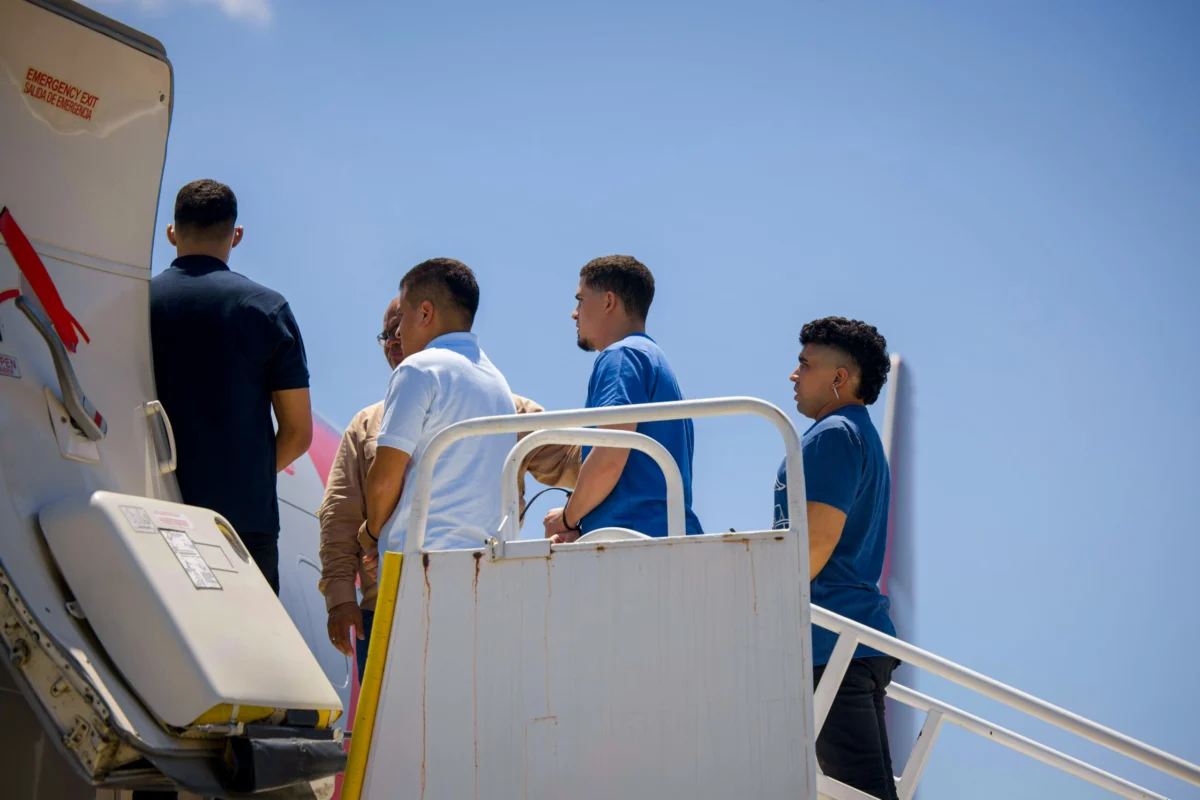
Liberia has become the latest nation to enter into an agreement with the United States under President Donald Trump’s administration, accepting the deportation of foreign nationals to its territory who are not its own citizens. This move marks a significant expansion of a controversial policy that sees individuals removed from the U.S. and sent to third countries, often thousands of miles from their places of origin. The first group of deportees, part of an anticipated total of 1,200, arrived in Monrovia, Liberia, from the United States, sparking debate and drawing attention to the humanitarian and geopolitical implications of such arrangements.
A New Chapter in US Immigration Enforcement
On a Thursday flight, the inaugural contingent of 20 individuals landed at Roberts International Airport in Monrovia. These deportees were predominantly from Latin American countries, including Venezuela and Cuba, underscoring the broad reach of the U.S. policy. Upon arrival, the group was swiftly escorted onto a bus by Liberian authorities and transported away, with no opportunity provided for them to interact with waiting reporters. This lack of access immediately raised questions about transparency and the welfare of the deportees.
The arrival followed a formal agreement announced just two days prior, on Tuesday, outlining a plan for up to 1,200 deportees to be transferred to the West African nation over the course of the coming year. This bilateral arrangement solidifies Liberia’s position within a growing network of countries partnering with the Trump administration on these third-country deportation initiatives.
Since commencing his second term as U.S. president in 2025, Donald Trump has demonstrably intensified efforts to reshape immigration enforcement. According to data compiled by the non-profit organization Human Rights First, his administration has inked agreements with at least 35 nations globally to facilitate the acceptance of non-national deportees. This aggressive pursuit of third-country arrangements represents a cornerstone of the administration’s broader immigration strategy, aiming to deter irregular migration and manage the flow of asylum seekers.
The Calculus of Cooperation: Aid and Influence
The motivations behind these agreements are complex and multifaceted. For many of the partner countries, the incentive has often come in the form of financial aid and preferential trade deals. Senate Democrats, in an estimate released in February, calculated that a minimum of $40 million had been allocated to such agreements within the first year of Trump’s second term alone. This substantial financial outlay highlights the U.S. commitment to incentivizing these partnerships.
Liberia, for instance, received $5 million from the U.S. this year, explicitly designated for what the U.S. terms "migration management activities." While the correlation between this aid and the deportation agreement appears evident to many observers, Liberia’s Ministry of Information has vehemently denied any suggestion that its consent to participate in the program was financially motivated.
In a public statement released earlier in the week, the ministry asserted, "The transfer of persons to Liberia is not a transaction with a quid pro quo." It further clarified, "Liberia has not demanded or received any compensation or promise of reward in exchange for its consent to participate in the program." This categorical denial seeks to frame Liberia’s participation as an act of humanitarian goodwill rather than a transactional arrangement.
Jerolinmek Piah, Liberia’s Information Minister, further elaborated to the news agency Reuters that the International Organization for Migration (IOM) and the United Nations Refugee Agency (UNHCR) would play crucial roles in providing essential services and support for the arriving deportees. This involvement of international bodies is often seen as a crucial safeguard, although critics remain skeptical about the practical implementation and the adequacy of resources.
Liberia’s Stance: A Humanitarian Gesture Rooted in History?
The Liberian government has gone to lengths to portray its role as a humanitarian one, emphasizing its historical legacy as a haven for those seeking refuge. The Tuesday statement from the Ministry of Information underscored that the deportees are not being classified as "criminals and are not being prosecuted in any manner." This distinction is critical, as it attempts to differentiate these third-country deportations from the repatriation of individuals with criminal records.
Drawing on its unique historical narrative, the ministry’s statement highlighted, "Liberia, the first black African independent nation on the African continent, has a long history of accepting people seeking refuge from political and other crises." It further invoked the nation’s founding principles: "As a matter of fact, Liberia itself was founded as a refuge for freed slaves from the United States of America and other parts of the world." This historical context is presented as the foundational ethos guiding Liberia’s decision to accept the deportees, positioning it as a country with a moral obligation to provide sanctuary.
The U.S. government, for its part, has framed these third-party deportations as a necessary measure, particularly for immigrants whose home countries are unwilling or unable to accept their return. Beyond logistical challenges, the policy is also explicitly presented as a form of deterrence, intended to discourage future attempts at irregular migration to the U.S. by making the potential consequences more severe and unpredictable.
Broader Implications and Growing Scrutiny
While Liberia presents its participation as a humanitarian endeavor, the policy has drawn sharp criticism from human rights advocates and international observers. Concerns are mounting over whether smaller nations, particularly in Africa and other developing regions, are being exploited as "dumping grounds" for U.S. deportees. Critics question the capacity of these countries to adequately absorb and provide for individuals who often arrive with little to no resources, no social networks, and frequently without proficiency in local languages.
Many characterize such third-country deportations as excessively punitive. They argue that these policies strand migrants and asylum seekers in unfamiliar environments, severing them from their cultural contexts and support systems, and potentially exposing them to new vulnerabilities. The logistical and psychological toll on individuals forcibly removed to a country not their own is immense, raising serious ethical questions about the responsibility of the deporting nation.
The case of Guatemala provides another recent illustration of this expanding trend. Guatemalan President Bernardo Arevalo revealed on Thursday that an estimated 2,300 Mexican citizens have been deported from the U.S. to his country this year alone, rather than being sent directly back to Mexico. Media outlets, including CBS News, have reported that this maneuver is a deliberate tactic to disincentivize Mexican nationals from attempting to return to the U.S. without legal immigration status.
President Arevalo, however, clarified that these deportees are not intended to remain in Guatemala. "They are arriving in planes of Guatemalan returnees, and what we have done is process them as in transit, in coordination with the Mexican immigration authorities," he stated. This "in-transit" arrangement suggests a complex, multi-layered deportation process that adds further logistical and humanitarian challenges, even if the ultimate destination is the country of origin.
Challenges and the Path Forward
The involvement of international bodies like the IOM and UNHCR in Liberia is a critical component designed to mitigate some of the humanitarian risks. These organizations typically provide assistance with shelter, food, medical care, and legal aid, as well as helping individuals navigate the asylum process if they choose to apply. Liberia’s statement indicates that deportees will be allowed to apply for asylum and are "free to depart the country when they so desire," suggesting a degree of agency, though the practicalities of exercising this freedom in a foreign land without resources remain a significant challenge.
The long-term implications of these agreements extend beyond the immediate welfare of the deportees. They raise fundamental questions about international refugee law, the principle of non-refoulement (which prohibits returning individuals to countries where they face persecution), and the responsibility of states in managing global migration flows. The U.S. policy, by creating a network of third-country recipients, shifts the burden of care and integration onto nations that are often less equipped to handle it, potentially destabilizing fragile regions and creating new humanitarian crises.
As the Trump administration continues to expand its network of third-country deportation partners, the international community will undoubtedly intensify its scrutiny. The balance between national sovereignty, immigration enforcement, and humanitarian obligations will remain a central tension, with the welfare of thousands of vulnerable individuals hanging in the balance. The unfolding situation in Liberia serves as a crucial case study in this evolving and controversial chapter of global migration policy.
