

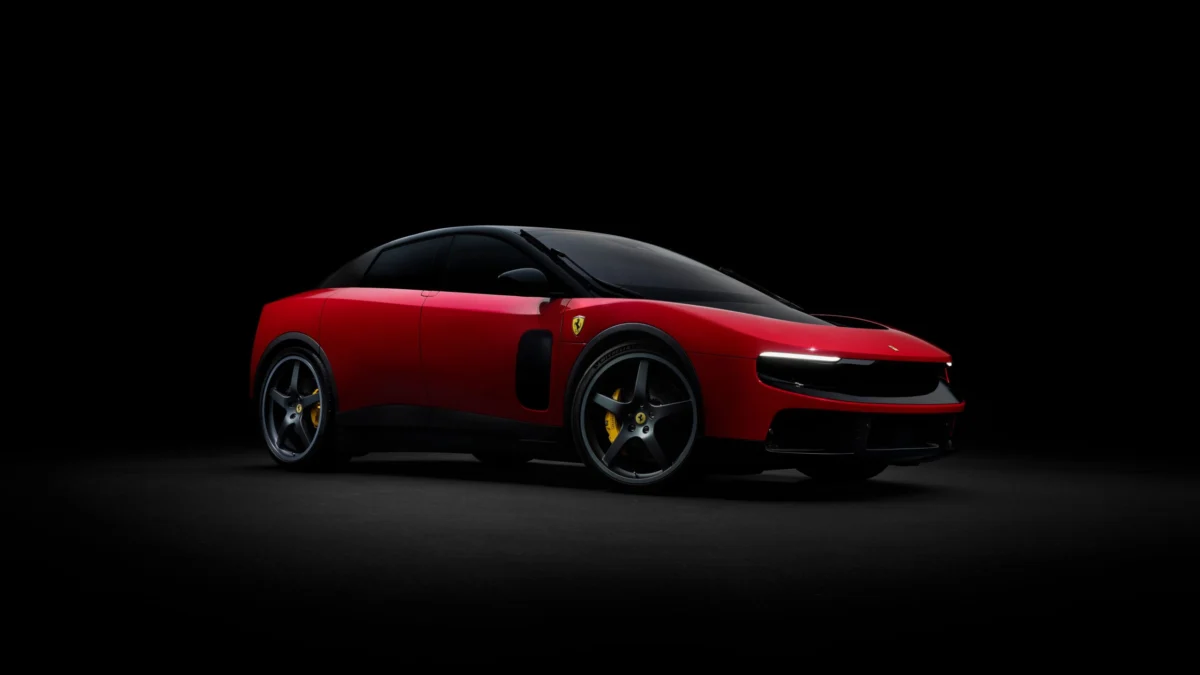
After eight years of strategic development, industry speculation, and a meticulously managed teaser campaign, Ferrari has officially pulled back the curtain on its most significant technological leap in decades: the Ferrari Luce. Revealed in the heart of Rome, the Luce—which translates to "light" in Italian—represents the Maranello-based manufacturer’s definitive answer to the electrification of the high-performance automotive sector. This all-electric grand tourer marks a pivotal moment for the Prancing Horse, signaling a transition from the era of internal combustion dominance to a future defined by sustainable luxury and silent, yet brutal, performance.
The journey to the Luce began in January 2018 at the North American International Auto Show in Detroit. There, the late Ferrari chairman and CEO Sergio Marchionne first hinted at an electric supercar that would challenge the hegemony of Tesla. Marchionne’s stance was clear: if an electric supercar were to be built, Ferrari would not merely participate but would aim to lead. While Ferrari may not have been the first to enter the electric vehicle (EV) market, the Luce arrives as the most anticipated luxury EV in history, blending traditional Italian craftsmanship with a radical design language born from a unique partnership with Jony Ive’s creative agency, LoveFrom.

A New Era of Engineering: Performance and Powertrain
The Ferrari Luce is not merely a battery-powered adaptation of an existing chassis; it is a ground-up reimagining of what a hypercar can be when freed from the constraints of a traditional engine block. The technical specifications position the Luce at the apex of the EV market. The vehicle utilizes a four-motor configuration, with one motor dedicated to each wheel, allowing for unprecedented levels of torque vectoring and handling precision.
In its "Boost" mode, the Luce delivers a combined output exceeding 1,000 horsepower. The distribution of this power is heavily biased toward the rear to maintain Ferrari’s signature driving dynamics; the rear axle contributes 832 hp and a staggering 7,750 Nm of wheel torque, while the front axle adds 282 hp and 3,400 Nm. This allows the Luce to sprint from zero to 62 mph (100 km/h) in a blistering 2.5 seconds, eventually reaching a top speed of 192 mph. Unlike many electric competitors that struggle with sustained performance, Ferrari claims full power is available in less than a second of driver input.
Powering this quartet of motors is a 122 kWh battery pack, currently one of the largest in the production EV space. Built on an 800-volt architecture, the system supports ultra-fast charging at rates of up to 350 kW, enabling the vehicle to regain significant range in minutes. Ferrari estimates a total driving range of over 329 miles (530 km) per charge. Despite the inherent weight of such a massive battery, Ferrari has managed to keep the curb weight at 4,982 pounds (2,260 kg). This is only approximately 200 pounds heavier than the Purosangue SUV, an achievement attributed to the extensive use of carbon fiber and lightweight alloys in the Luce’s structural composition.

The Aesthetic Revolution: The LoveFrom Influence
Perhaps the most controversial and discussed aspect of the Luce is its design. Breaking with its tradition of keeping design entirely within the Ferrari Design Studio, led by Flavio Manzoni, Maranello sought the expertise of LoveFrom, the agency founded by legendary former Apple designer Jony Ive and Marc Newson. This collaboration has resulted in an aesthetic that is distinctly "Apple-esque" in its pursuit of simplicity and purity of form.
The exterior of the Luce is defined by a "glass house" architecture—a seamless, shell-like form that creates a continuous line from the nose to the rear. The windscreen extends far down into the front of the car, eliminating the traditional hood line and contributing to the lowest drag coefficient in the history of Ferrari road cars. To maintain this aerodynamic purity, the large windscreen wipers have been relocated to the A-pillars, hidden from the primary airflow.
The vehicle’s stance is further emphasized by the largest staggered wheel diameters ever seen on a series-production Ferrari: 23 inches at the front and 24 inches at the rear. The rear features "suicide" doors, allowing for elegant entry into a cabin that accommodates five passengers—a first for a Ferrari hyper-performance model. The light panels, both front and rear, are integrated directly into the body surfaces, with "halo" taillights that pay homage to iconic models like the 360 Modena and 458 Italia.

Inside, the LoveFrom influence is even more pronounced. The cabin is a masterclass in minimalist luxury, featuring brushed aluminum, high-grade leather, and glass. The center console is dominated by a Corning glass gear-shift knob featuring 13,000 laser-etched holes, while the center infotainment screen is mounted on a ball-and-socket joint, allowing it to pivot toward the passenger. Physical switchgear remains, but it is executed with the precision of a high-end timepiece. Jony Ive described the Luce as "still clearly a Ferrari," but one that represents a "different manifestation based on some of the beliefs around simplicity."
Sound and Soul: The Acoustic Instrument
One of the primary criticisms of electric supercars is the lack of an emotive soundtrack. Ferrari has addressed this not through synthetic, "fake" engine noises pumped through speakers, but through an innovative mechanical solution. The company’s sound quality manager, Antonio Palermo, has developed a system that treats the electric powertrain like a musical instrument.
An accelerometer is fitted to the rear axle to sense the vibrations and frequencies generated by the motors. This system filters out the unpleasant high-pitched whines typical of EVs and amplifies the mechanical "soul" of the car, feeding the resulting audio into the cabin. This ensures that the driver remains connected to the machine’s physical exertion, providing a tactile and auditory feedback loop that is essential to the Ferrari experience.

Strategic Context and Market Challenges
The launch of the Luce comes at a time of significant cooling in the global electric vehicle market, particularly in the luxury segment. While Ferrari is pressing forward, its closest rivals have shown signs of hesitation. Lamborghini recently pushed the launch of its first EV back to 2029, and Bentley has delayed its all-electric transition from 2030 to 2035. Even Porsche has reinvested heavily in combustion technology as EV demand in Europe and North America has plateaued.
Ferrari itself is not immune to these market forces. In June 2025, the company announced a delay for its second EV model until at least 2028, citing weak demand for high-end electric cars. Consequently, the Luce is not intended to replace the company’s internal combustion engine (ICE) lineup but to augment it. CEO Benedetto Vigna has emphasized that the Luce is an "addition," not a "pivot." Ferrari’s 2030 target remains a balanced split: 20 percent fully electric, 40 percent hybrid, and 40 percent internal combustion.
This cautious approach is also a response to shareholder concerns. In late 2024, Ferrari’s shares saw a 16 percent dip following disappointment over long-term financial targets and the heavy capital expenditure required for the "e-building" in Maranello—the dedicated facility where the Luce and its successors will be produced.

Chronology of the Ferrari Luce Development
- January 2018: Sergio Marchionne announces Ferrari’s intent to build an electric supercar at the Detroit Auto Show.
- September 2021: Ferrari announces a long-term partnership with Jony Ive and LoveFrom.
- June 2022: Ferrari’s Capital Markets Day outlines the "e-building" and the 2030 electrification goals.
- October 2023: Reveal of the electric powertrain architecture and the "acoustic instrument" sound system.
- February 2024: The interior design is unveiled at a private event in San Francisco, showcasing the LoveFrom aesthetic.
- June 2025: Ferrari announces a delay for its second EV model, citing market conditions, while confirming the Luce remains on track.
- Present: Official exterior reveal in Rome and confirmation of production specifications.
Pricing and Availability
The Ferrari Luce is scheduled to enter production in late 2026, with the first customer deliveries expected in early 2027. Pricing is set to start at approximately $640,000, placing it well above the standard series-production models like the 296 GTB and closer to the territory of limited-run specials.
The success of the Luce will be a litmus test for the entire ultra-luxury automotive industry. If Ferrari can convince its loyal "tifosi" that an electric vehicle can possess the same "passion" and "soul" as a V12-powered masterpiece, it will have secured its place in the next century of automotive history. For now, the Luce stands as a bold, expensive, and technologically sophisticated gamble—a "light" intended to lead Ferrari through the complexities of a changing world.
