

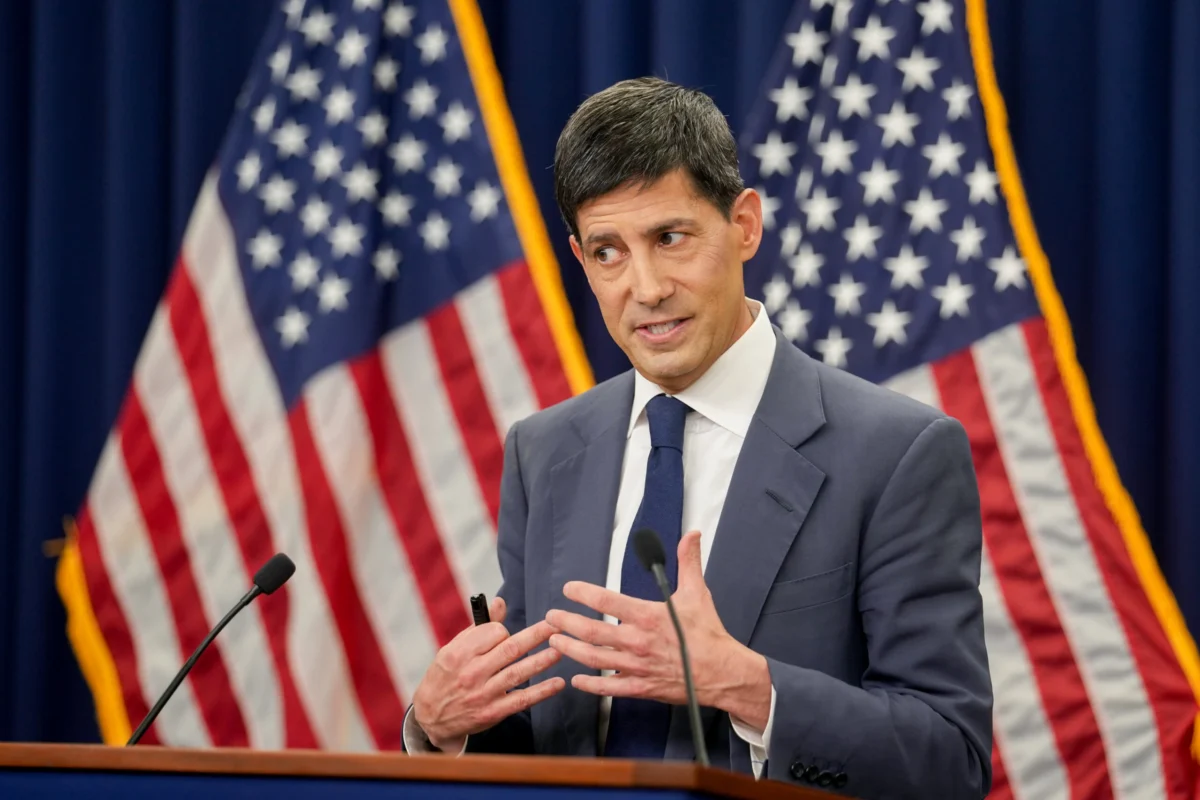
Federal Reserve Chairman Kevin Warsh faces a pivotal moment this week as he and his fellow policymakers on the Federal Open Market Committee (FOMC) deliberate the immediate and future trajectory of interest rates. While a quarter-percentage-point hike is widely anticipated for Wednesday’s meeting, the margin of consensus among the 12 voting members remains a significant point of uncertainty, potentially shaping not only monetary policy but also the Fed’s communication strategy and market confidence.
The market’s strong conviction in an imminent rate increase is underscored by the CME Group’s FedWatch tool, which, as of Monday afternoon, indicated a greater than 92% probability of a hike this week. Furthermore, futures traders were pricing in a more than 75% chance of a subsequent move in December. This anticipation is largely a reaction to recent economic indicators, including a resurgence in fuel prices and inflation data released last week, which showed prices continuing to climb in August. These developments align with Chairman Warsh’s recent pronouncements, notably his comments at Jackson Hole, Wyoming, where he signaled that the Federal Reserve would be compelled to act unless there were more definitive signs of inflation receding towards the central bank’s 2% target. The current benchmark federal funds rate stands in the range of 3.50% to 3.75%.
The prevailing market sentiment, while strong, is juxtaposed against a complex economic landscape and internal committee dynamics that present substantial challenges for Chairman Warsh. The debate hinges on whether current inflationary pressures are transitory or indicative of more entrenched price instability, a distinction that carries significant weight in monetary policy decisions.
The Tug-of-War: Wait or Act?
A primary consideration for the FOMC is the nature of the factors currently driving inflation. Economists generally acknowledge that a significant portion of this year’s price increases can be attributed to external shocks, such as tariffs and supply chain disruptions exacerbated by geopolitical events like the conflict in Iran. The long-term impact of these factors on the inflation outlook is inherently uncertain, leading some policymakers to advocate for a more patient approach.
David Mericle, an economist at Goldman Sachs, articulated this perspective in a client note, stating, "We do not see a strong economic case for raising the funds rate. We think that all of the overshoot of 2% can be attributed to one-time factors whose impact is likely to fade." Despite this assessment, Goldman Sachs revised its forecast from no change to a quarter-point hike for the upcoming meeting, a shift primarily driven by the firm’s belief that the market’s entrenched expectations will exert pressure on the Fed to act, thereby avoiding a potentially destabilizing surprise.
The potential for a divided vote is further highlighted by the FOMC’s July meeting, where the committee narrowly favored holding rates steady, with a 9-3 split. The three dissenting votes at that meeting came from regional Federal Reserve Bank presidents: Lorie Logan of Dallas, Beth Hammack of Cleveland, and Neel Kashkari of Minneapolis. All three had previously supported a quarter-point rate increase at the preceding meeting. If their positions remain unchanged – and there has been no public indication to suggest otherwise – then at least four other members of the committee would need to shift their stance from supporting a hold to favoring a hike for the current meeting to achieve a consensus for an increase.
Key Voices and Their Stances
Among the most closely watched members of the FOMC is Governor Christopher Waller. In public remarks delivered on September 3rd, Governor Waller indicated his support for holding rates steady at the September meeting. However, he also emphasized the importance of closely monitoring economic data to confirm that disinflationary trends are persistent. His commentary suggested a preference for patience over an immediate rush to raise rates, noting, "What’s the cost of waiting one meeting? Hiking 25 basis points, one meeting right now, is not going to bring the [consumer price index] down to 2%."
The latest Consumer Price Index (CPI) report for August indicated that headline inflation was running at an annual rate of 3.4%. The core inflation rate, which excludes volatile food and energy prices, presented a more moderate picture at 2.4%, a slight decrease of 0.1 percentage point from July. This divergence between headline and core inflation further fuels the debate on the nature and persistence of inflationary pressures.
Governor Waller is not alone in advocating for a cautious approach. New York Fed President John Williams, speaking to CNBC less than two weeks prior to the meeting, suggested that a "wait-and-see" strategy appeared prudent. Earlier in the summer, President Williams, whose role at the helm of the influential New York Fed traditionally places him at the center of the central bank’s "troika" of influence, expressed his view that inflation had likely peaked and that interest rates were "well-positioned."
Governor Michael Barr has also voiced his perspectives, expressing concern that temporary inflationary pressures might become more ingrained in the economy. He indicated an openness to a rate hike if inflation does not ease but stopped short of committing to one, suggesting a data-dependent stance.
Decoding the FOMC Breakdown
The crucial question facing the market and analysts is which members of the FOMC might join the three dissenters from the July meeting in supporting a rate hike. Chairman Warsh himself is widely expected to be among those favoring an increase, given his assertive remarks at Jackson Hole. Governor Lisa Cook, in early August, stated her readiness "to act" to address inflation, signaling a hawkish inclination. Conversely, regional bank presidents Anna Paulson of Philadelphia and Austan Goolsbee of Chicago have generally advocated for a more patient monetary policy stance.
This leaves several key figures whose decisions will be pivotal. Vice Chair Philip Jefferson, former Chair Jerome Powell (who has maintained a low public profile since stepping down from the top position), and Governor Michelle Bowman are among those whose positions are less definitively signaled. Governor Bowman’s most recent relevant public remarks in May expressed caution against unnecessary rate hikes due to inflation spikes. Her recent public commentary on monetary policy has been notably limited over the summer.
A significant factor that could influence the vote’s outcome is the potential for members on the fence to coalesce around Chairman Warsh’s position in the interest of presenting a unified front. The margin of the vote will not only illuminate the intellectual divide within the committee – between those who view current inflation as transient and those who believe price pressures are becoming entrenched – but will also offer insights into the effectiveness of Chairman Warsh’s leadership in guiding the committee’s deliberations.
David Kelly, Chief Global Strategist at JPMorgan Asset Management, commented in his weekly market note that if the Fed does indeed raise rates, "it may not look, in retrospect, like a close call." He added that if a majority coalesces around a hike, "the other members may well join them to portray a more united front to the public and the President." In such a scenario, Kelly anticipates the final vote could show only two, one, or even no dissents.
Beyond the Rate Hike: Forward Guidance and Market Signals
Following the interest rate decision, market participants will closely scrutinize the updated "dot plot," which provides anonymous projections of individual FOMC participants’ expectations for the future path of interest rates. Chairman Warsh notably abstained from submitting his projection for the June update, a decision that has fueled speculation about his approach to forward guidance.
Investors will be looking for indications of conviction regarding potential rate hikes for the remainder of the year and the outlook for 2027. The upcoming update will also feature the first projections for 2029. Historically, the Federal Reserve tends to implement monetary policy in cycles rather than through isolated, single moves, viewing incremental, one-off adjustments as less effective.
Mericle of Goldman Sachs suggested that a 10-8 split in favor of one hike, assuming Warsh’s continued reluctance towards explicit forward guidance and non-participation in the dot plot, would suggest "some participants might be ambivalent about the first hike and some might want to avoid pushing market expectations any higher." However, he also noted the "risk of a majority for two hikes if more participants than we expect see a hike this week as a normal response to higher oil prices and AI demand and the start of a series of rate hikes." The mention of "AI demand" points to the burgeoning influence of artificial intelligence on economic activity and its potential implications for productivity and inflationary pressures, a factor increasingly being factored into economic forecasts.
In the event of a closely divided vote, the focus will inevitably shift to Chairman Warsh’s press conference following the FOMC meeting. His articulation of the committee’s sentiment and rationale will be critical in shaping market expectations and conveying the Fed’s assessment of the economic landscape.
Former New York Fed President Bill Dudley emphasized the need for clear communication, stating, "The Fed needs to explain how they’re thinking about the economy." He added, "Now [Warsh has] just got to follow that up with action. If he does that, I think he’s basically fixed the problem that he created in his first two press conferences." This sentiment underscores the importance of a decisive and coherent message from the Fed chair to rebuild market confidence and ensure policy effectiveness. The economic implications of this week’s decision extend beyond immediate market reactions, influencing borrowing costs for businesses and consumers, investment decisions, and the broader trajectory of economic growth and inflation for the foreseeable future. The global economic environment, with its own set of inflationary pressures and growth uncertainties, will also be a key consideration in how the Fed’s actions are perceived and interpreted internationally.
