

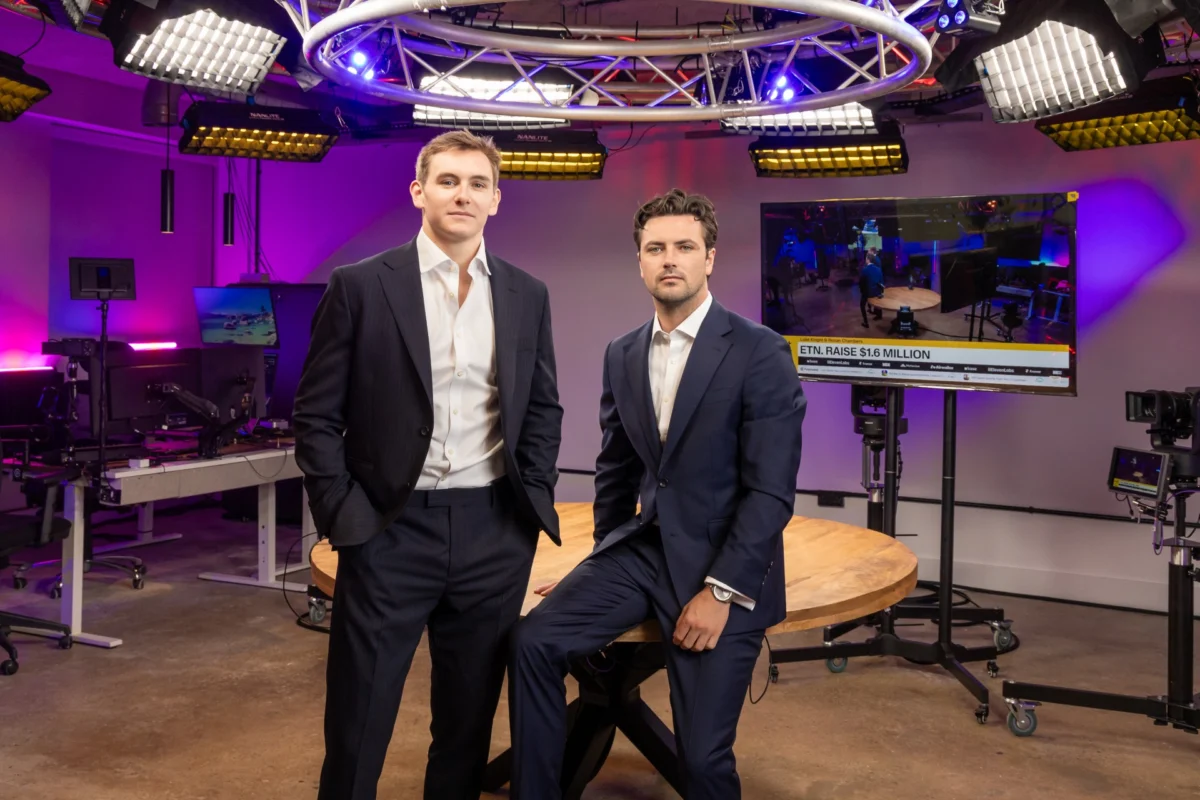
The London-based media startup European Technology Network (ETN) has announced the successful closure of a $1.6 million seed funding round, marking a significant milestone in its effort to become the primary digital broadcast hub for the continent’s rapidly accelerating technology sector. Founded by Luke Knight and Ronan Chambers, the network is positioning itself as the European counterpart to the American media phenomenon TBPN, which was recently acquired by OpenAI. This fresh infusion of capital, sourced from a coalition of media heavyweights and artificial intelligence pioneers, will facilitate a major operational expansion, including a move to a high-specification studio in London’s King’s Cross and a transition from a twice-weekly broadcast schedule to a full five-day-a-week live programming slate.
The funding round attracted a diverse array of strategic investors, reflecting the growing intersection between traditional media, venture capital, and cutting-edge technology. Participants include Powerhouse Capital and Axel Springer SE—the German media conglomerate that owns major outlets such as Business Insider and Politico. The round also saw contributions from a co-founder of the digital media giant LadBible, alongside high-profile angel investors from global AI leaders OpenAI and DeepMind. This backing underscores a broader industry belief in the necessity of a dedicated, fast-paced media outlet capable of documenting the surge in European venture capital activity and technological innovation.
A Chronology of Rapid Growth and Market Positioning
The European Technology Network was launched in October 2023, amidst a period of profound transformation in the global technology landscape driven by the generative AI boom. Founders Luke Knight and Ronan Chambers identified what they described as a "gaping hole" in the existing media ecosystem: the inability of traditional news cycles to keep pace with the velocity of startup founding, funding, and product deployment in Europe.
Initially operating as a two-day-a-week live stream on platforms such as X (formerly Twitter) and YouTube, ETN quickly established a foothold by offering raw, insider-led commentary on emerging trends. In less than a year, the show has amassed over 5 million views, demonstrating a significant appetite for tech-centric long-form content. The network’s growth has mirrored the acceleration of the London tech scene itself, which remains the primary engine of European venture activity.
The decision to move to a five-day-a-week schedule, effective immediately, is a direct response to the overwhelming volume of news and guest requests the founders have encountered. Chambers noted that the show was receiving approximately 70 pitches per week from founders and investors seeking airtime. The previous format, which attempted to condense 12 interviews into a four-hour weekly window, proved insufficient to cover the breadth of the market. The new schedule features a daily live show from 12:00 p.m. to 3:00 p.m. UK time, focusing on trending news, followed by two hours of deep-dive interviews and specialized segments.
Strategic Relocation to the London Knowledge Quarter
A central component of ETN’s expansion is its relocation to a new studio facility in King’s Cross. This move is more than logistical; it is a strategic alignment with the heart of London’s "Knowledge Quarter." King’s Cross has evolved into one of the world’s most concentrated hubs for artificial intelligence and biotechnology, housing the global headquarters of Google DeepMind, the Francis Crick Institute, and a growing cluster of high-growth AI startups.
By establishing a physical presence in this neighborhood, ETN places itself at the doorstep of the very innovators it covers. The founders intend for the studio to serve as a "town square" for the tech community, where investors and founders can drop in to discuss developments in real-time. This proximity has already paid dividends, with ETN hosting a diverse roster of guests ranging from Kanishka Narayan, the UK’s first Minister for AI, to executive leadership from European unicorns like Synthesia and ElevenLabs.
Data Analysis: The Surge in European Venture Capital
The expansion of ETN comes at a time when the European tech ecosystem is demonstrating unprecedented resilience and growth. According to data from Dealroom, London-based startups alone have raised $14.7 billion in the first half of 2024. This surge is largely driven by massive "mega-rounds" in the AI and deep-tech sectors.
Significant transactions this year include:
- Wayve: The autonomous driving startup secured $1.05 billion in Series C funding.
- ElevenLabs: The AI audio platform achieved unicorn status following a $80 million Series B.
- Isomorphic Labs: The Alphabet-owned drug discovery firm, led by DeepMind’s Demis Hassabis, has continued to expand its footprint in London.
- Mistral AI: While based in Paris, the company’s influence has catalyzed cross-border investment throughout Europe.
The founders of ETN argue that the speed at which capital is now flowing—exemplified by companies like Wayve and Superintelligence raising hundreds of millions within short windows—requires a new form of "high-frequency" journalism. They point to the emergence of companies founded by DeepMind alumni, such as Recursive and Ineffable Intelligence, as evidence that Europe is no longer just a consumer of technology but a primary laboratory for its development.
The TBPN Influence and the Rise of Insider Media
The strategic model for ETN draws clear inspiration from the United States, specifically The Buzzy Founder-Led Business Talk Show (TBPN). Founded by John Coogan and Jordi Hays, TBPN redefined tech media by prioritizing the founder’s perspective and maintaining a "pro-tech" stance that contrasted with the often adversarial tone of traditional investigative journalism. The acquisition of TBPN by OpenAI in early 2024 for a reported nine-figure sum sent shockwaves through the industry, signaling that AI laboratories see immense value in controlling the narrative and community engagement around their products.
Knight and Chambers acknowledge the influence of the TBPN model but emphasize the need for a regionalized version that understands the cultural and regulatory nuances of the European Union and the United Kingdom. "If we can have an ITV and a BBC, why wouldn’t we have a regional version of this?" Chambers remarked, highlighting the necessity of a platform that champions European success stories while remaining globally optimistic.
Unlike traditional journalists, the ETN founders view themselves as "tech insiders." This distinction is critical to their editorial approach. They do not aim to replace traditional investigative outlets but rather to work in tandem with them, providing a stage for discourse that is often too technical or niche for mainstream broadsheets. This "insider" status allows for a level of rapport with guests—such as Sequoia partner George Robson or former Prime Minister Rishi Sunak—that traditional media may struggle to replicate.
Operational Diversification and Revenue Streams
Beyond the daily live stream, the $1.6 million seed round will fund several new initiatives designed to deepen ETN’s engagement with the ecosystem:
- The ETN Newsletter: A daily briefing aimed at providing curated insights into European funding rounds and policy shifts.
- Interactive Formats: The introduction of "Shark Tank-style" pitching sessions, debates, and roundtables to foster active participation from the venture community.
- Pan-European Coverage: Despite being based in London, the network is committed to a continental scope. This includes mobile broadcasts from major tech summits like the RAISE AI Summit in Paris and events in Athens, ensuring representation from the 40+ countries and various cultures that comprise the European market.
The network’s revenue model remains rooted in high-value sponsorships and advertising. Current partners include Polymarket, a decentralized prediction market; Base, the Ethereum Layer 2 incubated by Coinbase; and ElevenLabs. These sponsorships indicate a strong alignment with the "Web3" and "AI" cohorts, which are currently the most active spenders in the tech B2B advertising space.
Broader Impact: Shifting the Cultural Paradigm
One of the most significant implications of ETN’s rise is its potential impact on the European talent pipeline. Historically, top graduates from institutions like Oxford, Cambridge, and ETH Zurich have gravitated toward careers in investment banking or management consulting. However, the founders of ETN believe that a dedicated media presence celebrating tech entrepreneurship can shift this cultural needle.
"It riles up the next generation to the point where it’s no longer cool to finish university and go into banking," Chambers said. By documenting the success of companies like Stockholm-based Lovable or London’s Wayve, ETN aims to provide the "social proof" necessary to encourage a new generation of builders.
As the network moves to a five-day-a-week schedule, the focus will remain on maintaining the pace of the industry it serves. With high-profile interviews on the horizon, including senior advisors to Anthropic and Microsoft, ETN is positioned to be the primary chronicler of Europe’s attempt to assert itself as a global technological superpower. In an era where "information advantage" is a key currency in venture capital, ETN’s move to provide real-time, daily coverage may prove to be a pivotal development for the European startup landscape.
