

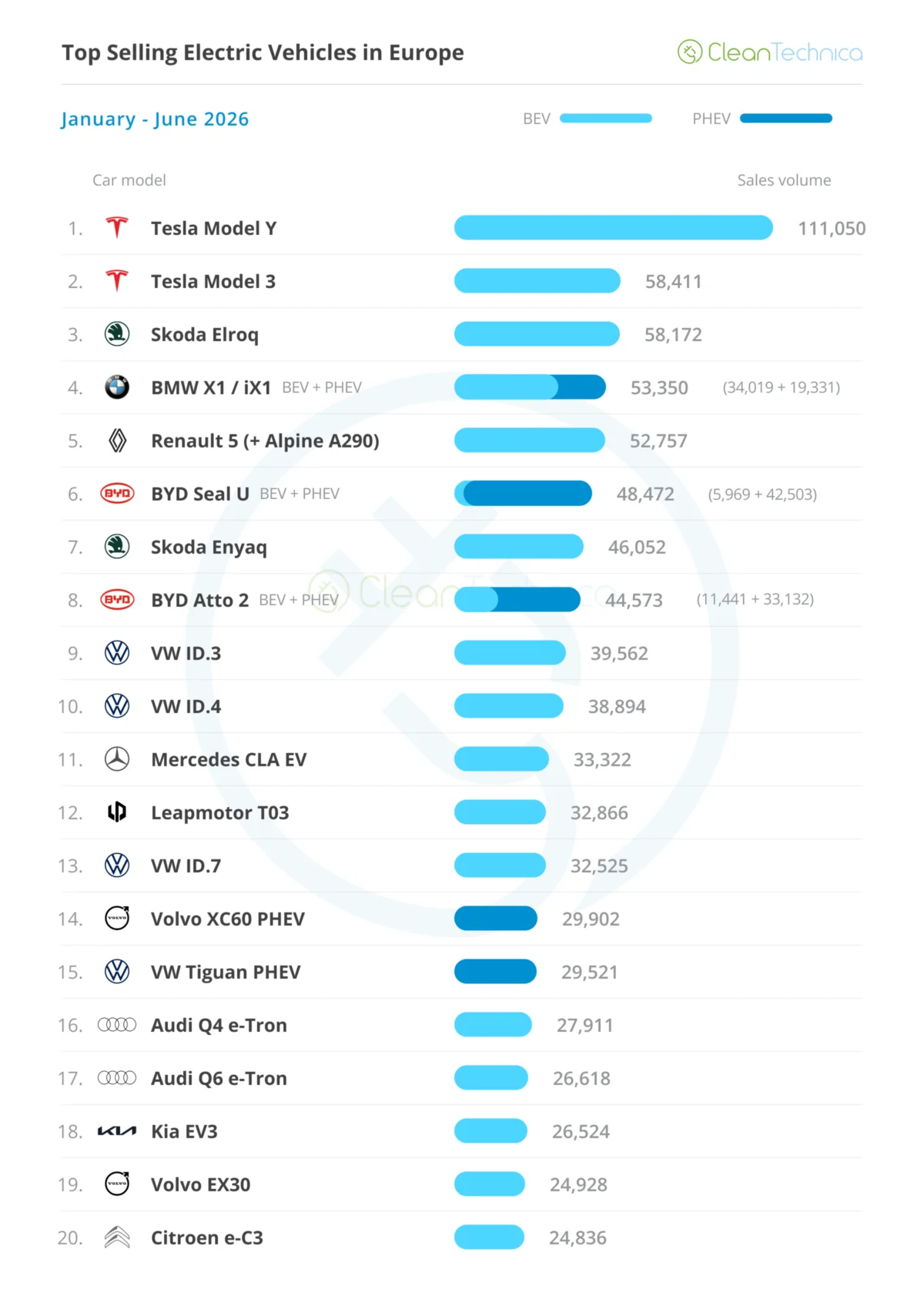
The broader plugin vehicle segment, which includes both BEVs and plugin hybrids (PHEVs), saw a 41% year-over-year increase. While PHEVs grew by a more modest 23%, the combined strength of the category pushed the total plugin market share to 37%. Within this segment, the shift toward pure electric propulsion is becoming increasingly dominant; BEVs accounted for 71% of all plugin sales in June, bringing the yearly average to 69%. This represents the highest ratio of BEVs to PHEVs seen in Europe since 2012, signaling that the continent is following a trajectory similar to China, where internal combustion engine (ICE) components are being rapidly phased out of the plugin mix.

Market Dynamics and the Decline of Internal Combustion
The overall European automotive market grew by 13% year-over-year in June, reaching 1.4 million total units. However, this growth was not distributed evenly across fuel types. While electrified options flourished, traditional internal combustion engines faced a sharp decline. Petrol-powered vehicle sales fell by 12%, dropping to a 21% market share. Diesel, once the backbone of the European fleet, saw a 17% contraction and now teeters on the edge of irrelevance with just 6% of the market.
In contrast, plugless hybrids (HEVs) maintained steady momentum, growing 17% to capture 35% of the market. When combined with the 37% share of plugin vehicles, the data reveals that 72% of all new cars sold in Europe in June featured some form of electrification. This shift is occurring faster than many industry analysts predicted, with the year-to-date BEV share now standing at 23% (and 33% for all plugins). These figures already surpass the final results of 2025, which saw a 20% BEV share and a 29% total plugin share.

Segment-by-Segment Electrification Trends
The transition to electric mobility is manifesting differently across various vehicle classes. The "A-segment," or city cars, is currently the closest to achieving a fully electric podium. In June, the Leapmotor T03 secured the third-place spot in the overall segment, followed closely by the Dacia Spring with 5,676 units. Analysts suggest that the city car category is ripe for total electrification because the competition from traditional ICE models is shrinking as manufacturers struggle to make small petrol engines compliant with tightening emissions standards at a profitable price point.
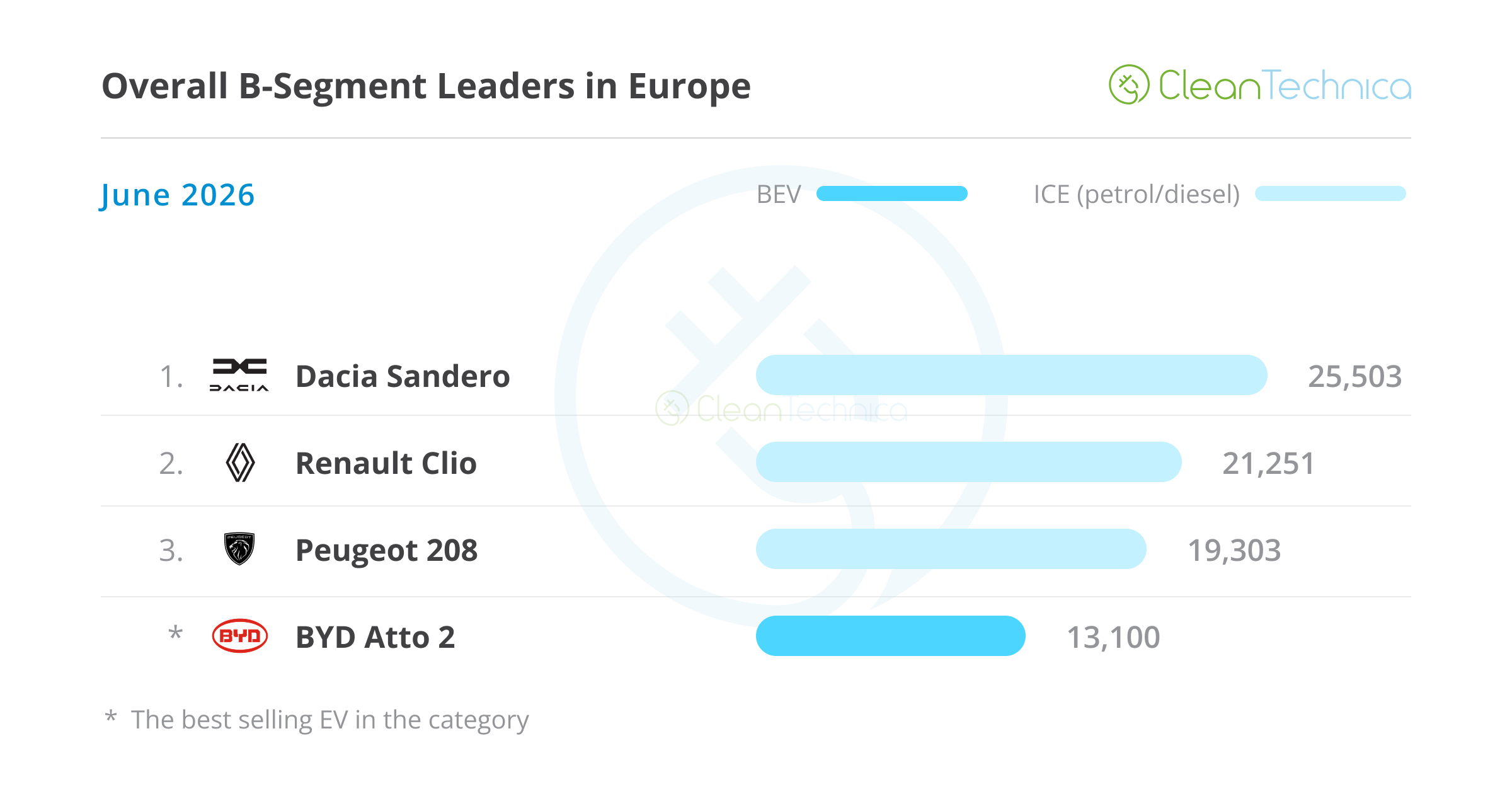
The B and C segments—compact hatchbacks and small SUVs—remain the primary laggards in the transition. In the B-segment, only the Peugeot 208 showed significant electrification, with 16% of its sales coming from the BEV version. The C-segment, dominated by the Volkswagen Golf and Tiguan, relies heavily on PHEV variants, which make up 14% and 32% of their respective sales.
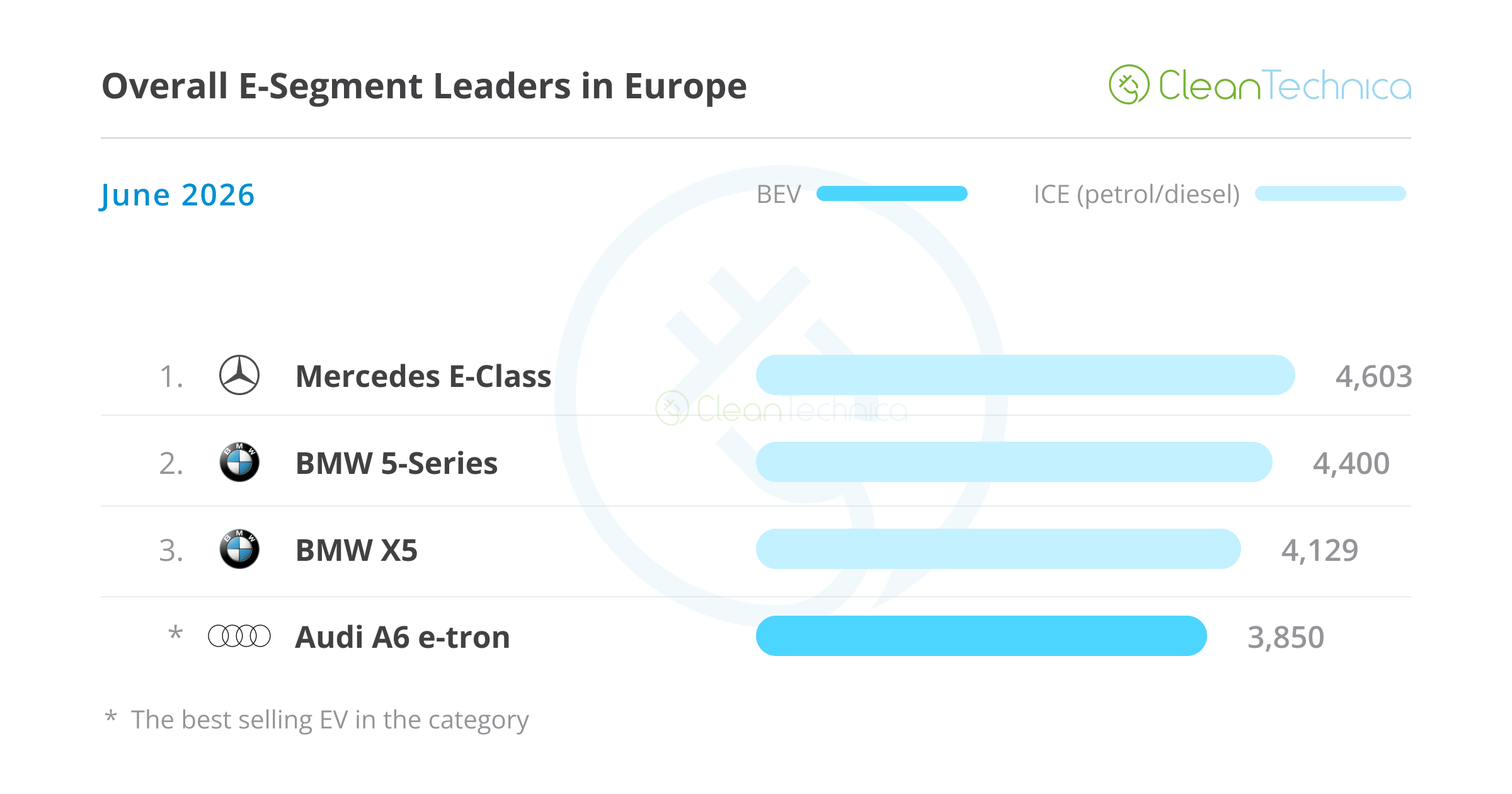
Conversely, the luxury and full-size categories (D and E segments) are rapidly electrifying. The Mercedes E-Class saw 36% of its sales come from PHEV versions, while the BMW 5 Series achieved an 89% electrification rate through a combination of the i5 BEV and various PHEV options. The Audi A6 e-tron also made a strong showing with 3,850 units, signaling high demand for premium electric sedans.
Top 5 Model Analysis: Tesla and BYD Lead the Charge
The individual model rankings for June highlight the intense competition at the top of the market, with Tesla reclaiming its traditional end-of-quarter dominance.

- Tesla Model Y: The midsize crossover returned to the top spot with 34,480 registrations, a 43% increase compared to June of the previous year. This performance allowed the Model Y to become the best-selling vehicle in the overall European market, surpassing the Dacia Sandero by approximately 9,000 units. The Model Y was the #1 seller in several key markets, including the United Kingdom, the Netherlands, Norway, and Switzerland.
- Tesla Model 3: Despite being a decade-old platform, the Model 3 experienced a 67% year-over-year surge, reaching 18,028 registrations. The sedan has found a "second wind" among price-conscious buyers who are prioritizing lower running costs over the latest design trends.
- BYD Atto 2: Representing the massive push from Chinese OEMs, the Atto 2 (known in other markets as the Yuan Up) hit a record 13,100 registrations. The success of this model is attributed to its competitive pricing and the introduction of a high-spec PHEV version featuring an 18 kWh battery and vehicle-to-load (V2L) capabilities.
- BMW iX1/X1 PHEV: BMW’s compact crossover remains a staple of the European market, recording 11,778 registrations. Favorable lease rates and a strong brand reputation have kept the iX1 on the podium as BMW prepares for its "Neue Klasse" transition.
- Renault 5: The French manufacturer’s retro-inspired electric hatchback saw 10,785 sales in June, a 38% increase year-over-year. Renault’s strategy of offering a high-tech, aesthetically pleasing EV at a competitive price point appears to be paying dividends, even as it prepares to face internal competition from the upcoming electric Twingo.
Manufacturer and Group Performance
The manufacturer rankings reveal a shift in power dynamics. While the Volkswagen brand remains the overall leader in plugin sales with an 8.9% market share, it has lost ground compared to previous months. In contrast, BYD is rapidly ascending, now holding 7.9% of the market. Tesla, bolstered by its June delivery peak, moved into third place among brands with a 7.1% share.
A notable distinction in this year’s data is Tesla’s brand ranking relative to its model rankings. While Tesla holds the #1 and #2 spots for individual models, it only ranks third as a manufacturer. This is due to a lack of lineup depth; while BMW and BYD offer 11 and 17 different plugin models in Europe, respectively, Tesla relies almost entirely on two high-volume nameplates.

When arranged by automotive group, the Volkswagen Group maintains a commanding lead with a 24% share of the plugin market. However, the group saw a 0.8% drop in share this month. The most significant change occurred in the runner-up spot, where the BMW Group (8.6%) overtook Stellantis (8.3%). Stellantis has faced a continuous decline in market share, leading to concerns among stakeholders regarding the group’s product planning and electrification pace.
Chronology of the 2026 Market Shift
The first half of 2026 has been characterized by a volatile but upward trend for EVs. In January and February, the market saw moderate growth as subsidies in several major markets were adjusted. However, by the second quarter, the arrival of more affordable models from Renault, Citroën, and various Chinese brands began to stimulate mass-market demand.
The June surge is viewed by analysts as a "high tide" moment, where several factors converged: Tesla’s quarterly delivery push, the clearing of order backlogs for new models like the Audi Q6 and Mercedes CLA EV, and a seasonal peak in consumer spending. Looking forward to the second half of the year, the industry expects a "silver medal" battle between the Tesla Model 3 and the Skoda Elroq for the year-end rankings, as both models vie for the position behind the likely champion, the Tesla Model Y.
Strategic Implications and Future Outlook
The rapid decline of diesel and petrol engines suggests that the European Union’s 2035 ban on new ICE vehicle sales may be preceded by a market-led obsolescence. Manufacturers that have invested heavily in dedicated EV platforms, such as Renault and the BMW Group, are currently reaping the benefits of their foresight. Conversely, groups like Stellantis, which have opted for multi-energy platforms that accommodate both ICE and EV powertrains, are facing criticism for failing to deliver class-leading EV specifications.

The "Chinese push" remains the most disruptive force in the region. Brands like BYD and Geely are no longer fringe players; they are now competing directly for podium spots in multiple segments. With BYD establishing manufacturing facilities in Hungary and Leapmotor partnering with Stellantis for European distribution, the presence of Chinese-engineered vehicles is expected to become a permanent and growing fixture of the European landscape.
As the market enters the third quarter of 2026, the focus will shift toward the "affordable EV" segment. The arrival of the Volkswagen ID.Polo, the new Dacia Spring, and the Renault Twingo will test whether electric mobility can finally achieve price parity with the petrol cars they are intended to replace. If the trends observed in June continue, the European market is well on its way to reaching a 100% plugin share well before the mid-2030s deadline.
