

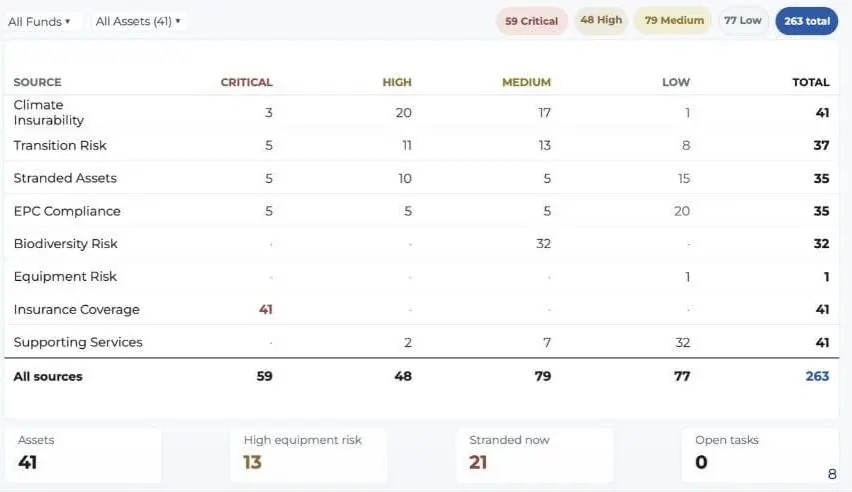
Sustainability and business risk software provider ESG Playbook has officially announced the launch of its specialized Real Estate Dashboard, a comprehensive tool designed to assist asset managers, institutional investors, and lenders in quantifying the financial implications of climate change, energy consumption, and necessary building retrofits. As the global real estate sector faces increasing pressure to decarbonize and comply with stringent environmental regulations, this new solution arrives as a critical instrument for assessing the "true cost" of property ownership and portfolio management in an era of climate volatility.
The launch marks a significant expansion of ESG Playbook’s suite of tools, shifting the focus from general corporate sustainability reporting to the granular, asset-level analysis required by the real estate industry. By integrating advanced data analytics with a vast database of global regulations and incentives, the dashboard aims to bridge the gap between environmental stewardship and financial performance.
The Financial Imperative: Quantifying the "True Cost" of Ownership
For years, real estate valuations were largely driven by location, occupancy rates, and net operating income (NOI). However, the emergence of "brown discounting"—the devaluation of buildings with poor environmental performance—has fundamentally altered the investment landscape. ESG Playbook’s new dashboard addresses this shift by allowing deal teams to rapidly screen large pipelines of potential acquisitions.
The platform enables users to see beyond the initial asking price of a property, identifying the capital expenditure (capex) required to bring a building up to modern energy standards or to meet future regulatory requirements. According to ESG Playbook, this allows investors and lenders to identify potential "red flags" and concerns earlier in the acquisition process, prioritizing properties that warrant deeper due diligence and excluding those that pose an existential risk to portfolio returns.
A standout feature of the solution is its ability to match specific retrofit plans with over 1,400 incentive programs, tax credits, and green loans across 52 different countries. This includes deep integration with regional programs such as the Inflation Reduction Act (IRA) in the United States and various European Union "Green Deal" funding mechanisms. By automating the identification of these subsidies, the dashboard helps asset managers offset the high costs of decarbonization, effectively turning climate risk management into a value-creation strategy.
AI-Assisted Screening and Stranded Asset Analysis
At the core of the new dashboard is an AI-assisted screening engine capable of processing high volumes of real estate opportunities. This system evaluates a wide array of data points, including:
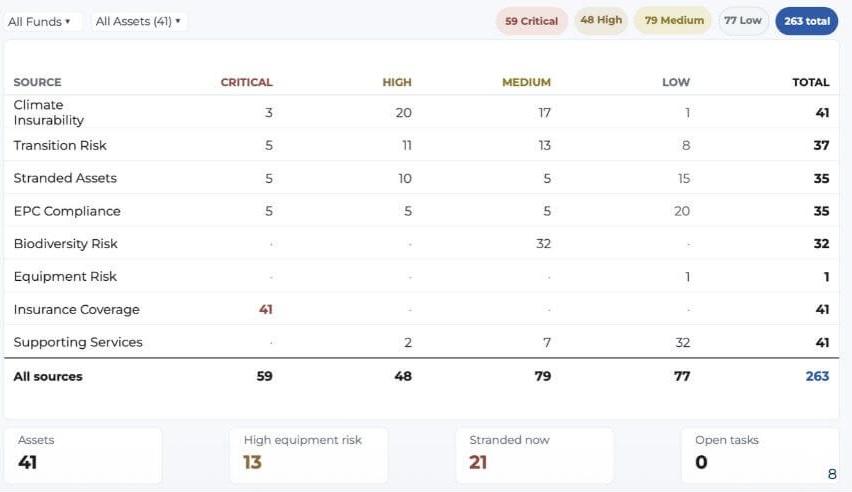
- Overall Risk and Strengths: A holistic view of an asset’s ESG profile.
- Data Gaps: Identifying where missing information might hide potential liabilities.
- Tenant and Rent Roll Sensitivity: Analyzing how energy costs and climate regulations might impact tenant retention and lease pricing.
- Comparable Transactions: Benchmarking assets against similar properties that have undergone green transitions.
One of the most pressing concerns for modern real estate investors is the risk of "stranded assets." A stranded asset is a property that loses significant value or becomes unmarketable because it no longer meets environmental standards or is too costly to insure. The ESG Playbook dashboard incorporates "stranded asset analysis" by projecting exactly when a building is likely to fall out of alignment with the Carbon Risk Real Estate Monitor (CRREM) decarbonization pathways.
By calculating the precise moment of "stranding," the tool allows managers to model various scenarios, including the cost of retrofit capex versus the potential "stranding discount" applied by the market. It also calculates "void risk"—the likelihood of a building remaining vacant due to its inability to meet energy performance certificate (EPC) requirements—and provides a climate-adjusted asset value.
Physical Risk and Surrounding-Area Resilience
While transition risk (the cost of moving to a low-carbon economy) is a primary concern, physical risk remains a direct threat to real estate infrastructure. The ESG Playbook dashboard provides a detailed analysis of physical hazards, such as flooding, wildfires, extreme heat, and sea-level rise.
Crucially, the tool goes beyond the individual asset to examine "surrounding-area resilience." This feature evaluates how climate hazards might affect the essential services, roads, and utilities that support a property. A building might be structurally sound and flood-proofed, but if the local power grid or access roads are vulnerable to extreme weather, the asset’s operational viability and value are compromised.
This data is further tied to insurability and insurance intelligence. As insurance premiums skyrocket in climate-vulnerable regions—and as some insurers pull out of markets entirely—the dashboard provides investors with a forward-looking view of insurance costs. This allows for more accurate long-term financial modeling and prevents "insurance shock" from eroding investment returns.
Navigating a Fragmented Global Regulatory Landscape
The real estate sector is currently navigating a complex web of local, national, and international regulations. From New York City’s Local Law 97, which imposes heavy fines on buildings that exceed carbon emissions limits, to the European Union’s Corporate Sustainability Reporting Directive (CSRD), the burden of compliance is heavier than ever.
ESG Playbook’s solution includes a global regulatory monitoring system that tracks benchmarking deadlines and carbon tax modeling. This ensures that asset managers are not caught off guard by shifting legal requirements. Furthermore, the dashboard connects directly to ESG Playbook’s existing carbon management tools, supporting reporting aligned with:

- The Greenhouse Gas (GHG) Protocol: For Scope 1, 2, and 3 emissions.
- TCFD and ISSB: Providing the climate-related disclosures required by financial regulators.
- SFDR and EU Taxonomy: Assisting European funds in classifying their investments as "green" or "sustainable."
- PCAF (Partnership for Carbon Accounting Financials): Specifically designed for lenders to report on their financed emissions, helping banks align their mortgage portfolios with net-zero targets.
Leadership Perspective: Future-Proofing Through Data
Sonia Zugel, CEO and Founder of ESG Playbook, emphasized that the era of vague sustainability claims is over. In the current market, climate data must be as rigorous and defensible as financial data.
"Real estate investors need to future-proof their portfolio for climate and transition risk with numbers they can defend," Zugel stated. "A deal team should be able to walk into an investment committee and say what the building will need, when it will need it, what funding can help pay for it, and where every figure came from."
Zugel’s comments reflect a broader industry trend where ESG is no longer viewed as a separate "impact" metric but as a fundamental component of fiduciary duty. For asset managers, the ability to provide transparent, data-backed evidence of a building’s resilience is becoming a prerequisite for raising capital from institutional investors like pension funds and sovereign wealth funds.
Broader Impact and Industry Implications
The launch of this dashboard comes at a pivotal time for the global real estate market. Buildings currently account for approximately 40% of global energy-related CO2 emissions. To reach net-zero goals by 2050, the International Energy Agency (IEA) suggests that most existing buildings will require deep energy retrofits.
However, the "split incentive" problem—where landlords pay for retrofits but tenants benefit from lower energy bills—has historically slowed progress. By quantifying the ROI of retrofits and identifying available subsidies, ESG Playbook’s tool helps resolve these economic frictions. It provides a roadmap for "green retrofitting" that aligns the interests of owners, tenants, and lenders.
For the banking sector, the dashboard serves as a vital tool for managing credit risk. As central banks begin to incorporate climate stress tests into their oversight, commercial lenders must understand the carbon footprint of their loan books. Tools like this enable banks to offer "sustainability-linked loans," where interest rates are tied to the building’s energy performance improvements.
In conclusion, the ESG Playbook Real Estate Dashboard represents a shift toward the "financialization" of climate risk. By providing a granular, asset-level view of energy performance, regulatory exposure, and physical vulnerability, it equips the real estate industry with the data necessary to navigate an increasingly complex and warming world. As the "true cost" of carbon becomes a standard line item on the balance sheet, such tools will likely become indispensable for anyone looking to buy, sell, or finance property in the 21st century.
