

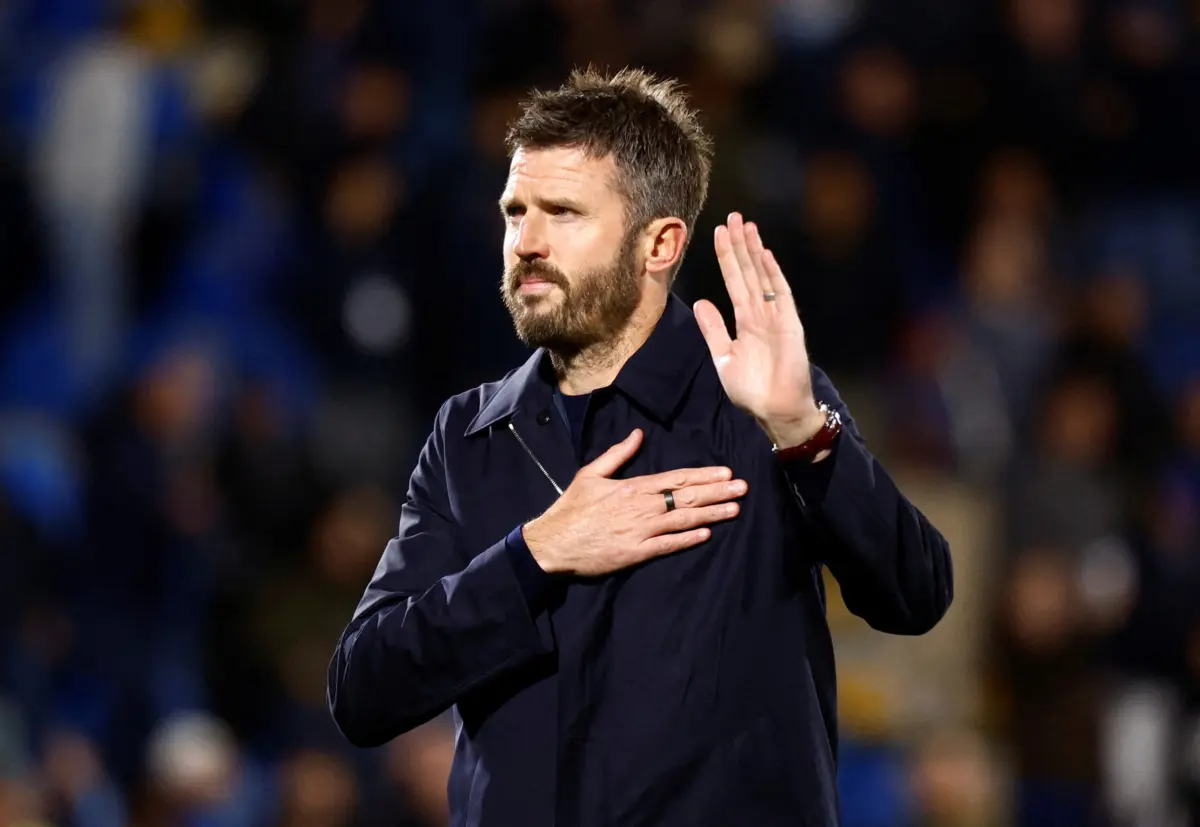
Manchester United manager Michael Carrick has dismissed mounting rumors regarding his job security as his side prepares for a critical Champions League league phase encounter against Roma. The fixture comes at a time when the club is navigating its most turbulent period in nearly four decades, a crisis that has left the Red Devils reeling both domestically and on the European stage. Despite the immense pressure stemming from a nine-match winless streak, Carrick remains steadfast, insisting that his primary focus is on tactical preparation rather than the noise surrounding his potential dismissal.
The atmosphere at Old Trafford has grown increasingly tense following a 2-0 defeat at Chelsea on Saturday, a result that further exposed the vulnerabilities of a squad struggling for identity and consistency. As it stands, Manchester United occupies a precarious position just outside the Premier League relegation zone, saved only by goal difference. With a mere seven points from their opening nine fixtures and only one victory since the campaign began, the statistical reality of United’s decline is stark. This represents the club’s worst run of form in 38 years, drawing uncomfortable parallels to the difficult period of the late 1980s.
The Magnitude of the Roma Challenge
Tuesday night’s visit of Roma is widely viewed by pundits and fans as a potential "make-or-break" moment for the Carrick era. The Italian side arrives in Manchester in formidable form, currently enjoying an unbeaten start to their Serie A campaign. The Giallorossi have been particularly lethal in front of goal, netting 16 times in their last four domestic matches. Their only setback this season came in a high-octane 4-3 defeat to Real Madrid in the Champions League at the Stadio Olimpico on October 14, a match where they proved they could compete with Europe’s elite.
For Carrick, the task is not merely about survival but about halting a slide that threatens to derail the club’s entire season. During his pre-match media conference, the manager was asked directly about the speculation regarding his future. He responded with the calm demeanor that characterized his playing career. "Speculation has no influence on how we prepare or on the game," Carrick stated. "We cannot wait for it. That is all I am focused on. What happens after, happens. Whatever direction it goes in."
This stoic approach is being tested by the reality of the Champions League league phase. Under the new format, every point is vital for securing a spot in the knockout rounds. While United’s solitary win of the season—a 4-0 thrashing of Sabah on September 10—provided a brief glimmer of hope, subsequent results have left them in a position where another defeat could prove catastrophic for their European ambitions.
A Season of Historical Struggles: The Chronology of Decline
The current crisis did not emerge in a vacuum but is the result of a steady erosion of form that began shortly after the opening weeks of the season. To understand the gravity of the situation, one must look at the timeline of United’s recent performances:

- August 2026: The season began with cautious optimism, but early draws hinted at an inability to close out games.
- September 10, 2026: United secured a 4-0 victory against Sabah at Old Trafford. At the time, it appeared to be a turning point, with the attack clicking and the defense remaining resolute.
- Mid-September to October 2026: A series of draws and narrow losses followed. The team’s inability to maintain leads became a recurring theme.
- October 10, 2026: A frustrating clash with Tottenham Hotspur saw United dominate possession but fail to score, highlighting a lack of clinical finishing in the final third.
- October 26, 2026: The 2-0 loss at Stamford Bridge marked the low point. A quickfire red card for Lisandro Martinez, accompanied by a penalty concession, effectively ended any hope of a United comeback and left the team hovering near the relegation zone.
The 38-year statistic is perhaps the most damning. Not since the 1988-89 season has a Manchester United side looked so vulnerable over such a sustained period. During that era, the club eventually found stability, but the modern football landscape is far less patient, particularly with the financial implications of missing out on the Champions League knockout stages.
Tactical Deficiencies and Player Commitment
In the aftermath of the Chelsea defeat, much of the criticism has been leveled at the team’s defensive discipline. Lisandro Martinez, a player usually praised for his tenacity, has found himself at the center of the storm after his dismissal at Stamford Bridge. However, Carrick was quick to defend his center-back, emphasizing that individual errors should not be mistaken for a lack of desire.
"I have no concerns about Martinez’s commitment," Carrick told reporters. "Things happen in football. Sometimes you make mistakes. The commitment is not an issue. The dressing room is in a good place. The commitment of the players to the club, to me, to each other—do not question it at all. We need to play better, we can make better decisions, but the commitment is not a thing at all."
The manager’s insistence that the "dressing room is in a good place" contrasts sharply with the visual evidence on the pitch, where players have often appeared dejected during the winless run. Carrick acknowledged the need for immediate improvement, noting that while the team has shown "bursts" of quality, they have failed to capitalize on their opportunities. "We have to find a way out of this moment. We have done a lot of good things, we just couldn’t capitalise on it, but we will do. We have to keep doing the right things," he added.
The Voice of the Dressing Room: Mainoo’s Support
Adding weight to Carrick’s claims of a united squad is Kobbie Mainoo. The young midfielder, who has become a focal point of the team’s transition, spoke passionately about his loyalty to the manager. Having risen through the ranks at Carrington, Mainoo represents the bridge between the club’s history and its future.
"I have been at this club for a long time and I know there’s always going to be ups and downs," Mainoo said. "It’s never going to be plain sailing to the top, so you expect bumps. The best thing about it is that you’re able to bounce back from them."
Mainoo’s comments reflect a deep-seated respect for Carrick, who has mentored the youngster since his appointment. The midfielder credited Carrick’s experience as a former player and his understanding of the club’s heritage as vital assets during this difficult period. "I feel like our way to repay the manager is to be behind him on and off the pitch and fight as a team. I’m grateful to the boss for putting trust in me as soon as he came in and giving me all the advice that he has."

Broader Implications and Statistical Analysis
The implications of the Roma match extend far beyond the immediate three points. From a financial perspective, Manchester United’s business model is heavily predicated on consistent participation in the later stages of the Champions League. Failure to progress from the league phase would result in a significant loss of broadcasting revenue and prize money, potentially impacting the club’s ability to maneuver in future transfer windows.
Statistically, the decline is evident in several key areas:
- Expected Goals (xG) vs. Actual Goals: United’s xG suggests they should be scoring more, but a conversion rate of less than 10% in their last five league matches has proved costly.
- Defensive Vulnerability: The team has conceded 14 goals in their last nine matches, with a high percentage of those coming from individual errors or set-pieces.
- Midfield Control: Despite Mainoo’s emergence, United have struggled to control the tempo of games, often being overrun by high-pressing teams like Chelsea and Roma.
Roma’s tactical setup under their current management poses a specific threat to United’s fragile defense. Utilizing a high-intensity system that focuses on rapid transitions, the Giallorossi are adept at exploiting the spaces left behind by attacking full-backs—a known weakness in United’s current configuration.
A Path Forward
As the clock ticks toward Tuesday’s kickoff, the narrative surrounding Manchester United remains one of a giant in distress. Carrick’s tenure, which began with the hope of a tactical evolution, is now defined by a desperate search for results. His philosophy of "staying strong and finding solutions" will be put to its ultimate test against a Roma side that smells blood.
"A lot of people could do my job when you are winning games," Carrick remarked, acknowledging the reality of elite-level management. "It is about finding solutions, finding answers, staying strong, leading right, and getting the best out of the players. We have to keep pushing for that. I love being here, I love working with the players. The struggles, the challenges, that just drives you on to want even more."
Whether that drive is enough to overcome a rampant Roma and silence the speculation remains to be seen. In the high-stakes world of European football, sentiment and commitment are often secondary to the cold, hard reality of the scoreboard. For Michael Carrick and Manchester United, the time for talk has passed; only a victory will suffice to alter the current trajectory of a season on the brink of collapse.
