

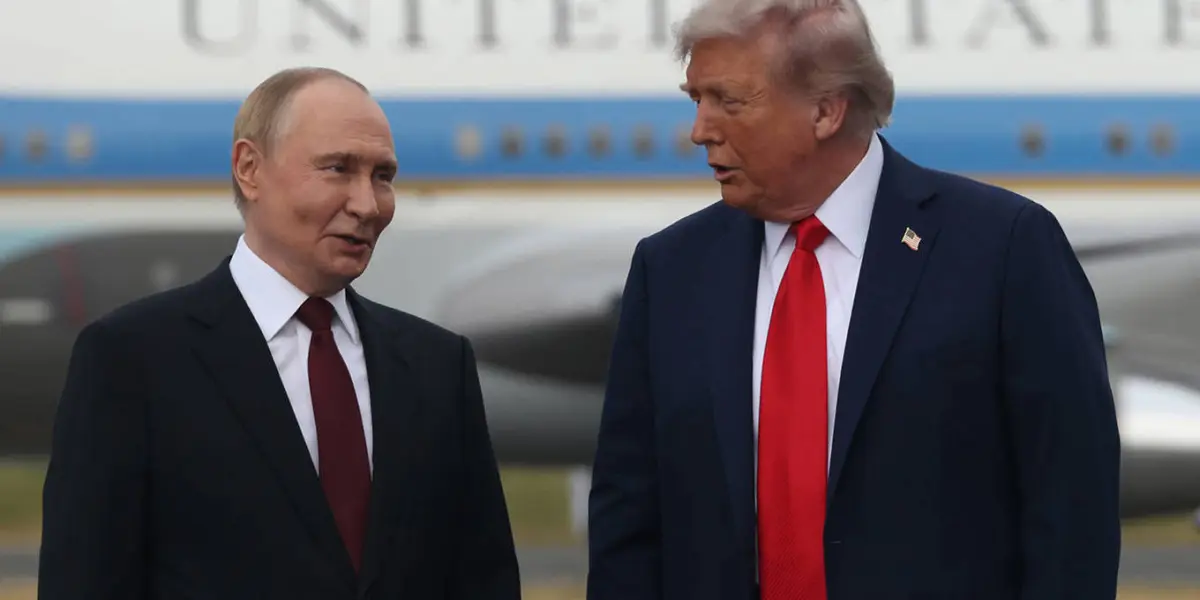
Unable to win his foolish war against Iran, Donald Trump blames its consequences on Ukraine and uses the lie to justify ending sanctions against Russia, thereby extending that war as well. His diesel deal with the Kremlin is less about lowering gas prices for Americans and more about submitting to Vladimir Putin.
TORONTO—Earlier this year, when I first described the guiding principle of Donald Trump’s foreign policy as superpower suicide, it was already obvious that the US President’s war of whimsy against Iran was a strategic catastrophe. Five months on, this failure is all the more glaring. Worse, it has provided Trump with another pretext to reward Russia. Weakness has begotten more weakness.
The Ill-Advised Iranian Campaign
The Trump administration’s confrontational stance towards Iran, initiated with the withdrawal from the Joint Comprehensive Plan of Action (JCPOA) in May 2018, has escalated into a sustained campaign of economic and military pressure. This policy, driven by a desire to cripple Iran’s nuclear program and curb its regional influence, has instead precipitated a series of escalations and unintended consequences. The initial rationale for withdrawing from the JCPOA was to negotiate a "better deal," one that would address Iran’s ballistic missile program and its support for regional proxies, elements not covered by the original agreement. However, these diplomatic objectives have proven elusive, replaced by a strategy of maximum pressure that has, by many accounts, pushed Iran further away from cooperation and closer to potential nuclear proliferation.
The economic toll on Iran has been severe. Sanctions have targeted its oil exports, a critical source of revenue, leading to significant currency devaluation and inflation. The International Monetary Fund (IMF) projected a contraction in Iran’s GDP for several consecutive years following the re-imposition of sanctions. For instance, in 2019, the IMF estimated a GDP contraction of 6.3% for Iran, a stark contrast to the modest growth observed in the years prior to the US withdrawal from the JCPOA. This economic strain has fueled internal dissent and exacerbated social inequalities, creating a volatile domestic environment.
The military dimension of this policy has been equally fraught with peril. The killing of Qassem Soleimani, a prominent Iranian general, in January 2020, marked a significant escalation, bringing the two nations to the brink of direct conflict. While the immediate crisis was averted, the incident underscored the high-risk nature of the administration’s approach. The subsequent Iranian retaliation, which included missile strikes on US bases in Iraq, demonstrated Iran’s capacity to inflict damage and highlighted the potential for a wider regional conflagration.
Shifting Blame: The Ukraine Connection
In an unexpected and arguably disingenuous move, President Trump has begun to link the negative economic repercussions of his Iran policy, particularly rising global oil prices, to the ongoing conflict in Ukraine. This narrative, often amplified through his public statements and social media, suggests that sanctions against Russia, imposed in response to its 2014 annexation of Crimea and subsequent actions in eastern Ukraine, are somehow exacerbating global energy market instability, which he then attributes to the pressure on Iran. This linkage serves a dual purpose: to deflect criticism from his own administration’s handling of the Iranian situation and to build a case for easing pressure on Russia.
The reality of global energy markets is far more complex than this simplistic attribution. While geopolitical events, including conflicts and sanctions, invariably influence oil and gas prices, the administration’s Iran policy has had its own distinct impact. The removal of Iranian oil from the global market, due to sanctions, has reduced overall supply. Simultaneously, the sustained conflict in Ukraine has disrupted supply chains and created significant uncertainty, contributing to price volatility. However, to directly attribute the consequences of the Iran sanctions to Ukraine, and then use that as a justification to weaken sanctions on Russia, represents a significant distortion of cause and effect.
The Strategic Pivot to Russia
The core of President Trump’s strategy appears to be a willingness to engage in a transactional relationship with Russia, even at the expense of long-standing US foreign policy principles and the interests of its allies. The proposed "diesel deal" with the Kremlin, framed as a measure to lower gasoline prices for American consumers, is seen by critics as a concession that significantly benefits Russia’s economy and bolsters its geopolitical standing.
The details of such a deal, if consummated, would likely involve the US either directly or indirectly facilitating the sale of Russian diesel fuel. Given that Russia is a major energy producer, its economic stability is closely tied to its oil and gas exports. Easing sanctions on Russian energy products, or creating new avenues for their sale, would provide a much-needed financial boost to the Russian state. This comes at a time when Russia’s economy has been under considerable strain, partly due to Western sanctions imposed following its actions in Ukraine.
The implications of such a move are profound. It would signal a significant shift in US foreign policy, potentially undermining decades of efforts to isolate Russia and counter its assertiveness on the global stage. Moreover, it would embolden Vladimir Putin, who has consistently sought to challenge the US-led international order. The argument that this is primarily about lowering gas prices for Americans overlooks the broader strategic implications. While energy prices are a legitimate concern for consumers, the proposed solution appears to prioritize short-term economic relief over long-term geopolitical stability and the commitment to democratic values.
Historical Context and Geopolitical Underpinnings
To understand the current dynamics, it is crucial to recall the historical context of US-Russia relations. Following the collapse of the Soviet Union, the United States played a significant role in supporting Russia’s transition to a market economy. However, as Vladimir Putin consolidated power, a more adversarial relationship emerged, marked by Russia’s actions in Georgia (2008), Ukraine (2014 onwards), and its alleged interference in Western elections.
The sanctions regime against Russia has been a cornerstone of Western policy aimed at penalizing these actions and deterring further aggression. These sanctions have targeted key sectors of the Russian economy, including finance, energy, and defense, and have been coordinated with European allies. Any unilateral move by the US to dismantle or significantly weaken these sanctions would create divisions within the Western alliance and weaken the collective leverage against Russia.
The war in Ukraine, now in its protracted phase, has become a defining issue in international relations. The ongoing conflict has led to immense human suffering, a refugee crisis, and significant economic disruption across Europe. The international community, led by the US and its allies, has provided substantial financial and military assistance to Ukraine, while simultaneously imposing stringent sanctions on Russia. President Trump’s apparent willingness to decouple the US stance on Russia from the broader international consensus raises serious questions about his commitment to collective security and democratic solidarity.
Expert Analysis and Reactions
The Trump administration’s approach has drawn sharp criticism from foreign policy experts and former officials. Many view the pivot towards Russia as a dangerous miscalculation that would embolden authoritarian regimes and undermine US credibility.
Dr. Evelyn Reed, a senior fellow at the Atlantic Council specializing in Eurasian security, stated, “The idea of easing sanctions on Russia, particularly in the context of an ongoing conflict in Ukraine and a destabilizing war in Iran, is deeply concerning. It signals a willingness to prioritize transactional gains over fundamental principles of international law and human rights. This could have devastating consequences for Ukraine and further embolden Russian aggression.”
Similarly, former Ambassador to Ukraine, John Evans, commented, “The sanctions regime against Russia was built on a broad international consensus. Any unilateral action by the US to weaken these sanctions would be a gift to Moscow and a blow to our allies. It would suggest that the US is no longer a reliable partner in defending shared democratic values.”
The potential implications of such a policy shift extend beyond the immediate economic and geopolitical consequences. It could signal a broader retreat from global leadership and a fracturing of the post-World War II international order. For Ukraine, it would represent a significant setback, potentially weakening its ability to defend itself and negotiate from a position of strength. For the broader international community, it would raise questions about the future of collective security and the effectiveness of international institutions in addressing global challenges.
The Broader Impact and Implications
The proposed "diesel deal" with Russia, if realized, would represent a significant departure from established US foreign policy and could have far-reaching implications:
- Weakened Western Alliance: Unilateral US actions that deviate from coordinated sanctions policies would strain relations with European allies, potentially weakening NATO and the broader transatlantic partnership.
- Empowerment of Russia: Easing sanctions would provide Russia with much-needed financial resources, enabling it to sustain its military operations and potentially project greater influence in its neighborhood and beyond.
- Undermining Ukraine’s Sovereignty: A less unified international front against Russia could diminish Ukraine’s leverage in ongoing peace negotiations and its ability to secure its territorial integrity.
- Global Energy Market Volatility: While framed as a way to lower prices, such a deal could create new market distortions and dependencies, with unpredictable long-term consequences.
- Erosion of US Credibility: A perceived abandonment of core foreign policy principles and allies could damage the US’s reputation as a reliable and principled global leader.
The narrative that President Trump is attempting to weave—linking the consequences of his Iran policy to Ukraine and using that as a justification to appease Russia—is a complex and strategically driven one. The evidence suggests that the failures in Iran have not led to a reassessment of US strategy but rather to a desperate attempt to pivot towards a transactional relationship with Russia, one that could have profound and detrimental consequences for global stability and the long-term interests of the United States. The "diesel deal" is not merely an economic transaction; it is a geopolitical gambit with potentially devastating implications.
