

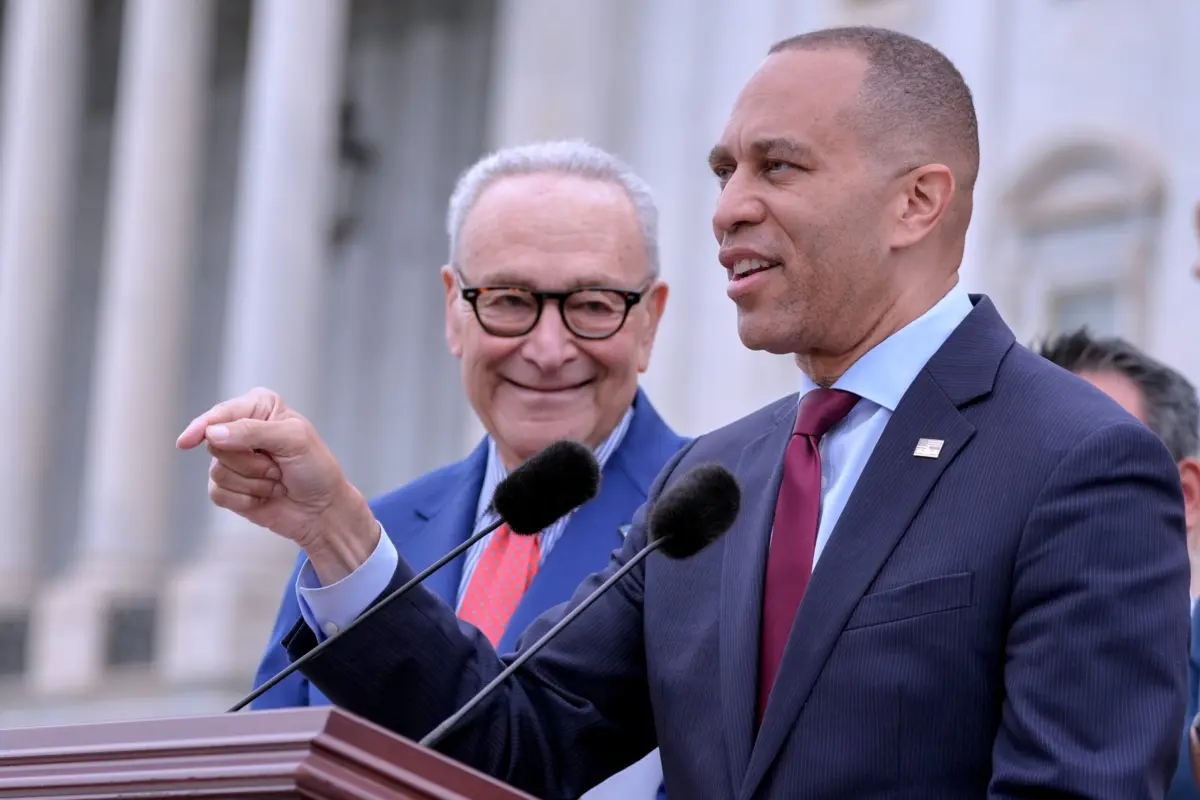
Over a week after Democrats rode a historic wave of support to retake the United States Congress, divisions within the party threaten to undermine its newfound political momentum, creating a complex internal struggle for leadership ahead of the new legislative session. Despite growing calls for a fundamental shift in direction and Congressional leadership, veteran lawmakers Chuck Schumer and Hakeem Jeffries appear poised to retain their positions at the helm of their respective US Senate and House caucuses, setting the stage for a critical period of internal realignment or consolidation.
After amassing the most Democratic power in Washington since 2009, the two New Yorkers are seeking to retain their leadership positions as their party prepares to take control of both chambers in January. Schumer, the US Senate’s 75-year-old minority leader, is vying to lead Democrats’ new majority in the chamber, a post he previously held during Joe Biden’s presidency. On the other side of the US Capitol, the 56-year-old Jeffries, as the current minority leader in the US House, is seeking the top role of speaker, placing him second in the line of succession for the US presidency.
The prospect of keeping Schumer and Jeffries in charge has, however, frustrated segments of the Democratic Party, exposing long-running tensions between lawmakers who advocate for continuity and stability, and those who believe their recent midterm victories represent a mandate to fundamentally reshape the party’s priorities and embrace more ambitious progressive policies. This internal friction highlights a deeper ideological battle within the party, even as it celebrates its significant electoral achievements.
A Historic Victory and the Mandate for Continuity
The Democratic Party’s performance in the November 2026 midterm elections was undeniably robust, defying historical trends that often see the president’s party lose ground. The party’s ability to not only defend vulnerable seats but also flip several Republican-held districts and states has been widely lauded as a monumental achievement. This electoral success, particularly in the Senate, has become the primary argument for maintaining the current leadership structure.
Schumer’s supporters argue that his strategic leadership was instrumental in securing at least eight Republican-held Senate seats, including critical victories in traditionally conservative states. This outcome is poised to give Democrats as many as 56 seats in the next Congress, a substantial majority not seen since former President Barack Obama’s first term in office, which began in 2009. This level of control offers the party a significant opportunity to advance its legislative agenda, albeit with the persistent challenge of the Senate’s filibuster rule.

Senator Ruben Gallego, a Democrat from Arizona, succinctly captured this sentiment, telling reporters on Tuesday, November 10, with Schumer by his side, “When the manager takes you to the World Series, you give him another contract. And this has been a really good election cycle for us.” This analogy underscores the view that successful leadership should be rewarded, particularly after such a decisive electoral performance.
Schumer’s role extended beyond mere campaign management; he played a central part in recruiting formidable candidates capable of competing effectively in states where Democrats have historically struggled. Notable examples include former Ohio Senator Sherrod Brown, who secured a return to the US Senate, and former North Carolina Governor Roy Cooper, who flipped a crucial US Senate seat in a swing state. These recruitment efforts, coupled with robust fundraising and strategic messaging, are credited by allies with helping the party reclaim the US Senate majority.
Adam Jentleson, a longtime US Senate aide and author of "Supermajority: How Democrats Can Build Lasting Power," affirmed that Schumer’s electoral success makes it exceedingly difficult for critics to mount a successful challenge. “It’s hard to argue with somebody who just oversaw the biggest election the Democrats have had since Watergate,” Jentleson stated during an interview with public radio station WBUR earlier in November. The reference to Watergate, a period of immense political upheaval and Democratic ascendancy in the 1970s, highlights the perceived scale of the recent victory.
Jentleson further explained that the only stakeholders who truly matter in leadership elections are the members of the Democratic caucus itself. He posited that lawmakers who had recently benefited from the midterm results would have little incentive to remove the very person who helped deliver those victories, creating a strong incumbent advantage. Senator Kirsten Gillibrand of New York, who chairs the Democratic Senatorial Campaign Committee, echoed this perspective, crediting Schumer’s candidate recruitment and fundraising efforts for the party’s success. “That takes vision. It takes clarity of thought. It takes strategic leadership,” she remarked.
Schumer himself has expressed unwavering confidence in his ability to retain the position. In an interview with The Washington Sun on Wednesday, November 12, he stated that he had already secured more than enough backing from his colleagues. “I am going to be elected leader, OK, and we’re united on the issues,” Schumer confidently told the Sun. “We’re united.” This assertion suggests that despite public dissent, the internal party machinery largely supports his continued leadership.
Schumer Faces a Progressive Challenge
Despite the celebratory atmosphere surrounding the electoral gains, not every Democrat believes last week’s victories are sufficient to anoint Schumer as the party’s unchallenged leader in the Senate for the next Congress. A significant faction within the Democratic base, particularly progressives, has intensified calls for new leadership, arguing that the party needs a more dynamic and ideologically aligned figure to lead its majority.

On Thursday, November 13, Senator Chris Van Hollen of Maryland announced he would mount a direct challenge for the role of Senate Majority Leader. Van Hollen’s decision injects a formal contest into what Schumer had hoped would be a largely ceremonial reaffirmation of his leadership. Van Hollen has garnered attention for actions that resonate with the progressive wing, such as his high-profile travel to El Salvador at the start of US President Donald Trump’s second term to meet with Kilmar Abrego Garcia, a constituent who had been deported despite a judge’s ruling barring his removal. This act, according to a senior Senate Democratic aide who spoke with Al Jazeera on condition of anonymity, exemplified “the fight Schumer just doesn’t have,” suggesting a perceived lack of aggressive advocacy from the current leader on certain issues.
Van Hollen articulated his rationale for challenging Schumer during a Thursday appearance on MSNOW, stating, “This is not about any one individual, but it is about answering the call of the American people.” He added that US voters had sent a clear message to “reject the status quo and to reject business as usual,” implying that Schumer’s leadership represents an outdated approach.
However, another Senate aide, also speaking anonymously to Al Jazeera, suggested that Van Hollen’s bid might be a strategic maneuver aimed more at extracting concessions from Schumer rather than securing the leadership position itself. These concessions could include a promise from Schumer to serve as a short-term “bridge” to a new generation of Democratic leadership, signaling a pathway for younger, more progressive voices to eventually assume top roles. This tactical challenge reflects the internal dynamics of a party grappling with its generational and ideological future.
An analysis by Al Jazeera revealed that while 12 Democratic senators have publicly committed to backing Schumer in next month’s leadership election, at least 10 senators, including independent Bernie Sanders, who caucuses with the Democrats, have stated they will not support him. Crucially, only half of those opposed to Schumer’s leadership have publicly endorsed Van Hollen’s challenge, indicating a fractured opposition that may struggle to coalesce around a single alternative.
Senator Bernie Sanders, a prominent voice for the progressive movement, articulated his concerns in an interview with The Nation published on Wednesday, November 12. While acknowledging a long-standing personal relationship and even liking Schumer, Sanders argued that personal relationships should not dictate who leads the party. “In this moment in American history, Chuck’s views are way out of touch with where the American people are at — and especially with where [the base of] the Democratic Party is,” Sanders asserted. He contended that Schumer was not sufficiently in tune with Democratic voters on key issues, advocating for a new and more ambitious direction for the party.
Michigan Senator Elissa Slotkin has also openly questioned Schumer’s leadership, calling for a concrete plan outlining how Democrats intend to utilize their newly won congressional power. Slotkin went further on Tuesday, November 11, suggesting to reporters at the US Capitol that senators might consider withholding a quorum—the minimum number of lawmakers required to conduct official business—if Schumer runs unopposed. Her condition was that he must first present a plan that provides members a meaningful voice in setting the party’s priorities, highlighting a demand for greater inclusivity and a more defined legislative agenda from the leadership.
Georgia Senator Raphael Warnock has similarly declined to commit to supporting Schumer. Speaking to CNN on Tuesday, November 11, Warnock stated that Democrats are at an “inflection point” and that any senator who believes they should lead deserves an opportunity to make their case, underscoring the sentiment that a leadership contest is a healthy and necessary part of the party’s evolution.

Despite these public expressions of dissatisfaction, the mechanism for leadership selection—a private ballot requiring only a simple majority of the caucus—suggests that public posturing might not translate directly into votes. Tre Easton, vice president for public policy at the Searchlight Institute and a former deputy chief of staff for Democratic Senator John Fetterman, questioned the timing of the push against Schumer. Easton argued that calls for new leadership would have carried more weight following Democratic losses, rather than immediately after significant electoral successes. “The job of the leader in each legislative chamber here in the U.S. isn’t to articulate a vision for the party,” Easton stated in a social media post. “It’s to keep each respective caucus together and count votes. Dassit.” This perspective emphasizes the practical, tactical role of a legislative leader over a purely ideological one.
Jeffries Faces a Different Kind of Challenge in the House
The outlook for Representative Hakeem Jeffries, who is seeking to become the first Black speaker of the House when the new Congress convenes on January 3, 2027, appears considerably clearer. Unlike Schumer, Jeffries does not face a prominent, declared challenger for his leadership position, despite criticism from some progressives regarding his perceived moderate stance on issues such as former President Trump and his long-standing support for Israel.
Jeffries’s strong backing from moderate Democrats has been particularly visible and vocal. The New Democrat Coalition, a influential group of Democratic centrists representing 142 current and newly elected lawmakers, issued a statement on Tuesday, November 11, unequivocally endorsing his bid for speaker. “Hakeem Jeffries is the right person at the right time to lead our party,” the group declared. “He’s smart, strategic, and action-oriented, with strong relationships across the Democratic caucus.” The coalition further affirmed its enthusiastic support, stating it “can’t wait to vote for Hakeem Jeffries to be Speaker of the House on January 3, 2027.” This unified endorsement from a substantial bloc of the caucus signals a significant advantage for Jeffries.
However, this robust support from the party’s moderate wing has not entirely eliminated dissatisfaction among progressives. Representative Pramila Jayapal, a former chair of the Congressional Progressive Caucus, has publicly stated she is withholding her support for Jeffries unless he commits to advancing Medicare for All, a proposal to establish a government-funded universal healthcare system. Jayapal’s stance highlights the ongoing tension between the pragmatic need for unity and the ideological demands of the party’s left flank.
Jayapal has also acknowledged that the current absence of an alternative candidate significantly complicates the leadership debate for progressives. “You can’t beat somebody with nobody,” the Washington state Democrat told Talking Points Memo, implying that the emergence of a viable challenger would fundamentally alter the calculations of lawmakers considering whether to support Jeffries. Similarly, Representative Alexandria Ocasio-Cortez of New York, when asked by CNN whether she supported Jeffries, responded, “The race is unopposed. Yeah,” suggesting that the lack of an alternative candidate was a decisive factor in her apparent acquiescence.
The internal tensions in the US House have also been starkly illustrated by the case of Don Leonard, an incoming Democratic congressman from Ohio. Leonard has publicly stated he will withhold his support for Jeffries unless the party commits to specific policy changes, notably calling for an end to US support for Israel and the war in Iran. In a video posted to social media, Leonard alleged that senior House Democrats threatened to make his life a “living hell” in Washington and undermine his chances of re-election in 2028 if he continued to attach conditions to his support for Jeffries. While he has not identified the lawmakers involved and the allegations have not been independently verified, the incident underscores the intense pressure applied to maintain party unity. House Democratic Caucus Chair Pete Aguilar told reporters on Tuesday, November 11, that he was unaware of which senior Democrats Leonard was referring to.

Jeffries, who has denied reports that US House Democrats have been receiving calls to oppose his bid for the speakership, addressed the frustrations within the party over his leadership on Thursday, November 13. “We take nothing for granted, because all of us in the House of Representatives are on a two-year employment contract,” Jeffries stated. “And we have to continue to make our case both with respect to our track record up until this point, as well as, perhaps even more importantly, our vision for the future.” This statement indicates an awareness of the internal challenges and a commitment to articulating a compelling vision to solidify his support.
The Road Ahead: Governing Challenges and Party Unity
The leadership contests are scheduled for November 18 and 19 for House Democrats, and at an unannounced date in December for Senate Democrats. If elected, both Schumer and Jeffries will likely continue to face competing demands from progressives seeking more aggressive action on a range of issues—from climate change to social justice and foreign policy—and from moderates representing districts and states where a more centrist approach may be politically imperative for retaining power.
These internal dynamics will inevitably shape the Democratic legislative agenda. Even with control of both chambers, Democrats will not command the 60 Senate votes generally required to overcome a filibuster, meaning they will need Republican support for much of their significant legislation. This reality necessitates a strategy of compromise and bipartisan negotiation, which can be at odds with the demands of the party’s most ideologically driven factions. The challenge for Schumer and Jeffries will be to unite their diverse caucuses while simultaneously seeking common ground with Republicans, a delicate balancing act that could define the effectiveness of the new Congress.
The implications extend beyond legislative outcomes, potentially affecting the party’s messaging and electoral strategy for future cycles, including the 2028 presidential election and subsequent midterms. How Schumer and Jeffries manage these internal tensions—whether through firm leadership, strategic concessions, or fostering genuine consensus—will determine the long-term health and political viability of the Democratic Party. For now, however, the party’s significant electoral gains provide Schumer and Jeffries with a powerful argument for continuity and stability in leadership.
As Schumer himself reiterated in an X post on Thursday, November 13, “I welcome any discussion about the future of our caucus and the important work ahead. I’m proud of what we’ve accomplished together—55 seats and counting is an amazing result—and I have the votes to continue serving as Democratic Leader.” This sentiment underscores the immediate focus on leveraging electoral success to consolidate power, even as deeper questions about the party’s direction and future leadership loom large. The coming weeks will be crucial in determining whether the Democrats can translate their electoral triumph into unified governance or if internal divisions will prove a significant impediment.
