

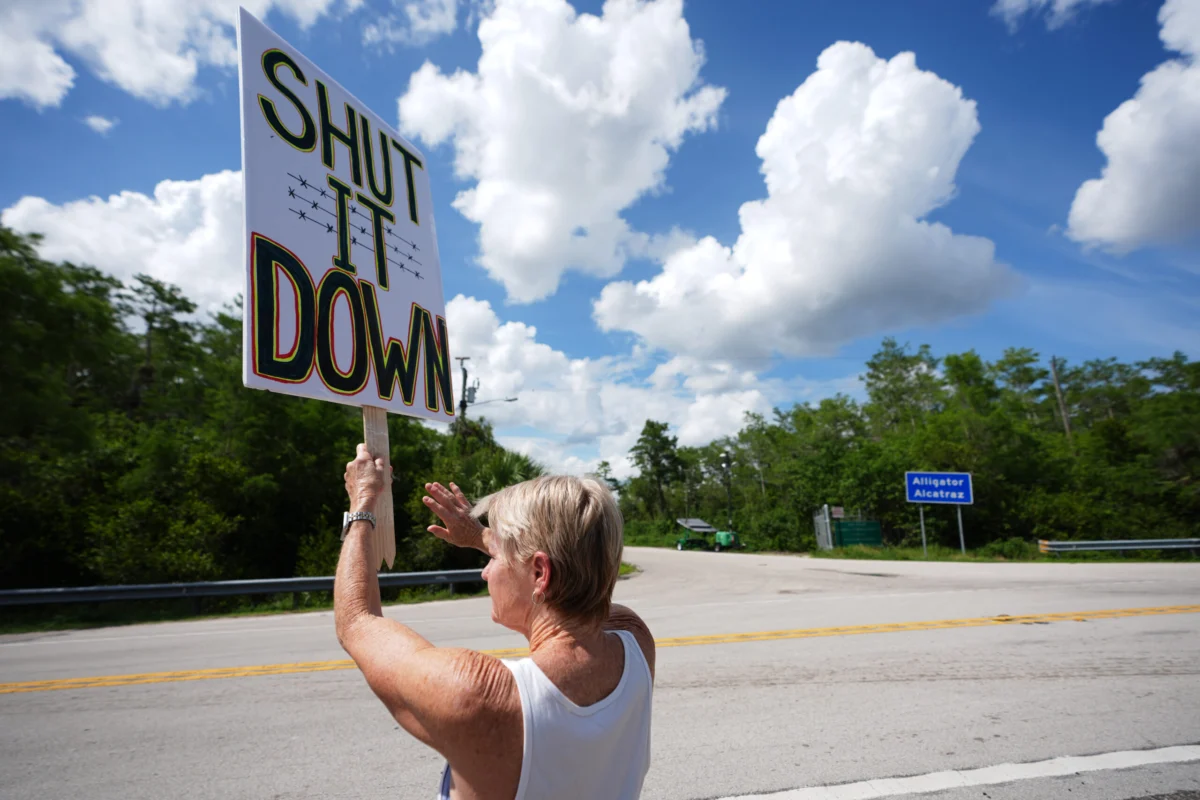
The notorious "Alligator Alcatraz" immigrant detention facility, located deep within Florida’s environmentally sensitive Big Cypress Natural Preserve, has been effectively shuttered by the United States government, with all detainees reportedly transferred out. The closure follows months of intense scrutiny, mounting human rights complaints, and escalating legal challenges over the facility’s remote location, challenging conditions, and significant operational costs. The Department of Homeland Security (DHS) cited the impending Atlantic hurricane season as the immediate impetus for the transfers, a decision that ironically underscored many of the environmental vulnerabilities critics had highlighted since its inception.
The Closure and Official Rationale
On Wednesday, the DHS confirmed that all individuals held at the state-run "Alligator Alcatraz" facility had been moved to other detention centers. Department spokesperson Lauren Bis, in a statement to The Associated Press, affirmed the administration’s rationale: "For the safety of the illegal alien detainees, we transferred them to other facilities." However, Bis refrained from disclosing the exact number of individuals transferred or their specific destinations, nor did she explicitly confirm whether the facility’s closure was permanent. Despite this official ambiguity, reports of its impending cessation of operations had been circulating for months, fueled by leaks from anonymous officials to outlets like The New York Times, which highlighted the exorbitant maintenance costs associated with the isolated site.
The timing of the transfers, coinciding with the official start of the Atlantic hurricane season (June 1st to November 30th), offered the administration a seemingly practical justification. Yet, for many human rights advocates and environmental groups, this reasoning rang hollow. They argued that the very dangers posed by Florida’s intense weather—heat, humidity, heavy rainfall, and the threat of powerful hurricanes—were precisely the concerns they had raised when the facility was first proposed and subsequently opened. The announcement of the final transfers occurred as the 2026 Atlantic hurricane season saw its first named storm, Tropical Storm Arthur, develop in the Gulf of Mexico, further emphasizing the meteorological risks inherent to the facility’s location.
A Brief History of ‘Alligator Alcatraz’
The concept of "Alligator Alcatraz" emerged from a broader push by the administration of President Donald Trump for stricter immigration enforcement and mass deportations during his second term. Announced on June 19, 2025, and opening its gates barely a month later in July 2025, the facility quickly became a symbol of the administration’s controversial approach to immigration. Florida Governor Ron DeSantis, a staunch ally and former rival in the 2024 presidential race, had actively sought to deploy state resources to support federal immigration efforts, making Florida a key battleground in the national debate over border security.
The facility’s provocative name, "Alligator Alcatraz," was a deliberate nod to the infamous Alcatraz Island prison in San Francisco Bay, a maximum-security federal penitentiary known for its inescapable location. The Florida iteration was similarly designed to leverage its natural surroundings as a deterrent. Florida Attorney General James Uthmeier infamously articulated this strategy, stating, "If people get out, there’s not much waiting for them other than alligators and pythons. Nowhere to go. Nowhere to hide." This statement, widely condemned for its dehumanizing implications, highlighted the facility’s harsh philosophy.
Upon its opening, President Trump personally toured the site alongside Governor DeSantis, underscoring the political significance attached to the project. The facility, constructed on an abandoned airstrip within the Big Cypress National Preserve, was initially billed as a temporary solution. Officials claimed its "aluminium-frame structure" was capable of withstanding winds equivalent to a Category 2 hurricane, an assertion that many experts and advocates viewed with skepticism given the extreme weather conditions characteristic of South Florida. Designed to hold up to 3,000 people, the facility’s remote location was touted as a strategic advantage, though it proved to be a significant liability for both its operational costs and the human rights of its detainees.
A Magnet for Controversy: Human Rights and Legal Battles
From its very inception, Alligator Alcatraz was embroiled in controversy. Indigenous leaders from the Miccosukee and Seminole nations were among the first and most vocal opponents. They argued that the facility’s construction and operation within the Big Cypress National Preserve represented a grave threat to their ancestral lands, sacred ceremonial sites, and the delicate ecological balance of the Everglades ecosystem, which is vital to their cultural heritage and way of life. Their protests brought attention to the broader implications of federal projects encroaching on protected natural and indigenous territories.
Beyond environmental and indigenous rights concerns, lawyers and human rights organizations swiftly raised alarm bells about the conditions within the facility. The temporary nature of its units, they argued, rendered them inherently unsuitable for housing individuals for extended periods, particularly in the face of South Florida’s oppressive heat, pervasive humidity, and frequent torrential rains. These concerns were quickly substantiated by harrowing accounts from detainees themselves. Reports emerged detailing severe medical neglect, including untreated chronic conditions and inadequate emergency care. Food quality was also a major point of contention, with multiple detainees describing meals contaminated with worms and other unsanitary conditions.
Perhaps most critically, the facility’s extreme isolation, initially presented as a security feature, became a significant barrier to legal representation. Detainees consistently reported being denied access to lawyers, effectively severing their lifelines to legal recourse and due process. The American Civil Liberties Union (ACLU) spearheaded a lawsuit against both the state and federal governments, specifically alleging that the remote location of Alligator Alcatraz was a deliberate strategy to isolate detainees and deny them essential legal services. "The remote location was not just an inconvenience; it was a calculated deprivation of fundamental rights, designed to cut off individuals from the legal resources they desperately needed," explained Amy Godshall, an ACLU lawyer involved in the lawsuit.
Godshall’s statement, delivered after the transfer announcement, underscored the lasting harm inflicted by the facility. "Transferring people out of this cruel facility is an important step, but it does not erase the harm that has already been done," she stated, adding a fervent call for permanent closure: "The state and federal government must permanently close this facility and commit to never detaining people there again." This sentiment was echoed by numerous other human rights organizations, including Human Rights Watch and Amnesty International, which had consistently denounced the conditions at Alligator Alcatraz as emblematic of broader systemic issues within the U.S. immigration detention apparatus.
Broader Context: The U.S. Immigration Detention System
The closure of Alligator Alcatraz cannot be viewed in isolation but rather as a significant development within the larger, often criticized, U.S. immigration detention system. For decades, the system has expanded, relying heavily on private contractors and a network of facilities, many of which have faced accusations of inhumane conditions, lack of oversight, and systemic abuses. The Trump administration’s "zero tolerance" policy at the border and its aggressive deportation agenda intensified the demand for detention beds, leading to the rapid deployment of facilities like Alligator Alcatraz.
Critics argue that the emphasis on detention, particularly in remote and temporary facilities, prioritizes deterrence and punitive measures over humanitarian concerns and due process. The operational costs associated with these facilities are often astronomical. While specific figures for Alligator Alcatraz were not publicly released, general estimates for immigrant detention range from hundreds to over a thousand dollars per detainee per day, depending on the facility type and security level. The anonymous officials who spoke to The New York Times about the facility’s unsustainability due to high maintenance costs point to a recurring problem within the detention system: the immense financial burden of housing thousands of individuals in often-inadequate conditions.
The repeated calls for the permanent closure of such facilities reflect a broader advocacy for alternatives to detention (ATD), such as community-based programs, electronic monitoring, or case management services, which are often significantly more cost-effective and humane. Organizations like the Vera Institute of Justice have published extensive research demonstrating that ATD programs have high rates of court appearance and compliance, while simultaneously preserving family unity and community ties.
Implications and The Road Ahead
The effective shuttering of Alligator Alcatraz represents a complex outcome. On one hand, it is a victory for human rights advocates, indigenous communities, and environmentalists who tirelessly campaigned against its operation. The cessation of a facility notorious for its harsh conditions and human rights violations is a welcome development. It removes a potent symbol of what many considered the most extreme elements of recent immigration policies.
However, the lack of transparency regarding the detainees’ new locations raises immediate concerns. Critics fear that individuals may simply be transferred to other facilities where similar issues persist, albeit perhaps without the unique environmental hazards of the Everglades. The U.S. immigration detention landscape is vast, and many existing facilities, both federal and privately run, have their own documented histories of neglect and abuse. The question remains whether the closure of Alligator Alcatraz signals a genuine reevaluation of detention practices or merely a pragmatic decision to divest from an unmanageable and politically costly venture.
For the Trump administration, the stated reason of "safety" due to hurricane season might be a face-saving measure to exit a facility that had become a public relations nightmare and a significant financial drain. It allows the administration to appear responsive to concerns, even if the underlying issues of its immigration policies remain largely unchanged.
Looking forward, the closure could set a precedent for increased scrutiny on other remote or temporary detention centers, particularly those in environmentally vulnerable locations. It also reignites the debate over the appropriate role of detention in immigration enforcement and the necessity of independent oversight for all such facilities. The long-term implications for immigration policy, human rights, and environmental protection in sensitive areas like the Big Cypress National Preserve will continue to unfold, but for now, the silence of "Alligator Alcatraz" marks the end of a particularly controversial chapter in the ongoing saga of U.S. immigration enforcement.
