


In an era where corporate environmental commitments have become a staple of annual reports, the gap between ambitious rhetoric and tangible action has emerged as a primary concern for the global investment community. To address this transparency deficit, Clarity AI, a leading sustainability data and analytics platform, has officially launched its Transition Credibility Assessment. This new analytical tool is designed to provide institutional investors with a rigorous, data-driven framework to evaluate whether corporations are genuinely progressing toward their stated climate targets or if their commitments lack the necessary operational and financial backing.
The launch comes at a critical juncture for the financial sector. While thousands of companies globally have pledged to achieve net-zero emissions by 2050, recent data suggests that a significant portion of these organizations lack interim milestones or the capital allocation strategies required to reach those goals. Clarity AI’s new solution aims to bridge this information gap by moving beyond surface-level disclosures and examining the underlying mechanics of corporate decarbonization.
The Growing Need for Transition Accountability
As the transition to a low-carbon economy accelerates, investors are increasingly pivoting from a philosophy of simple divestment to one of active engagement and transition financing. However, this shift requires high-fidelity data that can distinguish between "greenwashing"—the practice of making misleading environmental claims—and "transition leaders" who are actively retooling their business models.
According to Clarity AI, the current landscape of corporate climate targets is characterized by widespread adoption but uneven execution. While the Science Based Targets initiative (SBTi) and other bodies have helped standardize the goal-setting process, the "how" of the transition remains opaque. Investors are under mounting pressure from regulators and beneficiaries to prove that their portfolios are not just "green" in name, but are actively contributing to global climate mitigation efforts.
Alice Borgonovo, Senior Product Manager for Climate Solutions at Clarity AI, emphasized the urgency of this shift. "There is no shortage of climate targets," Borgonovo stated. "What investors need to understand is whether companies are taking the steps needed to meet them. A credible plan shows up in the evidence: in emissions, in investments, and in the technologies a company deploys. We built the assessment to examine that evidence, sector by sector, and show investors exactly where it comes from."
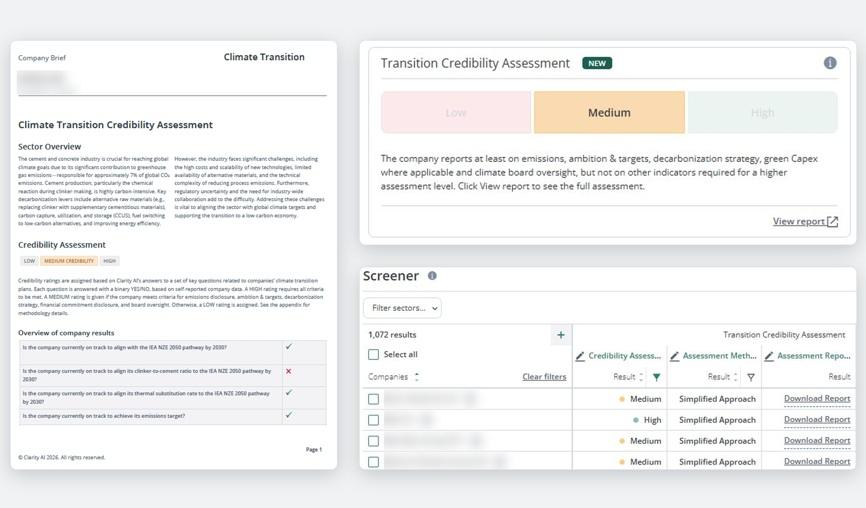
A Multi-Dimensional Framework for Assessment
The Transition Credibility Assessment does not rely on a single metric. Instead, it utilizes a multi-dimensional approach to build a holistic profile of a company’s climate maturity. By analyzing various facets of corporate behavior, the tool allows investors to pinpoint exactly where a company’s transition plan may be faltering. The core dimensions of the assessment include:
1. Emissions Performance and Disclosure
The foundation of any credibility assessment is a company’s historical and current emissions profile. Clarity AI evaluates not only the absolute reduction in Scope 1, 2, and 3 emissions but also the quality and transparency of the reporting itself. The solution distinguishes between companies that provide comprehensive, third-party verified data and those that rely on modeled estimates or incomplete disclosures.
2. Ambition and Target Setting
The tool scrutinizes the rigor of a company’s climate targets. This includes assessing whether targets are aligned with a 1.5°C warming scenario, whether they cover the company’s entire value chain (Scope 3), and whether there are clear short- and medium-term milestones to prevent the "backloading" of decarbonization efforts toward 2050.
3. Decarbonization Strategy and Technology Deployment
A credible transition requires a roadmap. The assessment looks for evidence of low-carbon technology deployment, such as the adoption of renewable energy, the electrification of fleets, or the implementation of carbon capture technologies in "hard-to-abate" sectors like cement and steel.
4. Green Capital Expenditure (CAPEX)
Perhaps the most telling indicator of a company’s commitment is where it spends its money. Clarity AI’s solution analyzes Green CAPEX to determine if financial resources are being directed toward transition-aligned assets. A company claiming to transition while continuing to invest heavily in fossil fuel expansion would receive a lower credibility score in this category.
5. Governance and Climate Oversight
The assessment evaluates whether climate risks and opportunities are integrated into a company’s executive compensation structures and board-level oversight. Credibility is higher when leadership is held financially accountable for meeting sustainability milestones.

Methodology Rooted in Global Standards
To ensure the Transition Credibility Assessment remains objective and relevant, Clarity AI has aligned its methodology with established global frameworks and sector-specific pathways. This includes the Transition Plan Taskforce (TPT) Disclosure Recommendations, which have become the gold standard for transition planning in the United Kingdom and are gaining traction globally.
The solution also draws on the Climate Action 100+ Net Zero Company Benchmark, an investor-led initiative that tracks the progress of the world’s largest corporate greenhouse gas emitters. By utilizing these benchmarks, Clarity AI ensures that its ratings are traceable to verifiable evidence, allowing investors to perform deep-dive due diligence rather than relying on "black box" scores.
Furthermore, the assessment recognizes that a one-size-fits-all approach is ineffective for climate analysis. The tool applies detailed, rigorous criteria to high-impact sectors—such as energy, utilities, and heavy industry—where the transition is most complex and capital-intensive. For companies in lower-impact sub-industries, a calibrated, simplified approach is used to ensure relevance and proportionality.
The Regulatory Context: CSRD and Beyond
The launch of this solution coincides with a massive shift in the global regulatory landscape. In Europe, the Corporate Sustainability Reporting Directive (CSRD) is beginning to mandate detailed disclosures regarding transition plans. Similarly, the International Sustainability Standards Board (ISSB) has released its S1 and S2 standards, creating a global baseline for climate-related financial disclosures.
As these regulations take effect, the volume of available data will explode. However, raw data is not the same as actionable insight. The role of companies like Clarity AI is to ingest this vast amount of regulatory disclosure and translate it into a format that asset managers can use for portfolio construction, risk management, and stewardship.
Market analysts suggest that the Transition Credibility Assessment will be particularly useful for "Article 8" and "Article 9" funds under the EU’s Sustainable Finance Disclosure Regulation (SFDR), which require high levels of transparency regarding the environmental characteristics and objectives of investment products.

Implications for the Investment Industry
The introduction of specialized transition assessment tools marks a maturation of the ESG (Environmental, Social, and Governance) data market. Earlier iterations of ESG ratings often conflated different types of risk and performance, leading to confusion and accusations of inconsistency. By isolating "transition credibility" as a specific metric, Clarity AI is providing a more surgical tool for financial decision-making.
For asset managers, the implications are significant:
- Risk Mitigation: Identifying companies with "hollow" climate targets can help investors avoid future stranded asset risks and regulatory fines.
- Enhanced Engagement: Investors can use specific data points from the assessment to lead more effective engagement dialogues with corporate boards, pushing for better CAPEX alignment or clearer disclosure.
- Product Development: The data can serve as the foundation for new financial products, such as transition-themed ETFs or green bonds with performance-linked triggers.
Looking Ahead: The Future of Climate Analytics
As the 2030 deadline for many interim climate targets approaches, the scrutiny on corporate performance will only intensify. The launch of Clarity AI’s Transition Credibility Assessment reflects a broader trend toward "impact-oriented" data. Investors no longer just want to know what a company’s carbon footprint is today; they want to know what it will be in five years and whether the company has the financial and strategic wherewithal to get there.
By leveraging artificial intelligence and machine learning to process unstructured data from transition plans, patent filings, and financial statements, Clarity AI is positioning itself as a critical intermediary in the transition to a net-zero economy. The ability to distinguish between a company with a marketing plan and a company with a transition plan may well become the defining competency of successful investors in the coming decade.
The Transition Credibility Assessment is now available to Clarity AI’s global client base, offering a new lens through which to view the complex, multi-decade challenge of global decarbonization. As the financial world moves from pledges to performance, such tools will be essential in ensuring that capital is directed toward the companies truly capable of surviving and thriving in a low-carbon future.
