

Citadel, the formidable hedge fund led by CEO Ken Griffin, reported impressive positive returns across its diverse hedge fund strategies in the first half of 2026, punctuated by double-digit gains in its tactical trading and equities funds. This strong performance unfolded against a backdrop of significant market turbulence, including geopolitical tensions, evolving artificial intelligence investment narratives, and shifting Federal Reserve policy expectations, demonstrating the firm’s robust risk management and sophisticated trading capabilities. The firm’s ability to navigate a late-June shakeout in the quantitative investing sector further underscored its strategic prowess.
Citadel’s Stellar Performance Across Key Funds
The first six months of 2026 proved to be a period of exceptional growth for Citadel, particularly for its specialized funds. The firm’s tactical trading fund, a hybrid strategy that integrates discretionary equity investing with advanced quantitative methodologies, emerged as a standout performer. It recorded a remarkable 14.3% increase through the end of June, with a notable 3.1% gain in June alone. This robust performance is particularly significant given the broader market environment.
Following closely, Citadel’s equities fund also delivered strong results, climbing 11.2% in the first half of the year, including a 3.5% surge in June. These figures, obtained from an individual familiar with Citadel’s confidential returns, highlight the firm’s successful execution across its equity-focused strategies.
The firm’s flagship multistrategy Wellington fund, which represents Citadel’s largest pool of capital and employs a diversified approach across various asset classes and trading styles, posted a respectable 5.7% gain through the end of June, with a 1.8% advance during the month of June. While more modest than its specialized counterparts, the Wellington fund’s consistent positive returns underscore the efficacy of Citadel’s core investment philosophy and its ability to generate alpha even in challenging conditions.
In contrast, Citadel’s global fixed income fund experienced a 1.7% rise in June, leaving its year-to-date performance relatively flat. This outcome reflects the inherent challenges within fixed income markets during periods of monetary policy uncertainty and fluctuating interest rate expectations, where strong directional bets can be difficult to sustain.
Navigating a Turbulent Market Landscape: H1 2026 Chronology
The first half of 2026 was characterized by a mosaic of macroeconomic headwinds and speculative rallies, making the financial landscape particularly treacherous for investors. The S&P 500, the benchmark index for U.S. equities, managed a 9.6% climb through June, ultimately reaching fresh record highs. However, this upward trajectory was far from smooth, marked by significant volatility and periods of sharp decline.
- February-March Market Correction: The year began with a period of investor apprehension, culminating in a five-week slide for the S&P 500 during February and March. This downturn was largely fueled by a confluence of factors, including escalating geopolitical tensions in the Middle East and renewed inflation concerns.
- Geopolitical Tensions and Energy Markets: The Iran conflict, in particular, cast a long shadow over global markets, leading to pronounced spikes in crude oil prices. Historically, significant increases in energy costs have tended to dampen consumer spending, elevate corporate operational expenses, and contribute to inflationary pressures, prompting investors to reassess economic growth forecasts and corporate earnings potential. The uncertainty surrounding energy supply chains and potential disruptions added a layer of complexity to market risk assessments.
- The AI Investment Enigma: The preceding years had witnessed an unprecedented surge in investment and speculation surrounding artificial intelligence. As 2026 unfolded, questions began to emerge regarding the sustainability of this massive AI spending spree. While a handful of mega-cap technology firms continued to command premium valuations based on their AI leadership, investors started scrutinizing the broader economic impact and the timeline for realizing substantial returns from these investments. This led to a period where the market rally, initially concentrated in a few AI-driven tech giants, struggled to broaden out.
- Shifting Federal Reserve Policy Expectations: Monetary policy remained a dominant theme, with market participants constantly adjusting their expectations for the Federal Reserve’s stance on interest rates. Inflation data, employment figures, and global economic indicators all played a role in shaping the narrative around potential rate hikes or cuts. The ambiguity surrounding the Fed’s future actions introduced significant volatility across equity, bond, and currency markets, making it challenging for funds relying on clear economic signals.
- Broadening Market Rally: Towards the latter part of the first half, the market rally began to show signs of broadening beyond just the largest technology stocks. This diversification signaled a potential shift in investor confidence, suggesting a more robust underlying economic recovery or a broader re-evaluation of value across different sectors.
The Quantitative Investing Shakeout: A Test of Resilience
One of the most critical events that highlighted Citadel’s robust strategy was the "late-June shakeout" in quantitative investing. This period saw systematic long-short strategies suffer their worst five-day performance since December 2023, according to reports from Goldman Sachs’ prime brokerage unit to its clients. The specific window of distress spanned from June 23 to the subsequent Monday, creating significant losses for many funds relying heavily on these models.
- Understanding Quantitative Investing: Quantitative investing is a sophisticated approach that leverages mathematical models, statistical analysis, machine learning, and complex algorithms to identify investment opportunities, construct portfolios, and manage risk. These strategies often involve high-frequency trading, arbitrage, and various forms of systematic market timing, aiming to exploit inefficiencies or predict price movements based on vast datasets.
- Systematic Long-Short Strategies: These strategies typically involve taking simultaneous "long" positions (buying assets with the expectation they will rise) and "short" positions (selling borrowed assets with the expectation they will fall) based on algorithmic signals. The goal is to profit from the relative performance of these positions, often with a market-neutral or low-net-exposure objective.
- Causes of the Shakeout: The severe downturn for these strategies was primarily attributed to the rapid unwinding of "crowded trades" and momentum positions on the short side. Crowded trades occur when a large number of investors or funds simultaneously take similar positions in particular assets, often driven by similar quantitative signals. When these positions begin to reverse, the selling pressure can cascade, creating a rapid and amplified downward spiral as funds are forced to exit their positions, leading to significant market dislocations. Momentum strategies, which bet on the continuation of recent price trends, are particularly vulnerable when trends abruptly reverse.
- Citadel’s Avoidance: Crucially, Citadel’s tactical trading strategy, despite its quantitative components, successfully avoided this latest sell-off. This resilience can be attributed to its unique design, which combines the rigor of quantitative strategies with the flexibility of discretionary equity investing. This hybrid approach likely allowed Citadel’s portfolio managers to override or adjust algorithmic signals when market conditions deviated sharply from model assumptions, or perhaps its models were inherently more diversified and less exposed to the specific crowded trades that unwound. This ability to integrate human judgment with algorithmic efficiency provides a crucial edge in navigating such volatile, model-driven market corrections. The firm’s reputation for highly sophisticated risk management frameworks also plays a pivotal role in preventing cascading losses during periods of market stress.
Citadel’s Background and Industry Standing
Citadel, founded by Ken Griffin in 1990, has grown into one of the world’s most prominent and successful alternative investment managers. Renowned for its multi-strategy approach, the firm deploys capital across a wide array of strategies including equities, fixed income, commodities, and quantitative strategies, managed by distinct teams. This diversification is a cornerstone of its risk management philosophy, aiming to generate consistent returns with lower correlation to broader market movements.
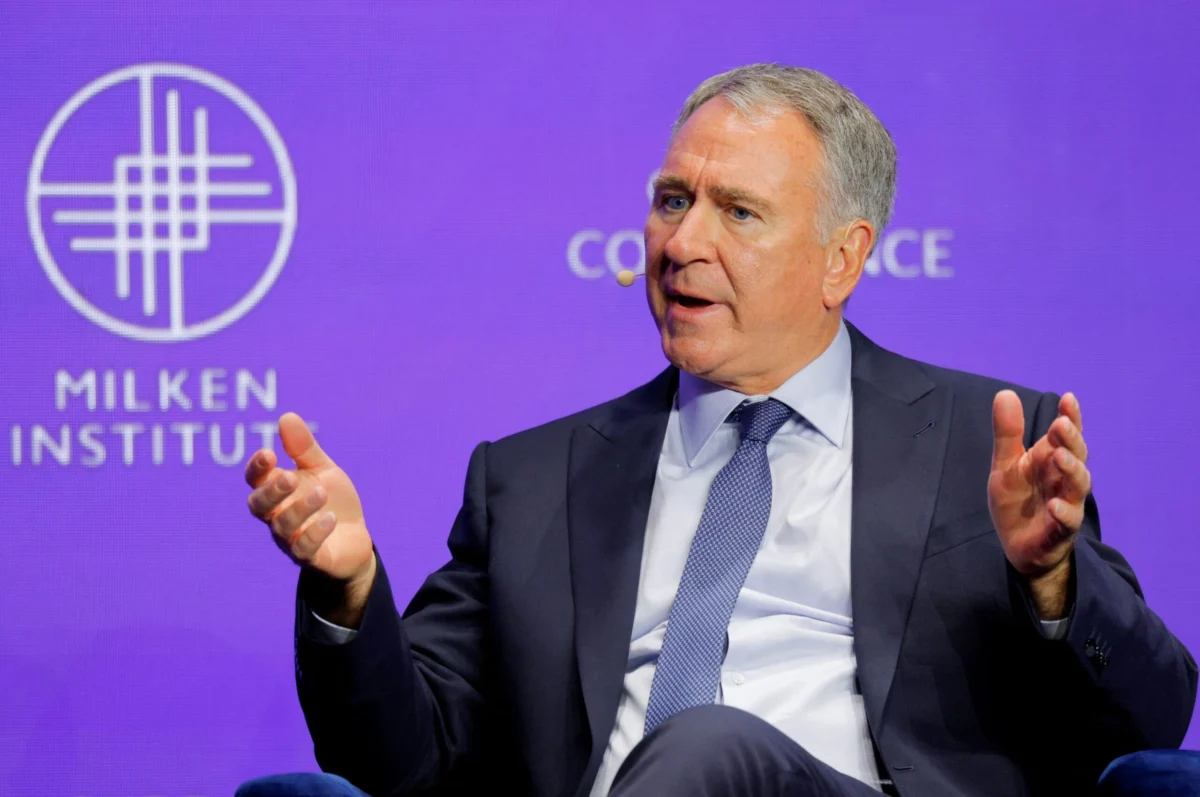
Ken Griffin, a titan of the financial industry, has cultivated Citadel into a global financial powerhouse, not only in hedge fund management but also as a leading market maker through Citadel Securities. His vision and leadership have consistently placed Citadel at the forefront of financial innovation and performance. Griffin’s presence at high-profile events, such as his interview with Michael Milken at the Milken Institute Global Conference 2025 (as pictured in May 2025, providing contextual insight into his public profile), underscores his influence and thought leadership within the global financial community.
As of June 1, Citadel managed approximately $69 billion in assets, solidifying its position among the largest and most influential hedge funds globally. The firm’s consistent outperformance, particularly during periods of market stress, often attracts significant investor capital, further enhancing its scale and market impact.
Implications and Broader Impact
Citadel’s strong first-half performance carries several significant implications for the firm, its investors, and the broader hedge fund industry.
- Validation of Multi-Strategy Approach: The firm’s ability to generate alpha across various strategies in a volatile market environment provides a strong validation of its multi-strategy model. This diversified approach demonstrably mitigates risk and allows the firm to capitalize on opportunities across different asset classes and market conditions, proving its resilience even when specific sectors or strategies face headwinds.
- Enhanced Investor Confidence: For its limited partners, these robust returns reinforce confidence in Citadel’s investment capabilities and its sophisticated risk management framework. In an era where many hedge funds struggle to consistently outperform benchmarks, Citadel’s performance stands out, likely attracting continued or increased capital allocations.
- Industry Benchmark: Citadel’s results often serve as a benchmark for the hedge fund industry. Its success during challenging periods can influence other funds to review their own strategies, risk management protocols, and technological investments, particularly in the realm of quantitative trading and its integration with discretionary management.
- Talent Attraction: Top-tier performance is a powerful magnet for talent. Citadel’s continued success helps it attract and retain the best financial professionals, quants, and technologists, further cementing its competitive edge.
- Resilience Against Systemic Shocks: The specific ability of Citadel’s tactical trading fund to avoid the quantitative investing shakeout highlights the importance of nuanced strategy design and potentially, the judicious application of human oversight within automated systems. This suggests that pure, unmitigated algorithmic trading can be susceptible to unique systemic risks, and a hybrid approach might offer superior robustness.
Official Responses
In line with standard practice for privately held hedge funds, Citadel declined to comment on its specific performance figures when approached for this report. This stance is typical within the industry, where proprietary trading strategies and detailed financial results are often kept confidential to maintain a competitive advantage and manage public perception. Reporting on such sensitive information frequently relies on well-placed, anonymous sources familiar with the firm’s internal data.
Conclusion
Citadel’s exceptional performance in the first half of 2026 underscores its enduring strength and strategic acumen in an increasingly complex and volatile global financial landscape. Led by Ken Griffin, the firm not only delivered impressive double-digit gains in key funds but also demonstrated remarkable resilience in navigating significant market headwinds, including geopolitical instability, shifting technological narratives, monetary policy uncertainty, and a notable dislocation in the quantitative investing sector. As the financial world looks ahead to the remainder of 2026, Citadel’s continued ability to adapt, innovate, and generate superior returns will undoubtedly solidify its position as a preeminent force in the alternative investment industry.
