

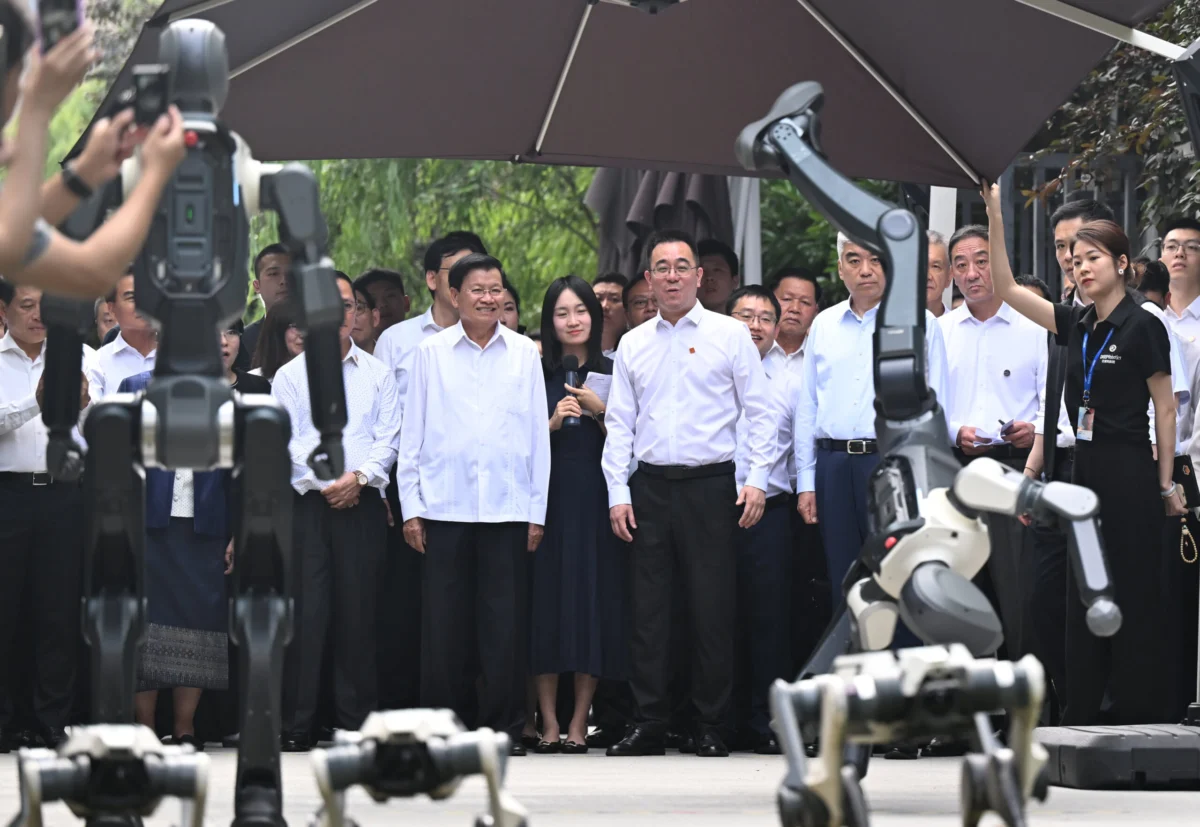
HANGZHOU, CHINA – June 02: General Secretary of the Lao People’s Revolutionary Party Central Committee and Lao President Thongloun Sisoulith observes a DR02 humanoid robot performance at Deep Robotics. This image, captured on June 2, 2026, in Hangzhou, Zhejiang Province of China, by Wang Gang for China News Service via Getty Images, precedes a period of significant regulatory shifts impacting China’s technology sector.
The seemingly unstoppable flow of capital into China’s burgeoning tech startup ecosystem has encountered a significant deceleration this month, signaling a pivotal moment in Beijing’s ambitious drive to achieve technological self-sufficiency and global leadership. Within a compressed timeframe last Friday, two high-profile developments underscored a concerted effort by central authorities to rein in the unbridled growth and potential misallocations that have characterized the nation’s tech funding landscape.
First, a municipal government in Jiangsu province, a powerhouse of Chinese electronics manufacturing, issued directives compelling local companies to meticulously disclose their financial entanglements with Dreame Technology, a leading manufacturer of robotic vacuums. This move, seemingly targeted at a specific high-profile company, served as a tangible indicator of increased scrutiny over corporate financial structures and investment dependencies.
Almost concurrently, China’s State Council, the nation’s chief administrative body, unveiled a comprehensive suite of regulations designed to dramatically tighten oversight of the country’s vast private fund industry. Valued at an imposing 23 trillion yuan (approximately $3.4 trillion), this sector has become a critical engine for channeling investment into strategic industries, including advanced technology. The swift succession of these events highlights a delicate balancing act by Beijing: fostering innovation and competing with established technological powers like the United States, while simultaneously establishing robust guardrails to prevent systemic risks and inefficient capital deployment.
This regulatory tightening signals a strategic recalcitrant against a co-investment model that local governments have enthusiastically adopted in recent years to attract and nurture businesses within their jurisdictions. Dan Wang, China director at Eurasia Group, observes that local authorities have frequently engaged in a competitive "race to outspend one another" on strategically important sectors. This often results in substantial fiscal waste and introduces elevated credit risks for the central government, as these investments may not always yield the anticipated returns or contribute to sustainable economic development.
The pivot by Chinese local governments away from land financing—a sector that has faced severe contractions following the property market crisis in the early 2020s—towards equity finance represents a significant shift in fiscal strategy. By leveraging state capital and government guidance funds, these entities have sought to acquire stakes in startups, viewing capital gains from these ventures as a novel source of fiscal income. This strategy, however, is not without its challenges. In recent years, Wall Street-linked U.S. funds, once active participants in China’s investment scene, have largely withdrawn due to escalating geopolitical tensions and regulatory uncertainties. This withdrawal has created an opening for local Chinese yuan-denominated funds to fill the void, often with less seasoned investment professionals at the helm.
As Wang notes, local officials, lacking the deep market expertise of professional investors, may be prone to concentrating substantial capital into a few favored ventures, thereby exposing public finances to significant risk when these bets inevitably falter. The recent actions by Beijing appear to be a direct response to these emerging vulnerabilities, aiming to instill greater discipline and accountability within the innovation funding ecosystem.
The Dreame Technology Scrutiny: A Case Study
The focus on Dreame Technology, a company that has experienced meteoric growth, serves as a potent illustration of the dynamics at play. By the first quarter of 2026, Dreame had ascended to become the world’s largest robotic vacuum cleaner manufacturer by sales, according to data from research consultancy IDC. The company has also established a rapid and expanding presence in key international markets, including Europe and the United States. However, Dreame’s ambitions extend far beyond household cleaning appliances.
Since its founding in 2017, Dreame has embarked on an aggressive diversification strategy, mirroring the rapid expansion patterns of other prominent Chinese tech firms. The company has spawned a vast network of nearly a thousand affiliated enterprises, venturing into diverse sectors such as electric vehicles, smartphones, humanoid robots, the beverage industry, and even satellite networks. In January 2026, founder Yu Hao boldly declared his vision of building an ecosystem that would "become the first $100 trillion company in human history," a statement that underscored the company’s audacious scale and global aspirations.
This remarkable sprawl has, in recent weeks, attracted significant regulatory attention. A municipal government in Jiangsu province, a critical hub for China’s electronics manufacturing, reportedly requested local companies to conduct thorough audits of their financial exposure to Dreame-linked entities. These audits were intended to ascertain investment volumes, fiscal outlays, and the nature of business operations, as reported by state-backed media. Further compounding the scrutiny, Yu Hao’s personal Weibo account, a prominent platform for his outspoken pronouncements, was suspended, effectively silencing his public commentary.
While official responses from the State Council, the Changzhou municipal government, and Dreame Technology to inquiries from CNBC were not forthcoming, the evidence suggests a deliberate move to curb unchecked expansion and ensure financial transparency. A significant portion of Dreame’s rapid growth has been fueled by state funding. Its Sky Factory Venture Capital Fund reportedly manages 41.6 billion yuan in assets, with approximately 80% of this capital originating from industry funds established by local governments in cities such as Suzhou and Xiamen. Furthermore, nearly all of Dreame’s 29 funds are understood to involve local state-owned capital, with investments spread across more than 10 cities, reflecting a deeply embedded network of government-backed financial support.
This complex web of financing layers has also prompted broader industry adjustments. Earlier this month, China’s Asset Management Association issued a call for increased disclosure requirements when a fund allocates more than 90% of its assets to a single investment vehicle. This measure aims to enhance transparency and mitigate risks associated with concentrated investments, particularly those involving public funds.
The ‘Patient Capital’ Model and Its Perils
The financial structure observed in companies like Dreame is emblematic of China’s broader strategy for funding its industrial development. Local authorities have been actively encouraged to deploy "guidance funds" as a form of "patient capital." This approach aims to support startups in long-horizon, high-risk technology fields, providing them with the necessary time to mature and achieve breakthroughs. However, as Tilly Zhang, an industrial policy analyst at Gavekal Dragonomics, points out, this model inherently incentivizes companies to align their strategies with government priorities, often through strategic repositioning rather than genuine alignment.
In contrast to the United States, which channels support to technology companies primarily through indirect mechanisms such as procurement contracts, grants, and tax incentives, Chinese governments at all levels actively participate in direct equity investments. This direct involvement places public money directly at risk, exposing it to valuation fluctuations, exit uncertainties, and governance challenges. Consequently, companies funded through this model face immense pressure to deliver results, even in ventures with inherently high risks. Moreover, a significant portion of this capital originates from state-linked funds that are often drawn to technology due to its political expediency rather than possessing deep technical expertise or proven investment acumen.
Zhang further elaborates that local governments often lack the professional discernment to differentiate between genuinely promising ventures and opportunistic pursuits. She cites the example of a loss-making semiconductor project in Wuhan in 2021, which resulted in a government expenditure of approximately 15 billion yuan, highlighting the potential for significant financial misallocations.
Research conducted by Rhodium Group has revealed that Chinese local governments have established thousands of such funds over the past decade, frequently leading to duplicated investments and considerable capital wastage. Official figures indicate that by the end of 2025, China had established over 2,100 government guidance funds, with a targeted capital pool exceeding 11 trillion yuan. Bob Chen, a Shanghai-based investor in a renminbi-denominated fund, aptly likens this decentralized approach to Singapore’s sovereign wealth fund, Temasek, stating, "Singapore has Temasek. In China, every level of government has its own Temasek."
The State Council’s new guideline directly addresses this proliferation by mandating "strict control over the establishment of new government investment funds" and prohibiting counties and districts from creating new funds without explicit approval from higher governmental echelons. These regulations effectively consolidate oversight at the city and provincial levels, creating a more centralized and controlled framework for government-backed investment.
A ‘Spray and Pray’ Approach Undergoing Revision
Despite its inherent flaws, the state equity-investing model has, in some instances, yielded significant successes and underpinned the rapid ascent of several Chinese technology champions. Hefei province’s early strategic investments in electric vehicle manufacturer Nio and chipmaker CXMT have positioned the city as a model for successful government venture investing. These early wins have fueled a widespread desire among smaller cities, which may have missed out on earlier waves of investment in sectors like semiconductors and core artificial intelligence, to identify the next big growth areas.
"They are eager to develop good companies but not in a position to win national-strategic hard-tech projects like chips," Chen explains. "So they went looking in the consumer tech sub-theme. Dreame was handing them exactly what they wanted."
Yuen Yuen Ang, a Professor of Political Economy at Johns Hopkins University, characterizes China’s innovation drive as a "spray and pray" approach, defined by its "enormous scale but low productivity." This strategy, she argues, produces significant output but is accompanied by a high failure rate, with success often judged not by efficiency but by the emergence of a few truly dominant players.
The Dreame episode, in this context, represents a familiar pattern within China’s policy cycle: a period of intensive mobilization towards a national priority, tolerance for significant deviations and waste, followed by a necessary course correction. As Beijing tightens its regulatory reins, lower-tier governments, often with fewer resources and less sophisticated investment capabilities, are likely to feel the immediate impact.
If equity investment opportunities are curtailed at the county level, "there won’t be many other levers left for local governments to drive investment," Chen concludes, suggesting that this regulatory shift could fundamentally alter the landscape of local economic development initiatives. The future of China’s tech funding model hinges on its ability to strike a more sustainable balance between fostering innovation and ensuring prudent financial stewardship.
