

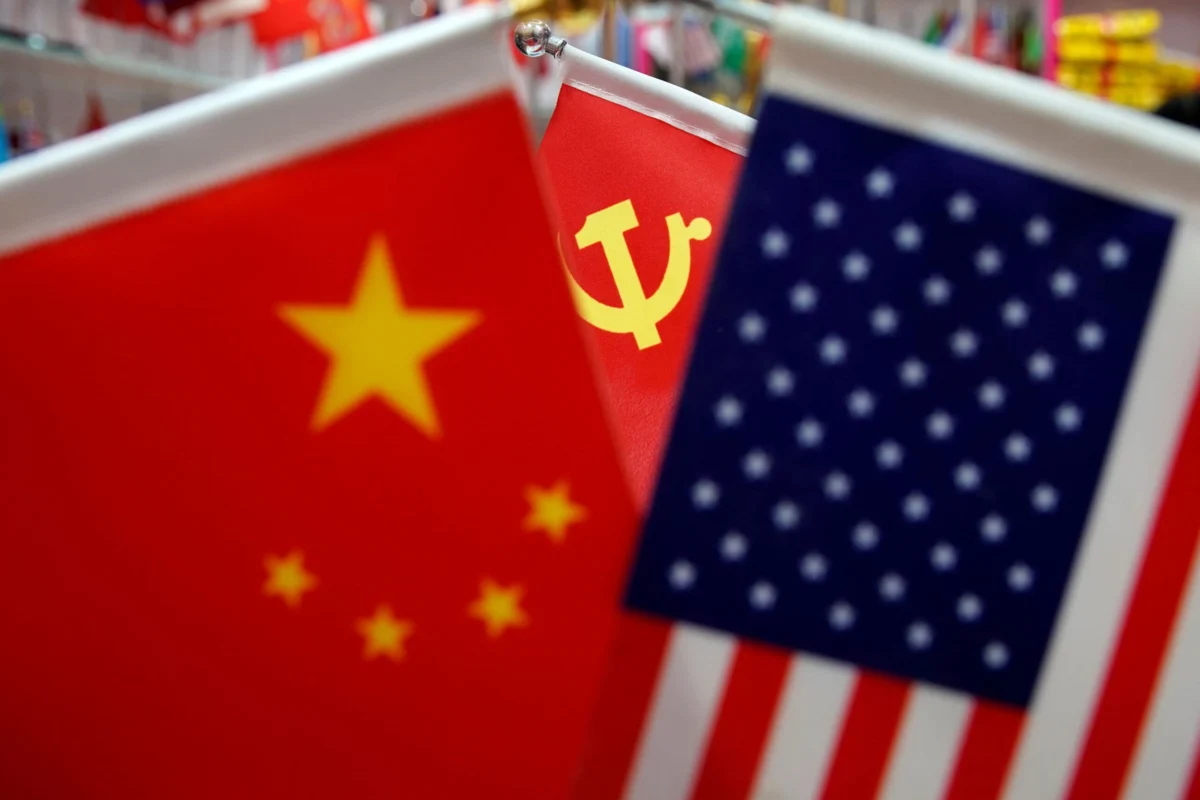
Beijing has firmly pushed back against entreaties from prominent U.S. artificial intelligence (AI) executives to deliberately decelerate the rapid advancement of the cutting-edge technology, signaling a deepening divergence in approaches to AI governance and an intensification of the global technological competition. The official stance from China underscores the nation’s commitment to accelerating its AI capabilities, even as Western counterparts voice escalating concerns about the potential societal and existential risks posed by unchecked development.
On a pivotal Monday, Guo Jiakun, a spokesperson for China’s Foreign Ministry, articulated Beijing’s position with unequivocal clarity. "Fear mongering, confrontation, competition will just disrupt [the] process of global AI governance," Guo stated, according to an English translation disseminated by Reuters. This declaration was a direct response to a growing chorus of U.S. industry leaders, including OpenAI CEO Sam Altman, Anthropic CEO Dario Amodei, and Tesla and X owner Elon Musk, who have publicly urged the AI industry to adopt a more measured pace in light of the profound dangers they believe rapid technological leaps present. These dangers encompass a spectrum from potential job displacement and societal disruption to more speculative, yet increasingly discussed, existential threats posed by superintelligent AI.
China’s Strategic Imperative: Accelerating AI Security and Dominance
The Chinese Foreign Ministry’s statement did not emerge in a vacuum but was preceded by a significant article published on Sunday by Chen Yixin, China’s Minister of State Security. In his extensive piece, Minister Chen explicitly called for the "acceleration of construction" of an AI security risk prevention and control system. This directive highlights China’s dual strategy: on one hand, acknowledging the inherent risks of advanced AI, and on the other, ensuring that risk mitigation does not impede the nation’s aggressive pursuit of technological leadership.
Minister Chen’s article further underscored the strategic importance Beijing places on AI, framing the field as "the main battleground for global technological competition and a new arena for strategic rivalry among major powers." He emphasized the necessity for "healthy and orderly" development of the technology, a phrase that, in the Chinese context, often implies state-guided and strategically aligned progress rather than a slowdown. This perspective aligns with China’s broader national strategies, such as "Made in China 2025" and the "New Generation Artificial Intelligence Development Plan," which aim for global dominance in key technological sectors, with AI at the forefront. The plan, unveiled in 2017, set ambitious targets for China to become a global AI innovation hub by 2030, a goal that appears incompatible with any significant deceleration.
The Western Dilemma: Balancing Innovation with Caution
The calls for a slowdown from U.S. AI executives stem from a different set of anxieties, largely centered on safety, ethical considerations, and the potential for misuse. Sam Altman, whose company OpenAI ignited the generative AI boom with ChatGPT, has frequently spoken about the need for robust safety measures and even potential international regulatory bodies to manage advanced AI. Elon Musk has been a long-standing proponent of strong AI regulation, often warning about the technology’s potential to surpass human control.

Dario Amodei, CEO of Anthropic, a leading AI safety-focused company, offered a nuanced perspective in an essay published on Saturday. While advocating for "pacing" the frontier of AI development, Amodei explicitly cautioned against slowing down excessively. He articulated a core geopolitical concern: "Not building the technology deprives humanity of benefits or simply places AI in the hands of authoritarian powers, while building it too fast is reckless." Crucially, Amodei elaborated on the limitations of such pacing, stating it would be constrained by the lead U.S. companies currently hold over "authoritarian regimes, chiefly the Chinese Communist Party." He warned, "If we slow down by more than this amount, then (unpaced) CCP-associated projects will pull ahead, creating significant national security risk." This perspective encapsulates the complex dilemma faced by Western nations: how to prioritize safety without ceding strategic advantage to geopolitical rivals.
Adding another layer to the American stance, former U.S. President Donald Trump also rejected the AI bosses’ calls during a trip to Ireland. "Look, we’re leading China in AI… and, frankly I want to keep it that way because whoever wins AI, wins," Trump asserted, echoing a sentiment that views AI development through the lens of a zero-sum geopolitical contest. This stance, shared across different political spectrums in the U.S., highlights the national security implications perceived in the AI race.
The Global AI Race: Investment, Innovation, and the Capability Gap
The "AI arms race" narrative is supported by significant investment and research output from both the U.S. and China. In recent years, both nations have poured billions into AI research and development. Data from various venture capital firms and research institutions consistently show the U.S. leading in private AI investment, particularly in cutting-edge generative AI startups. However, China has made substantial strides in areas like computer vision, natural language processing, and smart city applications, often with significant state backing. For instance, China’s patent filings in AI have consistently outpaced those of the U.S. in several categories.
According to Helen Toner, executive director of the Georgetown Center for Security and Emerging Technology and a former OpenAI board member, current estimates place China’s most advanced AI models "something like six to nine months behind the very best U.S. models." Speaking on "Squawk Box" Monday, Toner articulated the inherent tension: "If that means that we slow down and they just rip past us because they’re pretty close behind — that’s a problem." She further noted the complexity of predicting China’s trajectory if the U.S. were to slow its pace: "It’s actually not clear how much of their advancements are sort of fast following. Where if the U.S. frontier slows, perhaps China also slows somewhat." This uncertainty complicates strategic decisions for policymakers and industry leaders alike.
The global AI landscape has seen significant shifts, with Chinese AI models increasingly gaining traction among Western companies. Platforms like Hugging Face, a hub for open-source machine learning models, host numerous Chinese-developed AI models whose capabilities have steadily improved, indicating a narrowing of the performance gap. This cross-pollination of models, while fostering innovation, also raises questions about data security, intellectual property, and potential backdoors, especially in the context of geopolitical tensions.
Geopolitical Implications and the Quest for Governance
The divergent views on AI development underscore the broader geopolitical struggle between the U.S. and China. The U.S. has implemented stringent export controls on advanced semiconductor chips and AI-related hardware to China, explicitly aiming to curb Beijing’s technological progress, particularly in military applications. These controls are a testament to the strategic importance placed on maintaining a technological edge. China, in turn, has responded by intensifying its domestic chip manufacturing and AI research, viewing self-sufficiency as a national security imperative.

President Xi Jinping’s remarks at the BRICS bloc summit in New Delhi recently highlighted another facet of China’s AI strategy. Xi stated that China would "take the lead" to help foster AI collaboration and development among developing countries. This initiative positions China as a leader in AI for the Global South, potentially building an alternative technological ecosystem and standard-setting body that operates independently of Western influence. Such a move could fragment global AI governance efforts, making a unified international approach to safety and ethics even more challenging.
The economic implications of this tech rivalry are also palpable. AI-related stocks experienced a slump on Monday, reflecting investor sensitivity to regulatory and geopolitical developments. SoftBank, a major investor in OpenAI, saw its shares drop by 10% in Japan, indicating how deeply intertwined the financial markets are with the pace and direction of AI innovation.
The Path Forward: A Dual Challenge
The current standoff presents a formidable challenge to global AI governance. On one side, there are urgent calls from leading AI developers and ethicists for a collective pause or significant slowdown to adequately address the profound ethical, safety, and societal implications of rapidly advancing AI. These concerns range from algorithmic bias and privacy infringements to the potential for autonomous weapons and unforeseen systemic risks.
On the other side, national security interests and the fierce competitive drive for technological supremacy, particularly between the U.S. and China, make such a slowdown difficult, if not impossible. Both nations view AI as critical for economic growth, military advantage, and geopolitical influence. The fear of falling behind, as articulated by both Amodei and Trump, creates a powerful incentive to accelerate rather than decelerate.
The international community faces the arduous task of reconciling these conflicting imperatives. Developing robust, globally accepted frameworks for AI safety, ethics, and responsible development will require unprecedented levels of collaboration and trust, precisely at a time when geopolitical tensions are high. Without a shared understanding and commitment, the trajectory of AI development risks being dictated more by national competition than by collective human welfare, potentially leading to a future where the promises of AI are overshadowed by its perils. The ongoing dialogue, or lack thereof, between the world’s leading AI powers will undoubtedly shape the future of this transformative technology.
