

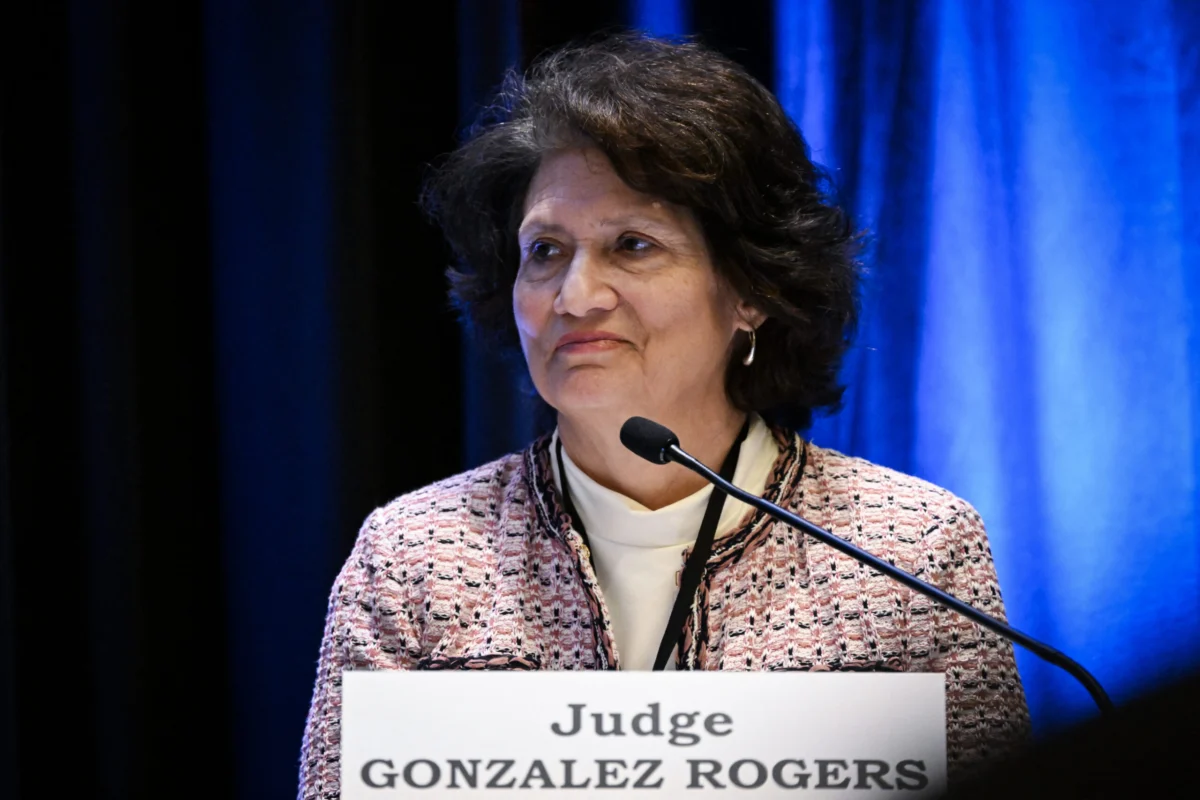
The legal landscape of Silicon Valley is currently navigating its most transformative era, and at the center of this storm sits Chief Judge Yvonne Gonzalez Rogers of the U.S. District Court for the Northern District of California. From her courtroom in downtown Oakland, the 61-year-old jurist is presiding over a series of high-profile litigations that will likely define the boundaries of corporate responsibility, antitrust enforcement, and the ethical deployment of artificial intelligence for decades to come. Having recently ascended to the role of Chief Judge, Gonzalez Rogers now oversees a district that serves as the primary judicial battleground for the world’s most powerful technology companies, including Meta, Apple, Google, and OpenAI.
The year 2025 has already proven to be a watershed period for Gonzalez Rogers. In late April and throughout much of May, she managed the intense courtroom drama between Tesla CEO Elon Musk and OpenAI CEO Sam Altman—a case that touched upon the foundational principles of the AI industry. Following that, she immediately transitioned into the second week of a federal trial that has been described by legal experts and state officials as social media’s "Big Tobacco moment." This ongoing litigation, led by California Attorney General Rob Bonta and a bipartisan coalition of state attorneys general, seeks to hold Meta Platforms Inc. accountable for what they allege is a calculated effort to exploit and addict young users.
The Path to the Chief Judgeship and a 35-Year Career
Yvonne Gonzalez Rogers’ appointment as Chief Judge marks the pinnacle of a legal career defined by "firsts" and a reputation for intellectual rigor. A native of Houston, Texas, she completed her undergraduate studies at Princeton University in 1987 before earning her Juris Doctor from the University of Texas School of Law. Upon entering private practice in 1991 at the law firm Cooley, she became the firm’s first Latina associate, a milestone that signaled her trajectory toward judicial leadership.
Her transition to the bench began in 2008 when then-Governor Arnold Schwarzenegger appointed her to the Alameda County Superior Court. Her performance in the state judiciary caught the attention of the late Senator Dianne Feinstein, who eventually recommended her for the federal bench. In 2011, President Barack Obama nominated her to the U.S. District Court for the Northern District of California. In 2024, she succeeded Judge Richard Seeborg as Chief Judge, taking the helm of the district at a moment when technology-related litigation has reached an unprecedented scale and complexity.
In the legal community, Gonzalez Rogers is frequently referred to by her initials, "YGR." She is widely respected—and occasionally feared—for a no-nonsense demeanor that prioritizes efficiency and candor. Steve Berman, managing partner at Hagens Berman and a veteran of the 1990s litigation against the tobacco industry, describes her as a "pistol" who has little patience for obfuscation from counsel. This reputation for strictness is paired with a deep respect for the judicial process; it is noted that she provides every juror with a pocket Constitution from the Supreme Court bookstore, accompanied by a handwritten thank-you note, emphasizing the civic importance of their service.
The Meta Trial: A Reckoning for Social Media Algorithms
The current trial against Meta is perhaps the most significant case on Gonzalez Rogers’ current docket. The lawsuit, supported by 29 states including California, Colorado, New Jersey, and Kentucky, alleges that Meta intentionally designed its platforms—Facebook and Instagram—to be addictive to children and teenagers. The core of the states’ argument is that Meta utilized features such as infinite scroll, near-constant push notifications, "likes," and autoplaying videos to manipulate the developing brains of young users.

The legal stakes are astronomical. While Meta has estimated that potential penalties could reach as high as $1.4 trillion based on statutory violations, the primary focus of Attorney General Rob Bonta is structural change. The states are seeking a court order that would force Meta to fundamentally alter its algorithms and design features. Because Meta derives approximately 98% of its revenue from targeted advertising—a business model dependent on maximum user engagement—any court-mandated changes to its algorithms could have a profound impact on its market valuation and future growth.
A unique aspect of this trial is Gonzalez Rogers’ decision to utilize an advisory jury. Under federal civil procedure, an advisory jury is employed in cases where the parties do not have an absolute right to a jury trial, but the judge seeks to gauge the "standard of the community." While the jury’s verdict will not be legally binding, it will provide Gonzalez Rogers with a barometer of public sentiment regarding social media’s impact on youth mental health. In her court filings, she noted that the issues at play impact the "daily lives of the public," justifying the need for community input.
A History of Confronting Big Tech: The Apple Precedents
Long before the current Meta and OpenAI disputes, Gonzalez Rogers was a central figure in the evolving antitrust landscape surrounding Apple Inc. Her history with the iPhone maker is extensive and includes some of the most significant rulings in modern digital commerce.
In 2012, she inherited Pepper v. Apple, an early challenge to the App Store’s closed ecosystem. While she initially dismissed the case, the Supreme Court eventually ruled that consumers had the standing to sue Apple for antitrust violations. However, her most famous encounter with Apple came in 2020 via the Epic Games v. Apple trial. Epic Games, the creator of Fortnite, sued Apple after being removed from the App Store for implementing a direct payment system that bypassed Apple’s 30% commission.
In her 2021 ruling, Gonzalez Rogers issued a nuanced split decision. She found that Epic Games failed to prove Apple was an illegal monopolist under federal law. However, she ruled that Apple’s "anti-steering" rules—which prevented developers from telling users about cheaper payment options outside the App Store—violated California’s Unfair Competition Law. She ordered Apple to allow developers to include links to external payment systems.
The relationship between the court and Apple grew even more contentious in 2024. Gonzalez Rogers accused Apple of willfully violating her injunction, stating in a court filing that a high-ranking Apple executive had "outright lied" to the court regarding the company’s internal timelines for implementing new fee structures. She went as far as referring the matter to U.S. attorneys for potential criminal contempt proceedings, although no formal prosecution followed. This history demonstrates her willingness to challenge the integrity of some of the world’s most powerful corporate executives.
The Musk vs. Altman Dispute: The Battle for AI’s Soul
The legal challenges overseen by Gonzalez Rogers also extend into the burgeoning field of artificial intelligence. Earlier this year, she presided over the high-stakes lawsuit filed by Elon Musk against Sam Altman and OpenAI. Musk, a co-founder of the organization, alleged that Altman and fellow co-founder Greg Brockman had abandoned OpenAI’s original non-profit mission in favor of a "for-profit" partnership with Microsoft.

The trial lasted three weeks and concluded with an advisory jury finding that Musk had failed to file his suit within the appropriate statute of limitations. While Musk criticized the verdict as a "technicality," Gonzalez Rogers upheld the finding, noting that there was a "substantial amount of evidence" to support the jury’s conclusion. This case highlighted the difficulties of applying traditional contract and charity laws to the rapidly evolving and opaque world of AI development.
Broader Implications and the Future of the Northern District
The influence of Chief Judge Gonzalez Rogers extends beyond individual high-profile trials. She is currently overseeing a massive multidistrict litigation (MDL) that consolidates nearly 3,000 pending lawsuits against a "who’s who" of social media giants, including Meta, TikTok, Snap, and YouTube. These cases all revolve around the alleged psychological harm caused to children and adolescents by social media platforms.
The outcome of these proceedings will likely set the national standard for how Section 230 of the Communications Decency Act is interpreted. For decades, Section 230 has shielded tech platforms from liability for content posted by users. However, the legal theories being tested in Gonzalez Rogers’ courtroom focus not on the content itself, but on the product design and algorithmic delivery—arguing that the platforms themselves are "defective products."
As Chief Judge, Gonzalez Rogers is also tasked with managing the administrative and security challenges of a district that is increasingly the target of global attention. The Northern District of California is no longer just a regional court; it is a global arbiter of the digital age.
Conclusion and Analysis of Judicial Impact
The tenure of Yvonne Gonzalez Rogers represents a shift in how the judiciary interacts with Silicon Valley. For years, tech companies operated in a relatively permissive legal environment, benefiting from laws written before the advent of the modern smartphone and advanced AI. Gonzalez Rogers has signaled a move toward more rigorous oversight, demanding transparency from executives and holding companies to account under state competition and consumer protection laws.
Her dual role as a legal scholar and a "no-nonsense" administrator makes her uniquely suited for the current moment. Whether she is ruling on the trillion-dollar implications of Meta’s advertising business or the contractual nuances of AI startups, her decisions are reshaping the economic and social fabric of the 21st century. As the Meta trial continues over the coming weeks, the world will be watching the Oakland courthouse to see if the "Big Tobacco moment" results in a fundamental transformation of the social media landscape. For Chief Judge Gonzalez Rogers, it is simply the latest chapter in a career spent at the intersection of law and the technological frontier.
