

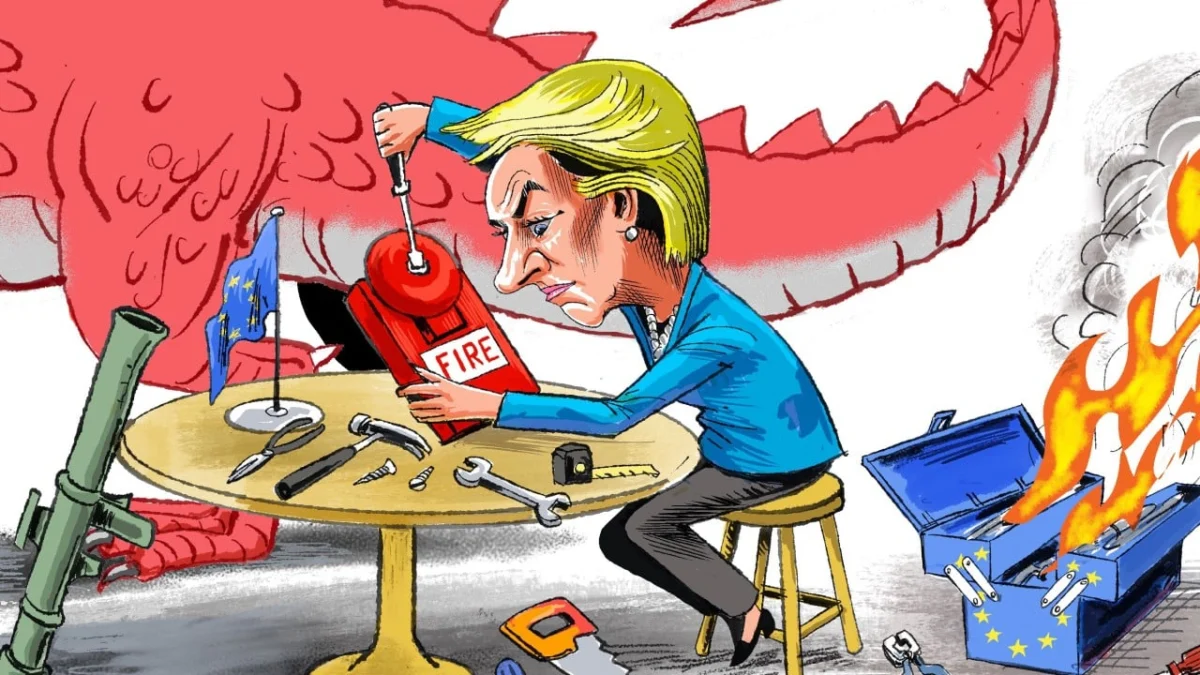
The European Union’s approach to its most complex bilateral relationship is undergoing a fundamental transformation as leaders in Brussels grapple with a widening trade deficit and a series of failed policy frameworks. At the most recent European Council meeting, heads of state and government converged on a new diagnostic label for their economic friction with Beijing: “global macroeconomic imbalances.” This shift in terminology reflects a growing realization within the bloc that previous attempts to recalibrate the relationship—most notably the "de-risking" strategy championed by European Commission President Ursula von der Leyen—have yet to produce the tangible results promised to European industries and voters. As the Commission is directed to engage in a results-oriented dialogue with China while simultaneously developing more robust economic security tools, the EU finds itself at a strategic crossroads, caught between its desire for open markets and the necessity of protecting its industrial base.
The Shift from De-risking to Macroeconomic Imbalances
For the past several years, the European Union has operated under the assumption that it could "de-risk" its relationship with China without fully "de-coupling" from the world’s second-largest economy. This middle-path strategy was intended to reduce critical dependencies—particularly in telecommunications, green energy technology, and raw materials—while maintaining the lucrative trade flows that support European manufacturing. However, the recent adoption of the phrase “global macroeconomic imbalances” suggests a pivot toward a more structural critique of the relationship.
The European Commission’s mandate now emphasizes a dual-track approach. On one hand, President von der Leyen has been tasked with high-level diplomacy focused on achieving specific concessions from Beijing regarding market access and overcapacity. On the other, the EU is doubling down on its "economic security toolkit," a collection of trade defense instruments designed to shield the internal market from what Brussels perceives as unfair competition. Critics of this approach argue that the proliferation of new labels and instruments acts as a facade, masking a deeper uncertainty about how to handle China’s rise as both a necessary economic partner and a formidable systemic rival.
A Chronology of Shifting Paradigms (2019–2024)
The current impasse is the result of a five-year evolution in EU-China policy that has seen the bloc move from cautious optimism to defensive skepticism.
In March 2019, the European Commission released a landmark strategic outlook that famously defined China as a "partner," an "economic competitor," and a "systemic rival" simultaneously. This "triptych" was intended to allow the EU to cooperate on global issues like climate change while competing in technology and confronting Beijing on human rights and governance. However, the balance proved difficult to maintain.
By 2020 and 2021, the relationship soured significantly. The conclusion of the Comprehensive Agreement on Investment (CAI) in late 2020 was quickly followed by its freezing in the European Parliament after China imposed sanctions on several MEPs and European think tanks in response to EU sanctions over human rights concerns in Xinjiang. This period marked the beginning of the EU’s search for "strategic autonomy."
In 2023, the concept of "de-risking" took center stage. Introduced by von der Leyen in a speech ahead of her visit to Beijing, the term was later adopted by the G7. It was during this year that the EU launched its most aggressive trade action to date: an anti-subsidy investigation into Chinese electric vehicles (EVs).
By 2024, the narrative has shifted again. Despite the implementation of various trade defense measures, the EU’s trade deficit with China remains at historically high levels, and European manufacturers continue to struggle with high energy costs and a perceived "China shock" in the green technology sector. The recent European Council meeting’s focus on "macroeconomic imbalances" is an admission that the issue is no longer just about specific trade disputes, but about the fundamental structure of the global economy.
The Trade Deficit: A Statistical Overview of Economic Divergence
The urgency in Brussels is driven by stark economic data. According to Eurostat, the EU’s trade deficit with China has expanded dramatically over the last decade. In 2013, the deficit stood at approximately €104 billion. By 2022, it had ballooned to a record €397 billion. While the deficit narrowed slightly in 2023 to roughly €291 billion—largely due to a decrease in the value of imports rather than a surge in European exports—the underlying trend remains a source of deep concern for European policymakers.
The composition of this trade is equally telling. The EU is heavily reliant on China for 98% of its rare earth element supplies, 97% of its magnesium, and significant portions of its lithium—all of which are essential for the "Green Deal" and the transition to electric mobility. Conversely, European exports to China are dominated by automotive parts, machinery, and luxury goods, sectors that are increasingly under pressure as China moves up the value chain and domestic Chinese brands gain market share.
Furthermore, the "China shock" is particularly visible in the solar industry. Between 2021 and 2023, the price of solar panels in Europe dropped by nearly 50% due to an influx of low-cost Chinese imports, leading several European manufacturers to file for bankruptcy or move production to the United States, where subsidies under the Inflation Reduction Act (IRA) offer a more protective environment.
The Arsenal of "Trade Weapons": Effectiveness and Critiques
In response to these challenges, Brussels has developed what some have called a "trade bazooka"—a suite of legislative tools designed to level the playing field. These include:
- The Anti-Coercion Instrument (ACI): Designed to allow the EU to retaliate if a third country uses economic pressure to influence EU or member state policy (a direct response to China’s trade restrictions on Lithuania).
- The International Procurement Instrument (IPI): Aimed at limiting access to the EU’s public procurement market for countries that do not offer reciprocal access to European companies.
- The Foreign Subsidies Regulation (FSR): Giving the Commission the power to investigate and block deals or public tenders where foreign state subsidies distort the internal market.
- The Carbon Border Adjustment Mechanism (CBAM): While primarily an environmental tool, it serves as a de facto tariff on carbon-intensive imports from countries with less stringent climate regulations.
Despite these tools, the central critique remains: Brussels is treating a competitiveness problem as a regulatory one. Critics argue that while these instruments can punish unfair practices, they do not address the fundamental reasons why European firms are losing ground—such as high energy prices, fragmented capital markets, and a slower pace of digital innovation.
Internal EU Friction: The Diverging Interests of Member States
The EU’s China policy is further complicated by the diverging economic interests of its 27 member states. Germany, with its massive automotive and manufacturing footprint in China, has traditionally favored a more conciliatory approach, fearing that aggressive trade barriers could lead to retaliatory measures against brands like Volkswagen and Mercedes-Benz. In contrast, France has been a vocal proponent of "European sovereignty" and has pushed for tougher anti-subsidy measures to protect domestic industries.
Smaller member states, particularly those in Central and Eastern Europe, often view China through the lens of security and their relationship with the United States. Countries like Lithuania and the Czech Republic have taken more confrontational stances on Taiwan and human rights, leading to friction within the bloc on how to maintain a unified "Team Europe" front. This lack of a singular, coherent diagnosis of what China represents—partner, rival, or competitor—continues to result in a policy that oscillates between engagement and confrontation.
Beijing’s Perspective and the Risk of Retaliation
Beijing has not been a passive observer of the EU’s policy shifts. The Chinese Ministry of Commerce has repeatedly warned that "de-risking" is merely "de-coupling" by another name and has characterized the EU’s anti-subsidy investigations as "naked protectionism."
In January 2024, China launched an anti-dumping investigation into brandy imported from the EU, a move widely seen as a targeted strike against France, the primary driver of the EV probe. Beijing has also hinted at potential restrictions on the export of critical minerals, such as gallium and germanium, which are vital for semiconductor manufacturing. This "tit-for-tat" dynamic raises the specter of a full-scale trade war that could derail the EU’s green transition and further stifle economic growth.
Structural Malaise: Competitiveness vs. Protectionism
The core of the European malaise, as suggested by the recent Council discussions, may lie at home rather than abroad. Analysts point out that the EU’s focus on "new weapons" often serves as an alibi to avoid uncomfortable conclusions about Europe’s own industrial decline.
The gap in technology and innovation between the EU and both the U.S. and China is widening. While the EU excels in regulation, it lags in the commercialization of new technologies. The high cost of energy in the wake of the Ukraine conflict has also placed a permanent "tax" on European manufacturing that trade defense instruments cannot offset. By framing the issue as a "China problem," Brussels risks ignoring the need for deep structural reforms within the Eurozone to foster competitiveness and reduce the regulatory burden on domestic firms.
Conclusion: The Path Forward for European Strategic Autonomy
As the European Commission moves forward with its mandate to address "global macroeconomic imbalances," the success of its strategy will depend on whether it can move beyond rhetoric and provide a measurable accounting of its policies. To date, there has been no public audit of which dependencies have been reduced or what the actual cost of "de-risking" has been for European consumers and businesses.
The path forward requires a more nuanced diagnosis. If Europe is to maintain its status as a global economic power, it must decide whether its priority is to protect its existing industries through barriers or to revitalize its economy through innovation and integration. The search for a "China solution" to Europe’s internal problems may provide temporary political cover, but without a genuine restoration of competitiveness, the "trade bazooka" may find itself with few targets it can hit without also wounding the European economy. The coming months will be a test of whether Brussels can transform its "economic security toolkit" from a collection of defensive reactions into a proactive strategy for long-term growth.
