

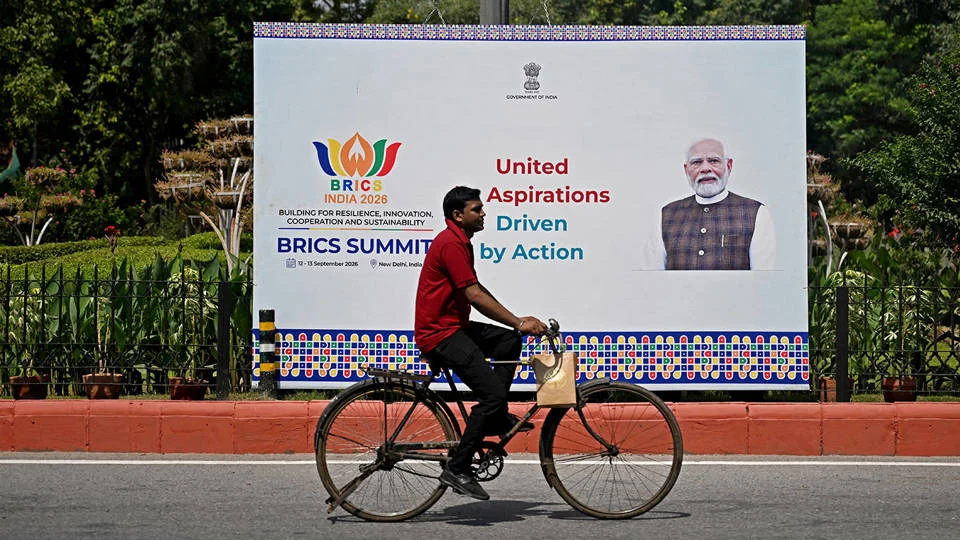
Twenty years ago this month, the foreign ministers of Brazil, Russia, India, and China held the first meeting of the BRICs. Since then, the grouping has been formalized—the first BRIC summit took place in June 2009—and expanded, with South Africa joining in 2011 and several more countries later coming on board, either as full members or official partners. Today, the BRICS represents a highly consequential experiment in international cooperation, which epitomizes the gradual rebalancing of global power away from the West and the emergence of a multipolar order.
If the promise of the BRICS was to establish a monetary union, a single market, or a tightly integrated political alliance, it has not been fulfilled. But if it was to build a platform for emerging economies to cooperate while advancing their own strategic autonomy, the BRICS has exceeded expectations. This assessment, offered by Brahma Chellaney, a noted geopolitical analyst, encapsulates the evolving narrative surrounding the bloc. What began as a quartet of rapidly growing economies has transformed into a significant force shaping global discourse and challenging established Western-dominated international institutions.
Genesis of a New Order: The BRICS Formation and Early Years
The concept of BRIC was first coined in 2001 by then-Goldman Sachs economist Jim O’Neill, who identified Brazil, Russia, India, and China as economies poised for significant growth and global influence in the 21st century. The initial foreign ministerial meeting, held in September 2006, marked the formal commencement of diplomatic engagement among these nations. This was followed by the first BRIC summit in Yekaterinburg, Russia, in June 2009. The primary objective articulated at these early stages was to foster greater economic cooperation and to provide a collective voice for emerging markets on the global stage.
The inclusion of South Africa in 2011, transforming BRIC into BRICS, broadened the bloc’s geographical representation and economic diversity. This expansion was a strategic move, bringing in a significant African economy and further solidifying the group’s commitment to representing the Global South. Over the subsequent decade, BRICS membership has continued to evolve, with the most recent expansion in January 2024 welcoming Saudi Arabia, Iran, Ethiopia, Egypt, and the United Arab Emirates as full members, and Argentina invited but subsequently withdrawing its application. This latest enlargement significantly boosts the bloc’s economic heft and geopolitical reach, particularly in energy markets and in regions traditionally influenced by Western powers.
From Economic Aspirations to Strategic Autonomy
The initial vision for BRICS was heavily centered on economic collaboration. Discussions often revolved around reforming global financial institutions like the International Monetary Fund (IMF) and the World Bank, advocating for greater representation for emerging economies. The establishment of the New Development Bank (NDB) in 2014, headquartered in Shanghai, and its contingent reserve arrangement (CRA) in 2015, marked concrete steps towards creating alternative financial mechanisms. The NDB, often referred to as the "BRICS Bank," aims to finance infrastructure and sustainable development projects in member countries and other emerging economies, providing an alternative to Western-led development finance.
However, the bloc’s ambitions have clearly transcended purely economic cooperation. In an era characterized by geopolitical shifts, rising protectionism, and what many perceive as a decline in the unipolar dominance of the United States, BRICS has increasingly become a platform for advancing strategic autonomy. Member states are seeking to reduce their dependence on Western-led financial systems and to forge independent foreign policy pathways. This pursuit of autonomy is driven by a desire to create a more equitable and multipolar international order, where the interests and perspectives of a wider range of nations are recognized and accommodated.
The Shifting Global Power Landscape: Supporting Data and Trends
The economic and demographic weight of BRICS nations underscores their growing significance. As of 2023, the original five BRICS members (Brazil, Russia, India, China, and South Africa) accounted for approximately 42% of the global population and a substantial portion of global GDP. With the recent expansion, the bloc’s share of global GDP has further increased, with some estimates suggesting it now represents over 30% of the world’s total economic output, surpassing that of the G7 nations.
- Economic Output: The combined GDP of the expanded BRICS bloc, according to 2023 estimates, represents a significant portion of global economic activity. For instance, the inclusion of major oil producers like Saudi Arabia and the UAE, along with the economic powerhouses of China and India, dramatically alters the global economic calculus.
- Demographics: The expanded BRICS group now comprises over 45% of the world’s population, granting it immense demographic influence and a vast consumer market.
- Trade and Investment: BRICS nations are major players in global trade and investment flows. China, in particular, has become a critical hub for manufacturing and supply chains. The collective push for de-dollarization and the exploration of alternative payment mechanisms are also significant trends.
- Energy Markets: The recent accession of key Middle Eastern oil-producing nations has amplified BRICS’ influence in global energy markets, potentially impacting energy pricing and supply dynamics.
These figures highlight the tangible economic and demographic power that BRICS wields. This power is increasingly being translated into a concerted effort to reshape global governance and economic architectures.
Broader Impact and Implications: A Multipolar World in Formation
The rise of BRICS signifies a fundamental shift in the global order. It challenges the post-World War II international system, which was largely designed and dominated by Western powers. The bloc’s growing influence is prompting a re-evaluation of existing international norms and institutions.
Reforming Global Governance
BRICS has consistently advocated for reforms within existing multilateral institutions, such as the United Nations Security Council and the Bretton Woods institutions. Member states argue that these bodies no longer adequately reflect the current geopolitical realities and that emerging economies deserve greater representation and a stronger voice in global decision-making. The establishment of the NDB and the CRA can be seen as early steps towards creating parallel structures that offer alternatives to Western-dominated financial mechanisms.
De-dollarization and Alternative Currencies
A prominent theme within BRICS discussions has been the concept of de-dollarization – reducing reliance on the U.S. dollar as the primary reserve currency and for international trade. While a complete shift away from the dollar is unlikely in the short term, BRICS members are actively exploring and promoting the use of their national currencies in bilateral trade and investment. Initiatives like the NDB’s lending in local currencies and the expansion of bilateral currency swap agreements are part of this broader strategy. The implications of successful de-dollarization efforts could be profound, potentially altering global financial flows and reducing the geopolitical leverage of the United States.
Geopolitical Realignment
The expansion of BRICS has also led to a geopolitical realignment. The inclusion of countries like Iran and Saudi Arabia, which have historically had complex relationships with both the West and each other, signals a desire among these nations to diversify their alliances and assert greater independence. This development is particularly significant in the context of ongoing geopolitical tensions and the fragmentation of the international order. The bloc is emerging as a significant counterweight to Western influence, offering an alternative framework for international cooperation and economic development.
Challenges and Future Trajectory
Despite its growing influence, BRICS faces several internal and external challenges. Divergent economic interests, political systems, and foreign policy objectives among member states can create friction. For instance, the growing economic rivalry between China and India, despite their membership in BRICS, poses a potential challenge to the bloc’s cohesion. Furthermore, the bloc’s ability to present a united front on critical global issues will be tested by the differing priorities of its expanded membership.
Externally, BRICS faces skepticism and, in some quarters, outright opposition from Western powers concerned about its potential to undermine the existing international order. The bloc’s commitment to multipolarity and its critique of Western hegemony are often viewed as a direct challenge to established global norms.
However, the trajectory of BRICS suggests a continued commitment to its core objectives. The bloc is unlikely to become a military alliance or a unified political entity in the mold of NATO or the European Union. Instead, its strength lies in its ability to act as a platform for cooperation, a voice for the Global South, and a catalyst for reforming global governance. As the world continues to navigate a complex and rapidly evolving geopolitical landscape, the role of BRICS as an architect of a multipolar order is likely to become increasingly significant. Its ability to manage internal diversity and to effectively articulate and pursue its collective interests will determine its long-term impact on the global stage. The coming years will be crucial in observing how this expanding bloc navigates the challenges and opportunities of shaping a new international paradigm.
