

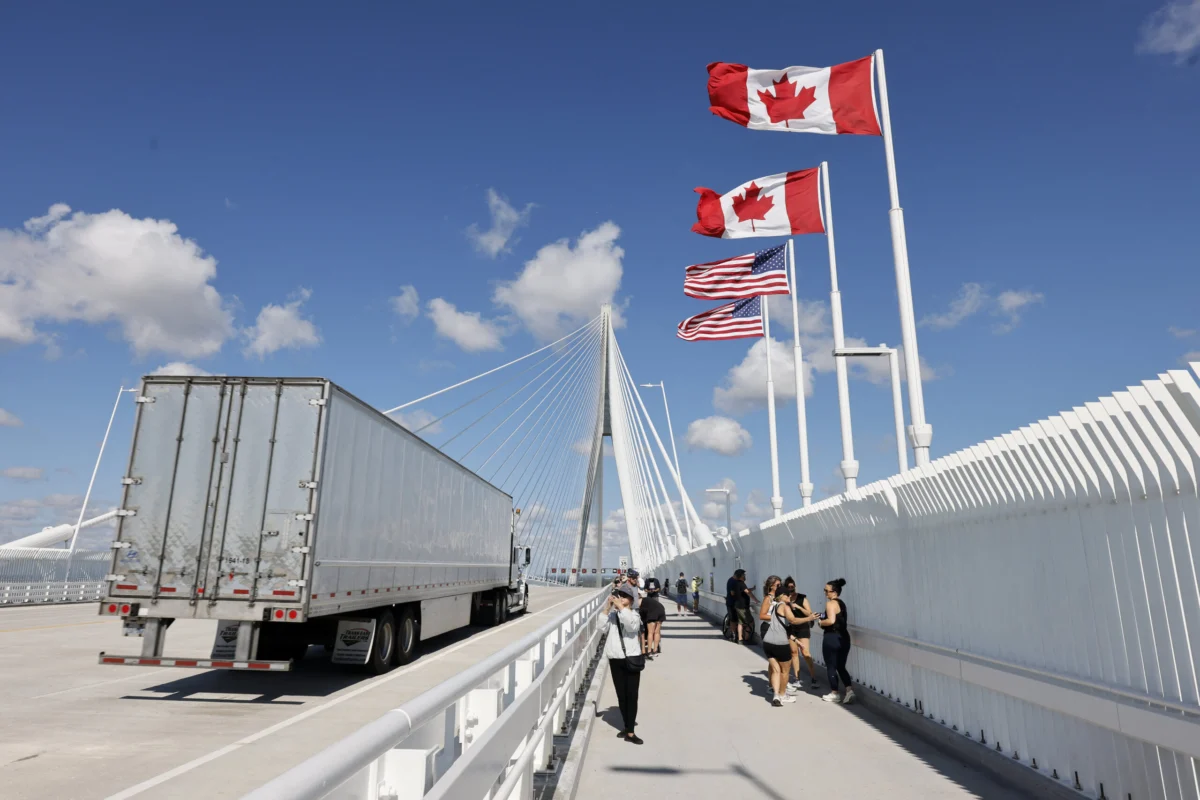
Canada’s retaliatory tariffs on a wide array of U.S. goods officially took effect Tuesday, marking a significant escalation in the burgeoning trade dispute between Ottawa and Washington. The move comes just weeks after trade talks between the two North American neighbors collapsed, ushering in a period of heightened economic friction. The newly imposed duties, ranging from 15% to a substantial 50%, target hundreds of American products valued at approximately CA$27.6 billion. This retaliatory wave directly mirrors U.S. tariffs previously levied on Canadian goods, intensifying the tit-for-tat economic warfare.
The scope of Canada’s retaliatory measures is broad, encompassing critical sectors of the U.S. economy. Consumers and businesses can expect to see increased prices on a diverse range of products including dairy, agricultural equipment, paper goods, household appliances, and electronics. In a particularly sharp escalation, Canadian tariffs on U.S. steel, aluminum, and iron products have been doubled to 50%. Luxury and consumer goods also face significant levies, with furniture, motorbikes, clothing, and certain beauty products being subjected to the highest tariff rate of 50%.
This decisive action by Ottawa is framed as a "dollar for dollar" response to the U.S. imposition of new 50% tariffs on approximately $20 billion worth of Canadian goods, which took effect on August 22. Those U.S. levies, notably invoked under a Depression-era law that has seen infrequent use, were enacted mere hours after prolonged trade negotiations between the two long-standing allies failed to yield an agreement that would have preempted such measures. Officials from both governments have publicly accused each other of introducing untenable last-minute demands, ultimately derailing a trade deal that was reportedly nearing completion.
Canada’s Department of Finance articulated the rationale behind these retaliatory measures, stating that they are designed to protect Canadian workers, producers, and manufacturers. The objective is to level the playing field by enabling domestic businesses to compete more effectively against U.S. products entering the Canadian market. This sentiment underscores a broader concern in Canada about the potential impact of U.S. trade policies on its national industries.
A Chronology of Escalating Trade Tensions
The current tariff dispute is the latest chapter in a complex and often contentious trade relationship between Canada and the United States. The roots of this particular escalation can be traced back to the breakdown of trade negotiations in late August.

- August 22, 2026: The United States imposes new 50% tariffs on approximately $20 billion worth of Canadian goods, including wine, hockey sticks, and other key products. These tariffs are invoked under a rarely used Depression-era law.
- Late August 2026: Trade talks between the U.S. and Canada collapse. Both sides accuse the other of introducing last-minute, untenable demands that scuttled a near-complete trade deal.
- Early September 2026: Canada announces its intention to implement retaliatory tariffs in response to the U.S. levies.
- September 3, 2026: President Donald Trump escalates tensions further by calling for a boycott of Canadian airplane manufacturer Bombardier, demanding that the company build its products in the U.S. if it wishes to access the American market.
- September 5, 2026 (Tuesday): Canada’s retaliatory tariffs on hundreds of U.S. goods, ranging from 15% to 50%, officially go into effect.
Existing Canadian counter-tariffs, including a 25% duty on the politically sensitive automotive sector, remain in force. This indicates a sustained period of trade friction that predates the most recent tariff impositions.
The Bombardier Controversy: A New Front in the Trade War
Adding another layer of complexity and tension to the trade dispute, U.S. President Donald Trump publicly called for a boycott of Canadian airplane manufacturer Bombardier on Monday. In a post on Truth Social, Trump declared, "NO MORE SELLING BOMBARDIER IN THE UNITED STATES! If they want our Market, they must build here, and stop treating America like a ‘piggybank.’" This broadside targeted a specific Canadian company, linking its market access to demands for increased manufacturing within the United States.
Bombardier, in a statement to CNBC, pushed back against the President’s assertions. The company highlighted its significant presence in the U.S., noting that it employs workers in over 20 states and utilizes numerous U.S.-made components in its products. "Bombardier values its great partnership with American companies and its U.S. employees," the company stated, underscoring its contribution to the American economy.
The President’s strong stance also elicited responses from some Republican lawmakers, particularly those representing states where Bombardier maintains a significant operational footprint. Senators from Kansas, a state with a substantial Bombardier presence, voiced concerns. Senator Jerry Moran, R-Kan., emphasized that Bombardier’s operations in Wichita support over a thousand local employees who contribute to national defense and aerospace capabilities. He indicated that he had reached out to the Trump administration to ensure the President was aware of Bombardier’s contributions to Kansas. Similarly, Senator Roger Marshall, R-Kan., stated on X (formerly Twitter) his commitment to protecting the more than 1,200 jobs Bombardier provides in Kansas, noting that he had raised this concern directly with the White House.
Economic Landscape: Trade Flows and Sectoral Impacts
The trade relationship between Canada and the United States is characterized by deep integration and substantial volume. In 2025, the U.S. exported approximately $333.6 billion worth of goods to Canada and imported $381.9 billion from its northern neighbor, according to the U.S. Trade Representative’s office. This indicates a significant trade surplus for Canada. The two nations share robust trade across a wide spectrum of industries, including energy, vehicles, heavy machinery, aircraft, pharmaceuticals, gems and jewelry, furniture, clothing, and a diverse array of food and beverage products.
While the total value of goods directly impacted by the latest tariffs represents a relatively small fraction of the overall bilateral trade, economists caution that the repercussions could be severe for specific sectors and small to medium-sized businesses. Industries that rely heavily on the affected U.S. imports or that face increased costs due to retaliatory tariffs could experience significant disruptions.

In response to the escalating trade friction and the U.S. global tariff offensive that began in April 2025, Ottawa had previously announced a CA$7.5 billion support package for affected businesses and workers. This measure supplemented an existing CA$25 billion allocation, demonstrating a commitment to mitigating the economic fallout of trade disputes. The current retaliatory measures are likely to prompt further consideration of support mechanisms for Canadian industries facing increased costs or reduced access to the U.S. market.
Broader Implications and Future Outlook
The escalating trade dispute between Canada and the United States carries significant implications beyond the immediate economic impact of tariffs. It signals a potential shift in the long-standing, often harmonious, trade relationship between the two countries. The reliance on protectionist measures, particularly the invocation of a Depression-era law by the U.S., raises concerns about the stability of international trade agreements and the broader global economic order.
The dispute also highlights the interconnectedness of national economies and the potential for trade friction to spill over into other areas, as seen with the Bombardier controversy. The challenges faced by industries heavily reliant on cross-border trade, such as the automotive sector, could have cascading effects on employment, investment, and consumer prices.
As the situation evolves, market participants and policymakers will be closely monitoring the duration and intensity of these retaliatory measures. The success of future trade negotiations will likely depend on the willingness of both sides to find common ground and address underlying economic concerns without resorting to protectionist policies. The current trajectory suggests a period of continued uncertainty, with both economies potentially facing headwinds as a result of this deepening trade feud. The long-term consequences for bilateral trade and economic cooperation remain to be seen, but the current path indicates a challenging period ahead.
