

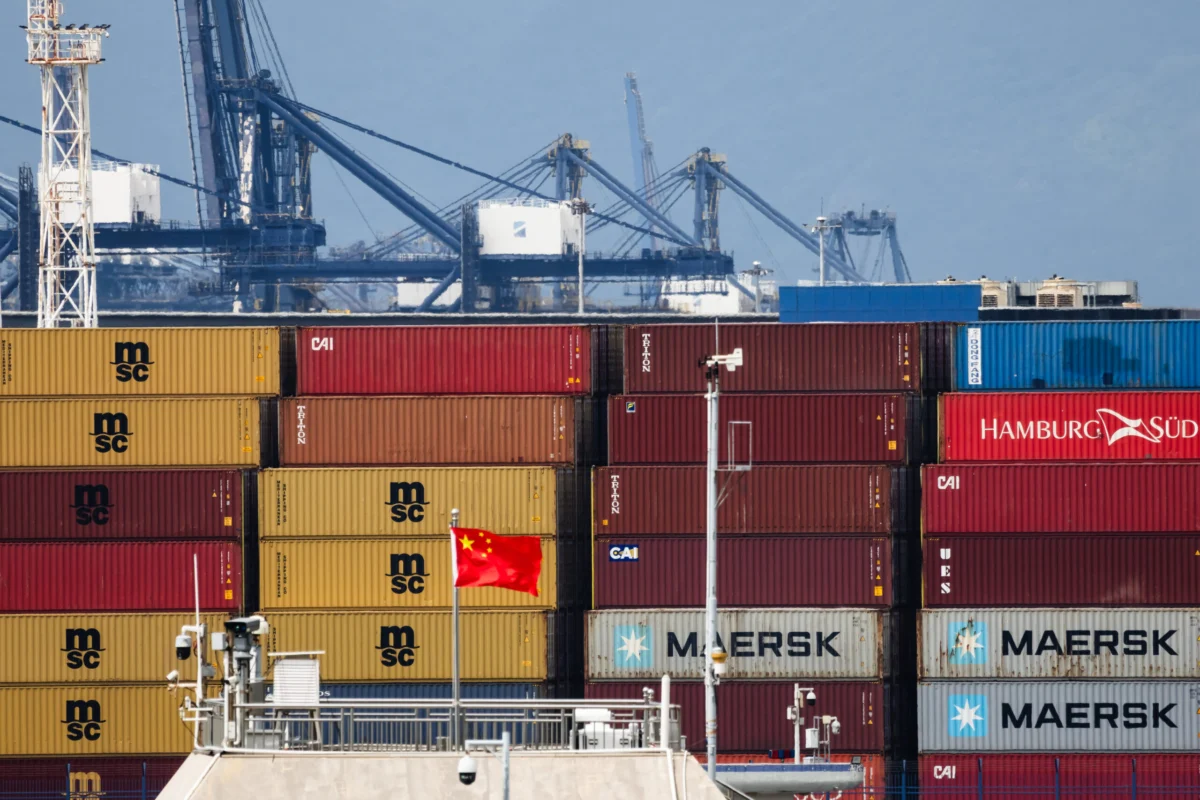
SHENZHEN, CHINA – MAY 1: The Chinese national flag is seen in front of stacked shipping containers bearing MSC (Mediterranean Shipping Company), Maersk, and Hamburg Süd branding at Yantian Port on May 1, 2026, in Shenzhen, Guangdong Province, China. Cheng Xin | Getty Images News | Getty Images
China’s trade performance in August demonstrated a notable acceleration in export growth, a critical lifeline for the world’s second-largest economy as it grapples with persistent sluggishness in domestic demand and increasing international pressure to rebalance its trade. While exports surged beyond expectations, imports, though growing, fell short of economists’ forecasts, underscoring the ongoing challenge of stimulating internal consumption.
Official customs data released on Tuesday revealed that China’s exports, denominated in U.S. dollars, climbed by a robust 25% in August compared to the same period last year. This figure aligns precisely with the consensus forecast of analysts polled by Reuters and represents an uptick from the 23.9% increase recorded in July. This sustained export momentum is a crucial factor underpinning China’s economic activity, particularly as global demand for high-tech components, fueled by the burgeoning artificial intelligence infrastructure build-out, provides a significant cushion against geopolitical headwinds and a subdued domestic investment landscape.
In contrast, imports rose by 28.2% last month. While this signifies a healthy expansion and a pickup from July’s 27.5% growth, it fell short of the 30% anticipated by economists in the Reuters poll. This divergence between export and import performance contributed to a widening of China’s trade surplus, which swelled to $119.09 billion in August, an increase from the $112.5 billion surplus recorded in July. This expanding surplus has intensified scrutiny from global trading partners, who are urging Beijing to address trade imbalances and foster greater domestic consumption.
The data also highlighted significant bilateral trade dynamics. Shipments from China to the United States saw a substantial surge of 34.4% in August, continuing a trend of double-digit gains that has characterized most of the year. U.S. imports from China, meanwhile, grew by 17.8%, according to CNBC’s calculations based on official data. Trade with the European Union also showed an increase, with exports expanding by 6.6% and imports rising by a more modest 0.7%. Notably, China’s trade with South Korea experienced a dramatic uptick, with imports more than doubling and exports jumping by nearly 50% last month, signaling a robust recovery and increased demand in that key Asian market.
Export-Led Growth: A Double-Edged Sword
The continued reliance on exports to drive economic growth is a central theme emerging from the latest trade figures. Zhiwei Zhang, President and Chief Economist at Pinpoint Asset Management, observed that "China continues to rely on exporters to support the economy" as domestic demand remains subdued. He further noted the growing international pushback against China’s trade surpluses, suggesting a mounting challenge for Beijing to maintain its current trade strategy.
The offshore yuan showed minimal reaction to the trade data release, trading at 6.7099 per U.S. dollar on Tuesday. Despite this immediate stability, the Chinese currency has demonstrated resilience throughout the year, outperforming its Asian peers with a year-to-date strengthening of 3.8% against the U.S. dollar. This relative strength of the yuan has implications for both trade competitiveness and international monetary policy discussions.
Calls for a Stronger Yuan and Trade Rebalancing
China’s substantial and persistent trade surpluses have amplified calls from economists and international officials for Beijing to allow its currency to appreciate further. Many argue that the yuan remains significantly undervalued, which unfairly boosts its export competitiveness. Brad Setser, a senior fellow at the Council on Foreign Relations, estimated last month that the Chinese currency is undervalued by as much as 20%. This perceived undervaluation is seen as a key contributor to the export boom and a source of trade friction.

The strong performance of Chinese exports has drawn considerable attention and criticism from Western trading partners, who are increasingly demanding that Beijing rebalance its economy by fostering stronger domestic demand and reducing its reliance on export-led growth. This sentiment was palpable at the recent gathering of Group of 20 finance ministers in the United States earlier this month. The ministers issued a joint statement criticizing economies that heavily depend on exports, with China being the only member country to dissent from this consensus.
Beijing has consistently pushed back against these trade complaints, characterizing them as an "excuse to pressure and restrict China." During a speech at the G20 summit, People’s Bank of China Governor Pan Gongsheng reiterated China’s stance, stating that the country has "never actively pursued" a trade surplus and has not intentionally depreciated its currency for competitive advantage. He also emphasized China’s commitment to maintaining an open market for foreign businesses.
Despite these diplomatic exchanges, frustration in Washington over trade relations remains a significant factor. However, according to analysts, this is unlikely to derail the upcoming high-stakes visit by Chinese leader Xi Jinping to Washington D.C. later this month. This assessment is partly based on the U.S.’s narrowing trade deficit with China in recent periods and its ongoing trade disputes with other global partners, which may temper its singular focus on China.
Navigating Domestic Challenges: Fiscal Stimulus and Monetary Policy
Looking ahead, economists anticipate that China’s economic growth may regain some traction in the latter half of the year. Neo Wang, China Strategist at Evercore ISI, points to "the sense of urgency and determination in Beijing’s recent policy communications" and the stabilizing manufacturing activity in August as positive indicators.
China has set a GDP growth target of 4.5%-5% for the current year. However, the economy experienced a slowdown in the second quarter, with growth decelerating to a more than three-year low of 4.3%. This moderation followed a relatively strong start to the year. Further complicating the economic picture, data released in July indicated a continued weakening of domestic demand and investment, with manufacturing activity contracting for a second consecutive month.
In response to these headwinds, fiscal spending by the Chinese government has accelerated in recent weeks. This increased expenditure is aimed at arresting the decline in investment and restoring economic stability. A significant move in this direction is the government’s plan to inject $54 billion in capital into several state-owned banks and insurers. This measure highlights Beijing’s strategy to bolster growth through constrained stimulus, as it seeks to navigate the complexities of its economic rebalancing act.
The prospect of further monetary easing by the People’s Bank of China (PBOC) also remains a key consideration for economists. Shan Guo, a partner at China-focused Hutong Research, forecasts one or two interest rate cuts by the end of the year. The pace and extent of such cuts are expected to be closely tied to the Federal Reserve’s monetary policy decisions, the Ministry of Finance’s bond issuance activities, and the trajectory of the yuan’s appreciation. Guo suggests that a stronger yuan could provide the PBOC with greater latitude for monetary easing, even if the Federal Reserve continues its tightening cycle. This interplay between currency strength, domestic policy, and global monetary trends will be crucial in shaping China’s economic landscape in the coming months.
The year 2026 has already presented a complex economic narrative for China. While the robust export performance in August offers a welcome boost, the underlying weakness in domestic demand and the increasing international pressure for trade rebalancing present significant challenges. Beijing’s policy responses, including accelerated fiscal spending and potential monetary easing, will be closely watched as the nation strives to achieve its growth targets while navigating a shifting global economic and geopolitical environment. The ability of China to foster a more balanced growth model, one that relies less on external demand and more on robust internal consumption, will be a defining factor in its long-term economic stability and its role in the global economy.
This article was compiled with contributions from CNBC’s Evelyn Cheng.
