

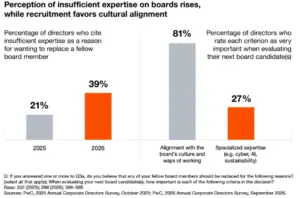
As corporate oversight demands continue to expand and evolve at an unprecedented pace, boards of directors are grappling with a fundamental question: do they possess the requisite capabilities to navigate the complexities of the modern business landscape? A recent analysis reveals that a significant majority of directors (55%) believe there is room for improvement within their current board composition, with more than a third (39%) specifically citing insufficient expertise as the primary reason for a potential board member replacement. This figure represents a substantial increase from 21% in 2025, underscoring a growing awareness of critical skill deficits.
Despite this acknowledged need for specialized knowledge, the survey highlights a curious paradox in board member selection. When evaluating prospective candidates, directors overwhelmingly prioritize cultural alignment, with a staggering 81% deeming it "very important." In stark contrast, only 27% assign the same level of importance to specialized expertise, such as proficiency in artificial intelligence (AI) or cybersecurity. This imbalance suggests that while the need for new skills is recognized, the practical application in recruitment may be lagging, potentially leaving boards ill-equipped for emerging challenges.

The rapid advancement of artificial intelligence stands out as the clearest illustration of this evolving capability landscape. A substantial 71% of directors identify AI as the most crucial skill their boards need to strengthen to ensure more effective oversight. This figure more than doubles the next highest identified skill, indicating a widespread recognition of AI’s transformative impact on business operations, risks, and opportunities. The implications of this gap are profound, as boards are tasked with overseeing the strategic integration and ethical deployment of AI technologies, a responsibility that demands a deep understanding of its potential and pitfalls.
The Growing Imperative for AI and Cybersecurity Expertise
The strategic imperative for AI proficiency on corporate boards is undeniable. As AI technologies permeate every sector, from optimizing supply chains to personalizing customer experiences and driving innovation, boards must be capable of understanding their strategic implications. This includes evaluating the return on investment of AI initiatives, assessing the associated risks of bias, data privacy, and job displacement, and ensuring that AI adoption aligns with the company’s long-term vision and ethical principles. Without adequate expertise, boards risk making ill-informed decisions or failing to capitalize on the transformative potential of AI.
Complementing the need for AI expertise is the enduring challenge of cybersecurity. While a long-standing concern for boards, the advent of AI has introduced new dimensions to this risk landscape. AI-powered cyberattacks are becoming more sophisticated, and the vast datasets processed by AI systems present new vulnerabilities. Consequently, 69% of directors identify cybersecurity and data privacy as their leading AI-related concern. This dual focus on AI and cybersecurity underscores the interconnectedness of these critical domains. Boards must not only understand how to leverage AI but also how to protect their organizations from AI-enabled threats, demanding a sophisticated understanding of threat landscapes, data governance, and incident response protocols.

The increasing sophistication of cyber threats necessitates a proactive approach to cybersecurity oversight. This includes ensuring that companies have robust cybersecurity frameworks in place, conduct regular risk assessments, and have well-rehearsed incident response plans. Directors need to be able to ask probing questions about the effectiveness of these measures and challenge management on their preparedness for evolving threats. The reputational and financial damage from a major cyber breach can be catastrophic, making this an area where board diligence is paramount.
Board Assessments: A Stumbling Block to Effectiveness
Beyond the acquisition of new skills, the effectiveness of a board is also contingent upon its ability to engage in candid self-evaluation. The survey reveals that nearly three-quarters of directors (73%) believe their boards’ assessment processes could be improved, with almost half (49%) indicating that these assessments lack sufficient candor. This suggests a systemic issue in how boards are evaluating their own performance, the dynamics within the boardroom, and the continued alignment of individual director capabilities with the company’s evolving needs.
The importance of robust board assessments cannot be overstated. These processes are crucial for identifying areas of strength and weakness, fostering accountability, and ensuring that the board remains a cohesive and high-performing unit. When assessments are perceived as lacking candor, it can lead to a culture of complacency, hindering the board’s ability to address critical issues and adapt to changing circumstances. A lack of honest feedback can also stifle individual director development and prevent the identification and remediation of performance gaps.

The findings suggest a need for boards to re-evaluate their assessment methodologies. This might involve engaging independent third-party facilitators, implementing more structured evaluation frameworks, and creating a safe environment for open and honest dialogue. The goal should be to move beyond perfunctory reviews to genuinely insightful evaluations that drive continuous improvement and ensure the board is functioning at its optimal capacity.
Strategy Oversight and Challenging Management
The foundational elements of effective board composition and rigorous self-assessment are particularly critical for the board’s most fundamental responsibility: overseeing corporate strategy. Despite the recognized importance of this role, a significant 81% of directors acknowledge that their boards could more effectively challenge management on corporate strategy. This points to a potential gap in the board’s ability to act as a true strategic partner and independent check on management’s proposals.
Challenging management on strategy is not about obstruction but about ensuring that strategic decisions are robust, well-considered, and aligned with shareholder interests. It involves scrutinizing assumptions, exploring alternative scenarios, and demanding clear evidence of the rationale behind proposed strategies. When boards are hesitant to challenge, there is a risk that management’s vision, however well-intentioned, may not be adequately vetted, potentially leading to suboptimal outcomes or unaddressed risks.

The ability of a board to effectively challenge management is directly linked to its expertise and its internal dynamics. Directors who possess deep industry knowledge, financial acumen, and a thorough understanding of emerging trends are better equipped to engage in substantive strategic discussions. Furthermore, a boardroom culture that encourages open debate and diverse perspectives, rather than groupthink, is essential for fostering constructive challenge.
Navigating the Market and Regulatory Environment
In addition to internal dynamics and strategic oversight, boards must also navigate an increasingly complex external landscape. The survey indicates that a substantial majority of directors (81%) believe the benefits of being a publicly traded company outweigh the associated demands of regulation, reporting, and market pressures. However, this majority view is not monolithic, with opinions diverging on the favorability of this balance. Specifically, 42% of directors feel the balance is becoming less favorable, while 39% maintain that the benefits continue to outweigh the demands.
This nuanced perspective highlights the ongoing pressure that public companies face. The rigorous reporting requirements, regulatory scrutiny, and the constant demands of the capital markets can be substantial burdens. For some, the increasing complexity and cost of compliance, coupled with the volatility of public markets, are starting to erode the perceived advantages of public status. This sentiment may be influenced by factors such as the rise of private equity, the increasing burden of ESG (Environmental, Social, and Governance) reporting, and the geopolitical uncertainties that impact market stability.

The observation that the balance is shifting for a significant portion of directors suggests that companies and regulators may need to reassess the efficiency and effectiveness of current disclosure and compliance frameworks. Striking the right balance between providing necessary investor protection and avoiding undue burdens on public companies is a continuous challenge for policymakers.
Looking Ahead: Cultivating Adaptable and Expert Boards
The overarching message from the survey is clear: boards must embrace a culture of continuous learning and adaptation to effectively guide their organizations through an era of unprecedented change. The future success of companies will increasingly depend on boards that possess the foresight to anticipate emerging trends, the agility to respond to evolving challenges, and the sound judgment to make critical decisions.
To foster this adaptability, several key areas require attention:

- Knowledge Refreshment: Directors must commit to ongoing education to stay abreast of technological advancements, market shifts, and evolving regulatory landscapes. This includes dedicated time for learning about critical areas like AI, cybersecurity, and sustainability.
- Strengthening Board Dynamics: Boards need to cultivate an environment that encourages open dialogue, constructive dissent, and diverse perspectives. This involves refining meeting protocols, promoting psychological safety, and ensuring that all voices are heard and valued.
- Constructive Engagement with Management: The relationship between the board and management should be one of partnership, characterized by mutual respect and a shared commitment to the company’s success. This involves clear communication channels, a willingness from management to share information transparently, and a board that is prepared to challenge constructively.
Executives play a crucial role in supporting board effectiveness. By providing directors with the necessary context, data, and insights, they can empower boards to make more informed decisions. Clarity on where board judgment is most valuable – whether in strategic direction, risk oversight, or ethical governance – is essential. Ultimately, the objective is to cultivate an adaptable board equipped with the expertise to comprehend emerging trends, the processes to prioritize critical issues, and the judgment to act decisively when it matters most. This proactive approach is not merely a best practice; it is a fundamental requirement for sustained corporate success in the 21st century.
