

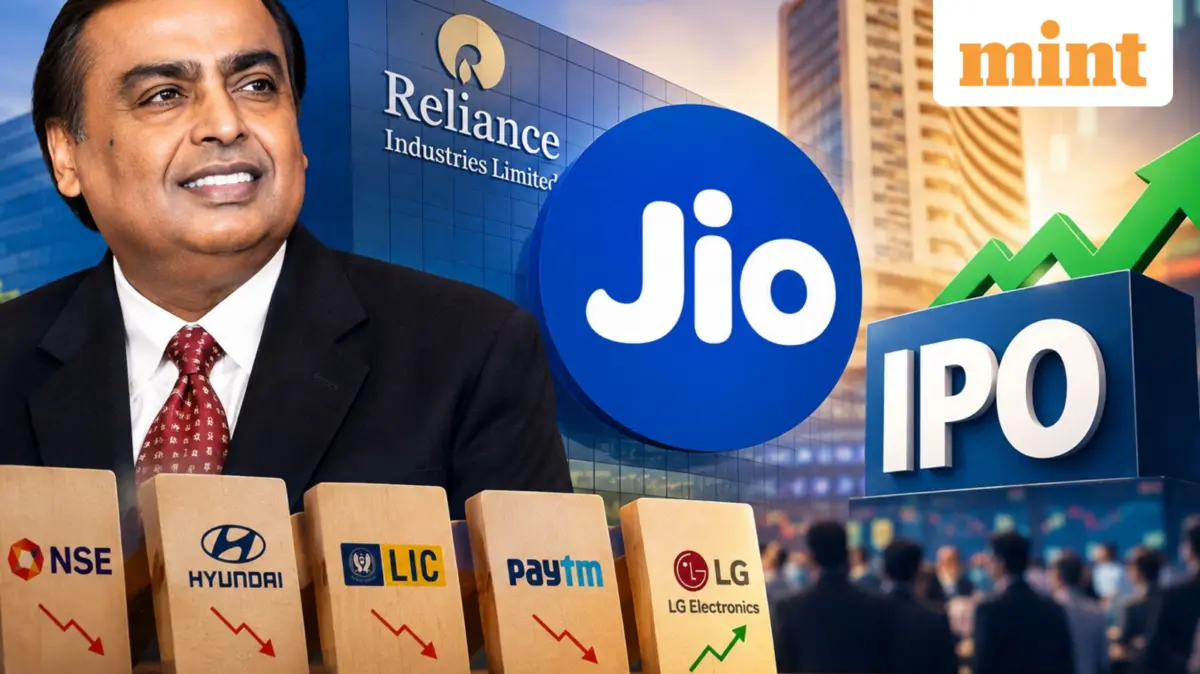
India’s primary market is currently navigating a period of paradoxical performance, where the sheer scale of an Initial Public Offering (IPO) no longer guarantees a celebratory debut on the stock exchanges. As Jio Platforms, the digital and telecommunications arm of Mukesh Ambani’s Reliance Industries Limited (RIL), prepares to launch what is anticipated to be the country’s largest-ever public issue, the shadow of previous "mega-IPO" underperformances looms large. From the tepid listing of Hyundai Motor India to the historic discount of LIC, the Indian markets have developed a cautious stance toward high-valuation, large-cap offerings. However, early indicators—ranging from a massive oversubscription in the anchor book to a resilient grey market premium—suggest that Jio Platforms might possess the unique momentum required to shatter this trend of listing-day disappointment.
The Historical Burden of India’s Largest IPOs
The track record for Indian IPOs with issue sizes exceeding ₹10,000 crore has been historically underwhelming. Data indicates that out of the 13 largest offerings in the history of the Indian capital markets, eight have failed to provide investors with significant listing-day gains. This phenomenon is often attributed to "valuation fatigue," where the pricing of a large issue leaves little "money on the table" for retail and institutional investors once the stock begins secondary market trading.
One of the most recent examples of this trend is Hyundai Motor India. In October 2024, the South Korean automaker’s Indian subsidiary launched a massive ₹27,858 crore IPO. Despite the company’s strong brand equity and market share, the shares debuted at ₹1,934, a discount to the issue price of ₹1,960. Analysts noted at the time that the sheer size of the issue required an immense amount of liquidity to sustain a post-listing rally, which the market was unable to provide in the short term.
The narrative of struggling giants is perhaps best personified by the Life Insurance Corporation of India (LIC). In May 2022, the state-owned insurer’s ₹21,000 crore IPO—then the largest in India—was met with significant fanfare. However, the stock listed at an 8.62% discount, opening at ₹867.20 against an issue price of ₹949. Similarly, One 97 Communications, the parent company of Paytm, saw its ₹18,300 crore IPO in November 2021 list at a 9.3% discount. Paytm’s debut became a cautionary tale for the fintech sector, as the stock price continued to erode for months following its listing. Even the National Stock Exchange (NSE), a pillar of the financial ecosystem, saw a modest premium of just 0.84% upon its recent entry into the public domain.
Amidst these struggles, LG Electronics India stands as a notable outlier. Its public offering delivered a staggering 50% listing premium, proving that while large-cap listings are difficult to execute, they are not destined for failure if the timing, sector sentiment, and valuation align perfectly.
Jio Platforms: A Strategic Departure for Reliance Industries
The Jio Platforms IPO is not merely another large-cap entry; it represents a seismic shift for the Reliance group. This marks the first public issue from the Mukesh Ambani-led conglomerate in nearly two decades. For the market, this is a milestone event, signaling the transition of Reliance from a traditional petrochemical-heavy giant into a consumer-centric digital powerhouse.
Since filing its Draft Red Herring Prospectus (DRHP) in June, Jio Platforms has been positioned as more than just a telecom provider. It is an integrated digital ecosystem encompassing high-speed 5G connectivity, fiber-to-the-home (FTTH) services, and a suite of digital applications spanning media, commerce, and finance. This diversification is a key factor in why analysts believe Jio might avoid the pitfalls of pure-play industrial or insurance IPOs.
The offering is viewed as a value-unlocking exercise for Reliance Industries’ shareholders and a formal valuation benchmark for the digital business, which has already seen significant private equity investment from the likes of Google and Meta (formerly Facebook).
Unprecedented Demand in the Anchor Book
If the strength of the anchor book is any indication of broader market sentiment, Jio Platforms is already ahead of its predecessors. On Monday, the company successfully allotted shares worth ₹8,109.85 crore to 212 anchor investors. This allotment was made at the upper end of the price band, which is set at ₹1,119 per share.
What caught the attention of market veterans was the sheer scale of institutional interest. Demand for the anchor portion reportedly exceeded ₹2.5 trillion. This means the anchor book was subscribed more than 30 times the available shares, a level of demand rarely seen in issues of this magnitude.
The list of participating anchor investors reads like a "who’s who" of global finance. It includes sovereign wealth funds and asset management giants such as:

- BlackRock: The world’s largest asset manager.
- GIC (Singapore): A major sovereign wealth fund with a long-term horizon.
- Abu Dhabi Investment Authority (ADIA): Bringing significant Middle Eastern capital.
- Fidelity Investments and JPMorgan Asset Management: Providing a stamp of approval from the US financial sector.
- Schroders, Franklin Templeton, and Invesco: Further diversifying the institutional base.
This high concentration of "long-only" institutional capital suggests that the world’s most sophisticated investors view Jio Platforms as a long-term compounder rather than a speculative listing-gain play.
Grey Market Indicators and Valuation Metrics
As of Tuesday, the Grey Market Premium (GMP) for Jio Platforms has been hovering around ₹200 to ₹260. At the upper end of this range, the GMP suggests a potential listing premium of approximately 18% to 23% over the issue price of ₹1,119.
While the grey market is an unregulated and unofficial indicator, it often reflects the retail and high-net-worth individual (HNI) sentiment toward an IPO. An 18% premium for an issue of this size would be a significant victory, potentially adding billions of dollars to the company’s market capitalization on day one.
The valuation of Jio Platforms is a critical component of this optimism. By pricing the shares at ₹1,119, the company is seeking a valuation that reflects its dominant position in the Indian telecom market—where it holds the largest subscriber base—and its growth potential in the digital services space. Unlike Paytm, which faced criticism for lack of profitability at the time of its IPO, Jio Platforms is a cash-generating entity with a clear path toward increasing its Average Revenue Per User (ARPU).
Chronology of the Jio Platforms Public Offering
The journey to this IPO has been years in the making, following a deliberate strategy by Reliance Industries to deleverage its balance sheet and invite global partners.
- 2020: Reliance Jio raised over ₹1.5 lakh crore from global investors including Facebook, Google, Silver Lake, and KKR, setting a private market valuation floor.
- June 2026: Jio Platforms filed its DRHP with the Securities and Exchange Board of India (SEBI), officially beginning the countdown to the public issue.
- Early October 2026: SEBI provided its final observations and approval for the IPO.
- October 19, 2026: The company announced its price band of ₹1,080 to ₹1,119.
- October 20, 2026: The anchor book opened and closed, recording over ₹2.5 trillion in demand.
- October 21, 2026: The IPO officially opens for public subscription.
Broader Implications for the Indian Equities Market
The success or failure of the Jio Platforms IPO will have ramifications far beyond the Reliance conglomerate. A strong listing would likely reinvigorate the Indian primary market, providing a "green light" for other tech unicorns and large-scale enterprises currently waiting on the sidelines. Companies like Swiggy, Zepto, and various green energy subsidiaries of major conglomerates are reportedly watching the Jio debut closely to gauge market appetite for large-ticket issues.
Furthermore, a successful listing would bolster the weighting of the digital services sector within the Nifty 50 and Sensex indices. As India continues its transition toward a digital economy, the presence of a trillion-dollar (in rupee terms) digital native company on the exchanges provides a more accurate reflection of the country’s economic evolution.
However, risks remain. Global macroeconomic factors, including fluctuating crude oil prices and interest rate trajectories in the United States, could impact FII (Foreign Institutional Investor) flows into India. Additionally, any post-listing volatility in the broader market could dampen the enthusiasm for Jio, regardless of its fundamental strength.
Conclusion: Can the Trend Be Broken?
The "curse" of the Indian mega-IPO is rooted in the difficulty of finding enough liquidity to drive a massive stock significantly higher on its first day of trading. However, Jio Platforms enters the market with several advantages that Hyundai, LIC, and Paytm lacked. It has the backing of India’s most successful conglomerate, a proven track record of industry disruption, and an anchor book that demonstrates overwhelming global confidence.
While history suggests caution, the specific dynamics of the Jio Platforms offering—particularly the 30x anchor subscription and the healthy grey market activity—point toward a debut that could finally buck the trend. If Jio Platforms delivers a strong listing, it will not only reward its investors but also redefine the parameters of success for large-scale public offerings in India’s maturing financial landscape.
Disclaimer: The information provided in this article is for informational purposes only and does not constitute financial advice. Market investments are subject to risk, and investors are urged to consult with certified financial advisors before making investment decisions.
