

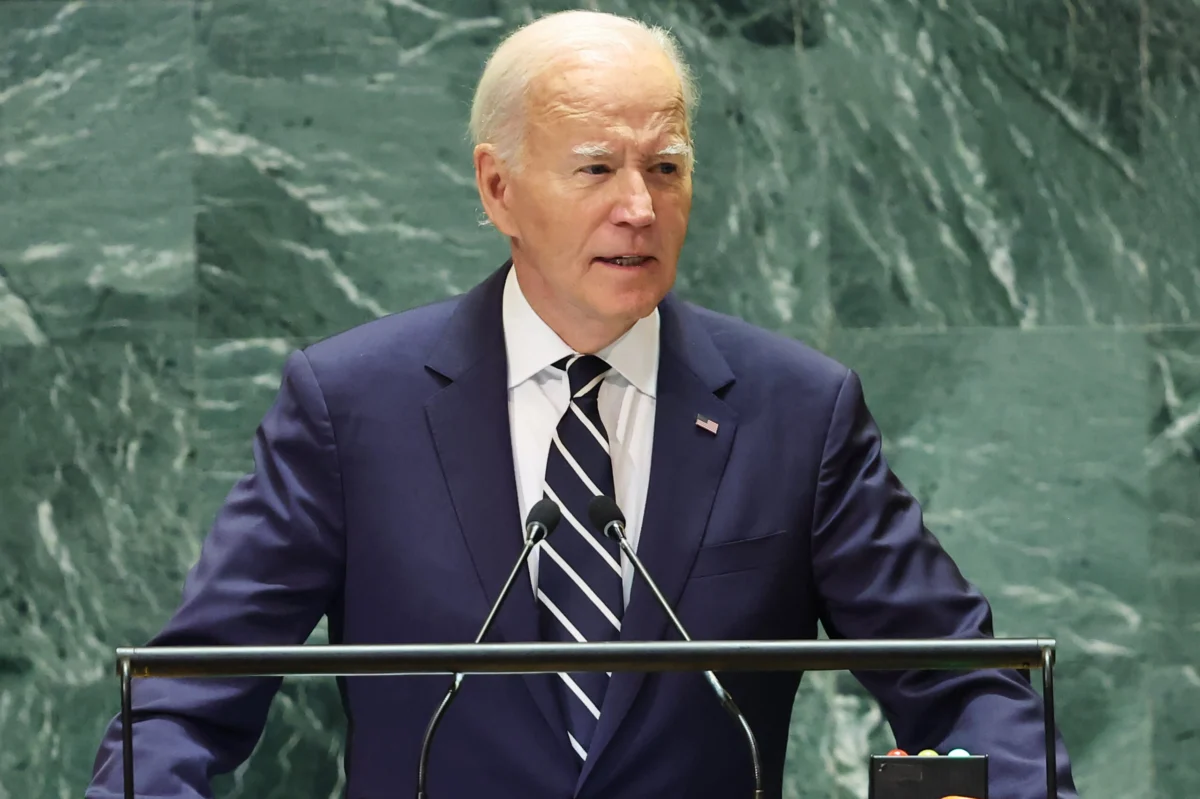
President Joe Biden stood before the United Nations General Assembly on Tuesday to deliver the final address of his presidency, attempting to reconcile a half-century of diplomatic idealism with a world currently fractured by brutal conflicts in Europe, the Middle East, and Africa. Speaking to the 79th session of the global body in New York City, Biden sought to frame his four-year tenure not merely as a period of crisis management, but as a sustained effort to preserve the international order established in the wake of World War II. The President’s remarks arrived at a pivotal moment, as the "inflection point" he has frequently cited throughout his term appears to have reached a fever pitch, with the threat of a wider regional war in the Middle East and a grinding war of attrition in Ukraine dominating the global agenda.
"I know many look at the world today and see difficulties and react with despair," Biden told the assembled heads of state and diplomats. "But maybe because of all I’ve seen and all we have done together over the decades, I have hope." This message of cautious optimism was tempered by the immediate gravity of the geopolitical landscape, which offered little room for the traditional "victory lap" often associated with a departing world leader. Instead, Biden used his platform to issue a stern warning against isolationism and a passionate defense of democratic values, while simultaneously addressing the humanitarian catastrophes that continue to challenge the efficacy of the United Nations.
A Legacy of Alliances and the Challenge of Ukraine
A central pillar of Biden’s address was the ongoing defense of Ukraine, a conflict that has come to define much of his administration’s foreign policy. Since the full-scale Russian invasion in February 2022, the United States has led an international coalition to provide unprecedented levels of military, economic, and humanitarian aid to Kyiv. Biden reminded the assembly that when Russian tanks first crossed the border, the survival of the U.N. Charter itself was at stake. He emphasized that the global response—spearheaded by the U.S. and its NATO allies—was a necessary stand against the principle that "might makes right."
Biden pointed to the expansion of NATO, which recently welcomed Finland and Sweden into its ranks, as a direct consequence of President Vladimir Putin’s miscalculations. However, he also acknowledged the growing fatigue within some domestic and international circles. In the United States, a vocal faction of the Republican Party has expressed increasing skepticism regarding continued funding for Ukraine, a sentiment that Biden indirectly addressed by urging world leaders to maintain their resolve. "You cannot let up," he cautioned. "You cannot grow weary. We will not let up on our support for Ukraine, not until Ukraine wins a just and durable peace."
The timing of these remarks is significant, as Ukrainian President Volodymyr Zelenskyy is scheduled to meet with Biden at the White House later this week. Zelenskyy is expected to present a "victory plan" that reportedly includes requests for long-range strike capabilities and guaranteed security paths—proposals that will test the limits of the Biden administration’s support in its final months.
The Middle East on the Brink
While Ukraine remains a strategic priority, the escalating violence in the Middle East provided a somber backdrop to the President’s speech. Since Biden’s last UNGA address in September 2023, the region has been transformed by the October 7 Hamas attacks and Israel’s subsequent military campaign in Gaza. The conflict has recently expanded, with Israel and Hezbollah engaging in the most significant exchange of fire in nearly two decades along the Lebanese border.
Biden addressed the humanitarian toll in Gaza with a level of urgency that reflected the mounting pressure from the international community and domestic constituencies. He reiterated his administration’s commitment to a three-phase ceasefire and hostage deal, which has remained elusive despite months of intensive mediation involving Egypt and Qatar. "Now is the time for the parties to finalize its terms, bring the hostages home, to secure security for Israel and Gaza free from Hamas’ grip, ease the suffering in Gaza, and end this war," Biden declared.
Furthermore, the President pivoted to the broader regional stability, specifically condemning the rise in violence against innocent Palestinians in the West Bank. He reaffirmed his support for a two-state solution, describing it as the only viable path toward a future where Israel enjoys normalized relations with its neighbors and Palestinians live with "security, dignity, and self-determination." This vision, however, remains at odds with the current political reality on the ground, where the Israeli government has largely rejected calls for Palestinian statehood.
Addressing the "Forgotten War" in Sudan
In a departure from the primary focus on Ukraine and the Middle East, Biden dedicated a portion of his speech to the civil war in Sudan, a conflict often overshadowed by other global crises. Since April 2023, the struggle between the Sudanese Armed Forces (SAF) and the paramilitary Rapid Support Forces (RSF) has displaced millions and created one of the world’s worst hunger crises.
Biden called on the international community to stop the flow of weapons to the warring generals and to prioritize humanitarian access. By highlighting Sudan, the President sought to demonstrate that his administration’s "moral leadership" extends beyond traditional Western interests, addressing the U.N.’s core mission of preventing mass atrocities and providing relief to the vulnerable.

Strategic Competition and Emerging Threats
Beyond active conflicts, Biden outlined his administration’s approach to the systemic challenges of the 21st century. He touched upon the management of competition with China, insisting that while the U.S. will continue to push back against unfair economic practices and coercion in the South China Sea, it does not seek a "new Cold War."
The President also introduced global principles for artificial intelligence, an area where his administration has sought to lead by establishing safety standards and ethical guidelines. He argued that the rapid advancement of technology must be harnessed to benefit humanity rather than to empower autocrats or facilitate misinformation. This focus on "governing the future" is a key element of Biden’s effort to modernize international institutions to meet contemporary threats.
The Transition of Power and the 2024 Election
Perhaps the most personal moment of the address came when Biden discussed his decision to withdraw from the 2024 presidential race. In July, following concerns over his age and performance, Biden announced he would not seek re-election, endorsing Vice President Kamala Harris as his successor.
In the hallowed halls of the United Nations, Biden framed this personal decision as a lesson in democratic leadership. "As much as I love the job, I love my country more," he said. "My fellow leaders, let us never forget: Some things are more important than staying in power." This statement served as a subtle but clear rebuke to authoritarian leaders worldwide who have manipulated laws to extend their tenures, as well as a reflection on the peaceful transition of power within the United States.
The shadow of the upcoming election loomed large over the assembly. Foreign leaders are acutely aware that the outcome of the November vote could fundamentally alter U.S. foreign policy. While Biden and Harris represent a continuation of the current internationalist approach, former President Donald Trump has championed an "America First" platform that has previously questioned the value of NATO and traditional alliances.
A Week of High-Stakes Diplomacy
Biden’s speech kicked off a grueling week of diplomatic activity. Following his remarks, the President participated in a summit focused on the trafficking of synthetic drugs, a domestic crisis with deep international roots. His schedule for the remainder of the week includes a meeting with Vietnamese President Tô Lâm, reflecting the administration’s "Indo-Pacific strategy" and the deepening ties with Hanoi as a hedge against Chinese influence.
Earlier in the week, Biden hosted the "Quad" leaders from Australia, India, and Japan in his hometown of Wilmington, Delaware, emphasizing the importance of maritime security and regional stability. He also met with United Arab Emirates President Mohamed bin Zayed Al Nahyan, highlighting the UAE’s growing role as a middle-power mediator in the Middle East.
Simultaneously, Vice President Kamala Harris has taken an increasingly prominent role on the world stage, holding her own meetings with world leaders, including the UAE President and President Zelenskyy. This dual-track diplomacy serves to introduce Harris to the global community as a potential president-in-waiting while maintaining the current administration’s momentum.
Analysis: The Biden Doctrine at its Sunset
As Joe Biden prepares to exit the world stage, his final UNGA address serves as a testament to a presidency that sought to restore American leadership through traditional alliances. The "Biden Doctrine"—characterized by multilateralism, the defense of democracy against autocracy, and a belief in the power of personal diplomacy—has faced its most severe tests in the last 24 months.
While Biden can claim success in revitalizing NATO and strengthening partnerships in the Pacific, the unresolved wars in Gaza and Ukraine cast a long shadow over his legacy. The President’s speech was an attempt to convince the world that the "difficulties" of the present are not insurmountable and that the international system he has championed for 50 years remains the best hope for a peaceful future.
However, the reality of a multipolar world, where regional powers increasingly act independently of Washington’s influence, suggests that the next administration will inherit a landscape that is more fractured and less predictable than the one Biden entered in 2021. Whether his message of hope will resonate beyond the assembly hall remains to be seen, but for one final time, Joe Biden used the world’s most prominent stage to argue that the survival of the global order depends on the collective will of those who lead it.
