

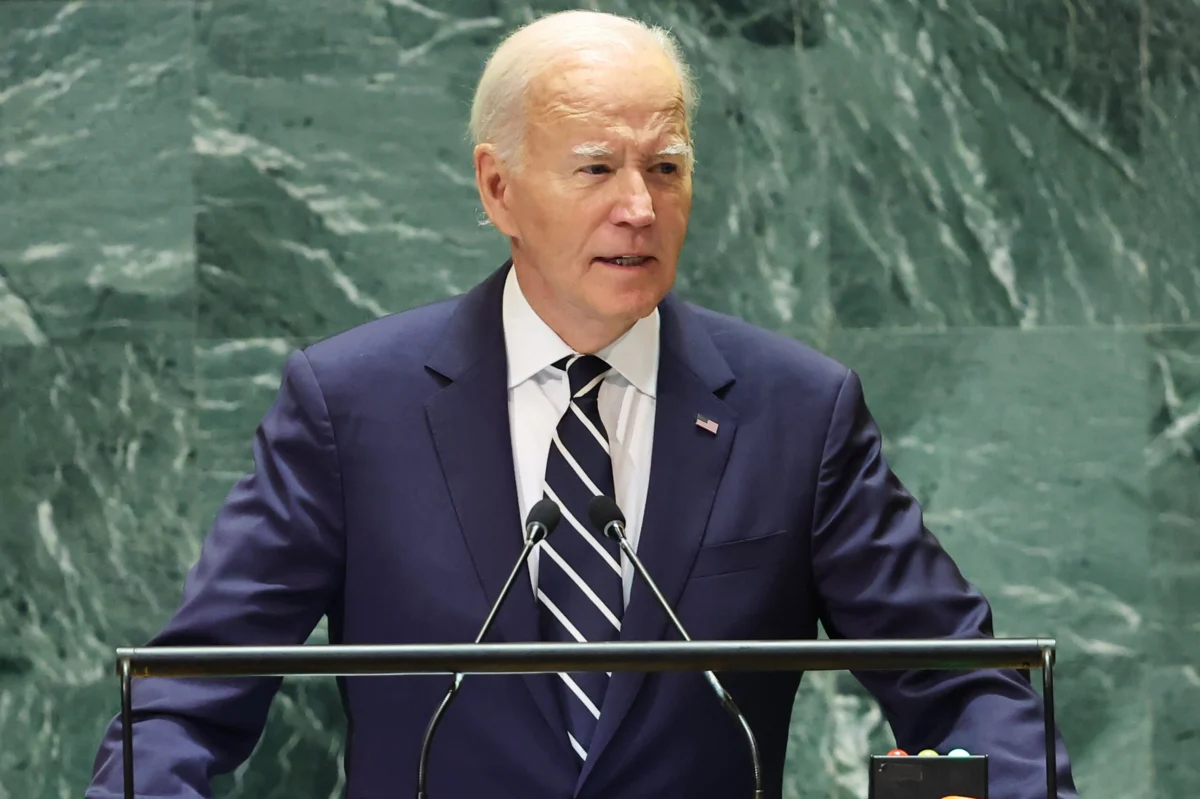
President Joe Biden stood before the United Nations General Assembly on Tuesday, delivering his final address as the leader of the United States to a room filled with world leaders, diplomats, and observers. In a speech that served as both a valedictory reflection on a fifty-year career in public service and an urgent appeal for collective action, Biden attempted to reconcile his administration’s diplomatic aspirations with the brutal realities of escalating conflicts in the Middle East, Eastern Europe, and Africa. Speaking at the 79th session of the General Assembly in New York, the President acknowledged the pervasive sense of "despair" that has gripped the international community but countered it with a plea for "hope," grounded in the historical capacity of nations to overcome seemingly insurmountable odds through unity and adherence to the international order.
The address came at a pivotal moment in global history. While Biden sought to frame his foreign policy legacy around the revitalization of alliances and the defense of democratic norms, the backdrop was one of extreme volatility. From the devastating humanitarian collapse in Gaza and the threat of a wider regional war in Lebanon to the grinding war of attrition in Ukraine and the catastrophic civil war in Sudan, the "rules-based order" Biden has long championed is facing its most significant stress test since the end of the Cold War. With only four months remaining in his term, Biden used the platform to argue that the choices made by the leaders in the room would determine the trajectory of the 21st century.
A Legacy Framed by Crisis and Resilience
President Biden began his remarks by reflecting on the state of the world when he took office in January 2021. He reminded the assembly that his presidency began in the shadow of a global pandemic, domestic political upheaval, and a sense of declining American engagement on the world stage. "I came to the presidency at a time of crisis and uncertainty," Biden remarked, noting that his administration’s primary goal had been to restore American leadership while fostering a "new era of humbler, yet more effective" diplomacy.
The President’s speech touched upon what the White House considers its hallmark foreign policy achievements. Chief among these was the swift and sustained mobilization of a global coalition to support Ukraine following Russia’s full-scale invasion in February 2022. Biden also highlighted the administration’s efforts to manage the complex, competitive relationship with China through "de-risking" rather than "decoupling," and the establishment of global principles for the ethical development of artificial intelligence (AI). However, he was quick to pivot from these achievements to the "grim reality" of the present, acknowledging that the international community is currently grappling with multiple, simultaneous "poly-crises."
The Middle East: A Region on the Brink
A significant portion of the President’s address was dedicated to the volatile situation in the Middle East. Since Biden’s last address to the UNGA in September 2023, the region has been transformed by the October 7 Hamas attacks and the subsequent, ongoing Israeli military operations in Gaza. The conflict has reached a critical juncture, with the death toll in Gaza surpassing 41,000 according to local health officials, and a worsening humanitarian crisis that has left millions facing food insecurity and displacement.
"Now is the time for the parties to finalize the terms," Biden declared, referring to the cease-fire and hostage release deal that the United States, Qatar, and Egypt have been mediating for months. He emphasized that such a deal is essential to "bring the hostages home, secure security for Israel, and ensure Gaza is free from Hamas’ grip." Furthermore, Biden addressed the recent escalation between Israel and Hezbollah in Lebanon, which has raised fears of a full-scale regional conflagration. He called for a diplomatic solution along the Blue Line, the demarcation line between the two nations, to prevent further bloodshed.
In a notable addition to his previous rhetoric, Biden also spoke directly to the rising violence in the West Bank. He called for an end to attacks against innocent Palestinians and reiterated his firm belief in a two-state solution. He described a future where Israel enjoys full recognition and normalized relations with its neighbors, while Palestinians live in "security, dignity, and self-determination in a state of their own."
Ukraine: The Persistence of the Defense Against Aggression
As the war in Ukraine enters its third year, Biden used the UNGA stage to reaffirm the United States’ unwavering commitment to Kyiv. This comes at a time of increasing domestic political pressure, as some members of the U.S. Congress, particularly within the Republican Party, have expressed skepticism regarding the continued flow of multi-billion dollar aid packages. Since the start of the conflict, the U.S. has authorized over $175 billion in total assistance to Ukraine, including advanced weaponry like HIMARS, Abrams tanks, and Patriot missile systems.
"We could have stood by and merely protested," Biden told the assembly, "but Vice President [Kamala] Harris and I understood that [the invasion] was an assault on everything this institution was supposed to stand for." He celebrated the expansion of NATO, which saw Finland and Sweden join the alliance in response to Russian aggression, but warned that the international community "cannot grow weary."
The timing of the speech is critical, as Ukrainian President Volodymyr Zelenskyy is scheduled to meet with Biden at the White House later this week to present what he calls a "Victory Plan." Biden’s remarks served as a preemptive strike against isolationist sentiments, arguing that a victory for Russia would signal the end of the UN Charter’s protections for sovereign borders. "We will not let up on our support for Ukraine, not until Ukraine wins a just and durable peace," Biden vowed.

The Forgotten War in Sudan and Global Responsibility
While Ukraine and the Middle East dominated the headlines, Biden made a point to address the catastrophic conflict in Sudan. Since April 2023, the war between the Sudanese Armed Forces (SAF) and the Rapid Support Forces (RSF) has created the world’s largest displacement crisis. Over 10 million people have been forced from their homes, and international monitors have recently confirmed famine conditions in parts of North Darfur.
Biden called on the global community to stop the flow of arms to the warring generals and to pressure both sides to return to the negotiating table. He framed the crisis in Sudan as a test of the UN’s humanitarian mission, urging member states to fulfill their funding pledges for relief efforts. The inclusion of Sudan in his address was seen by analysts as an attempt to counter the perception that the U.S. is only concerned with conflicts that directly impact Western security interests.
A Personal Reflection on Power and Democracy
In one of the most poignant moments of the speech, President Biden addressed his decision to withdraw from the 2024 presidential race. In July, following a period of intense internal party debate, Biden announced he would not seek re-election, effectively passing the torch to Vice President Kamala Harris. At the UN, he used this personal transition as a metaphor for democratic leadership.
"As much as I love the job, I love my country more," Biden said, receiving a round of applause. "I decided, after 50 years of public service, it’s time for a new generation of leadership to take my nation forward." He issued a challenge to the other leaders in the room, many of whom have held power for decades: "My fellow leaders, let us never forget: Some things are more important than staying in power. Your people are what matter most."
Diplomatic Chronology and the Path Ahead
The UNGA address is only one component of a grueling final diplomatic sprint for the Biden administration. The President’s schedule for the week reflects a "full-court press" on multiple geopolitical fronts:
- September 21: Biden hosted the Quad Summit (Australia, India, Japan) in Wilmington, Delaware, focusing on maritime security in the Indo-Pacific.
- September 23: A bilateral meeting with UAE President Mohamed bin Zayed Al Nahyan focused on regional stability and the "IMEC" (India-Middle East-Europe Economic Corridor) project.
- September 24: Following the UNGA speech, Biden chaired a summit on the global synthetic drug crisis, targeting the fentanyl supply chain.
- September 25: A scheduled meeting with Vietnamese President Tô Lâm to solidify the Comprehensive Strategic Partnership established last year.
- September 26: A high-stakes meeting with President Zelenskyy to discuss the "Victory Plan" and additional military aid.
The Shadow of the 2024 Election
Despite Biden’s focus on the present, the "shadow presidency" of the 2024 election loomed large over the halls of the United Nations. Foreign leaders are increasingly hedging their bets, seeking meetings not just with the sitting administration but with the two individuals who might lead the U.S. come January: Vice President Kamala Harris and former President Donald Trump.
Harris has taken an increasingly visible role, conducting her own bilateral meetings with leaders like the UAE President and preparing for her own session with Zelenskyy. Simultaneously, Donald Trump’s campaign has indicated that the former President plans to meet with Zelenskyy, Indian Prime Minister Narendra Modi, and Polish President Andrzej Duda. This dual-track diplomacy highlights the global anxiety over the potential for a radical shift in U.S. foreign policy—from Biden’s multilateralism to Trump’s "America First" approach.
Analysis: The End of an Era
Biden’s final UNGA address marks the end of an era for a specific brand of American internationalism. For five decades, Joe Biden has been a fixture of the foreign policy establishment, believing deeply in the efficacy of personal relationships between leaders and the moral necessity of American intervention in global affairs.
However, the world he leaves behind is arguably more fractured than the one he inherited. The "hope" he spoke of is tempered by the reality of a paralyzed UN Security Council, where veto powers frequently stall action on Gaza and Ukraine. Furthermore, the rise of the "Global South" as a non-aligned bloc suggests that the U.S.-led order is being challenged by nations that seek a more multipolar world.
Ultimately, Biden’s speech was an attempt to provide a roadmap for his successor. By emphasizing the defense of Ukraine, the necessity of a two-state solution in the Middle East, and the ethical management of new technologies, he sought to cement a legacy of "principled engagement." Whether that legacy survives the upcoming U.S. election and the shifting tides of global power remains the defining question for the international community. As the President concluded his remarks and stepped away from the green-marbled podium, the message was clear: the world is at an inflection point, and the window for collective action is rapidly closing.
