

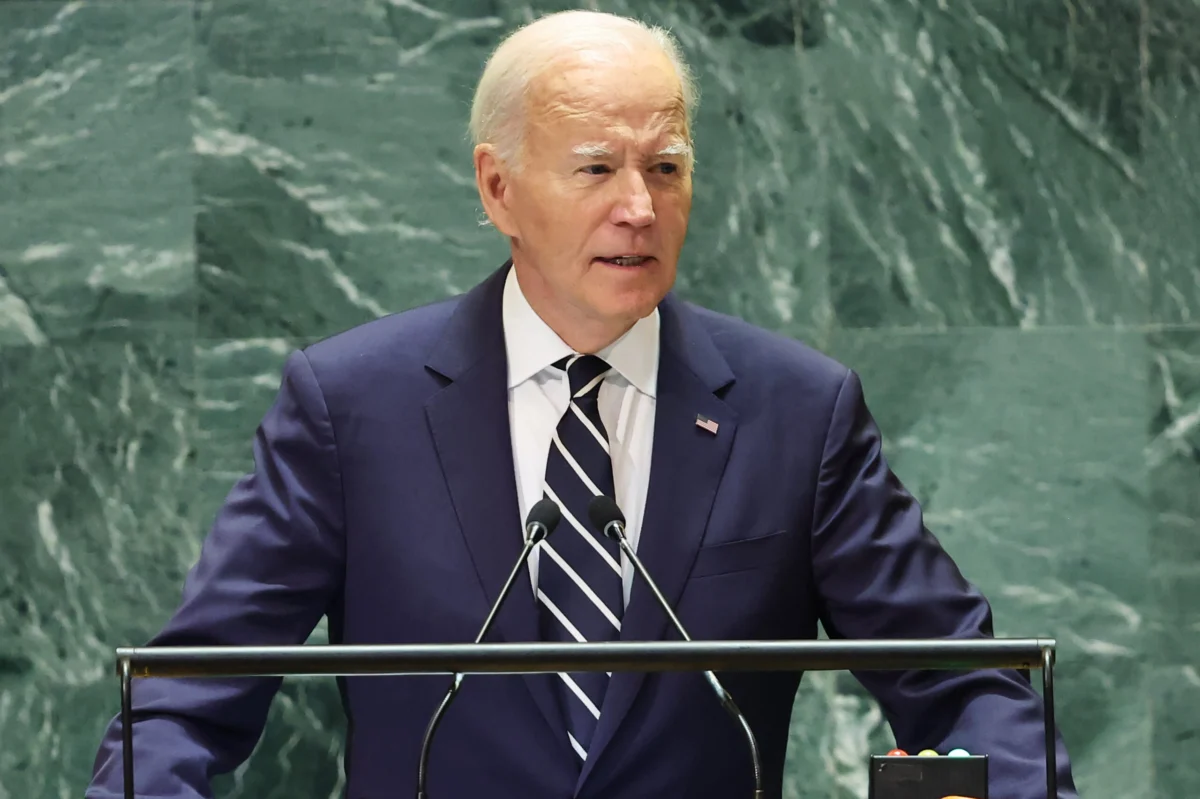
President Joe Biden stood before the United Nations General Assembly on Tuesday to deliver his final address as the leader of the United States, attempting to reconcile a career-long belief in international diplomacy with a global landscape currently fractured by devastating wars and rising authoritarianism. Speaking to a hall filled with heads of state and diplomats, Biden used the high-profile platform to frame his foreign policy legacy, emphasizing the necessity of collective action while acknowledging the grim realities currently unfolding in the Middle East, Eastern Europe, and East Africa. The speech served as both a valedictory reflection on his fifty years in public service and a stark warning to the international community that the stability of the global order remains under its most significant threat since the end of the Cold War.
A Message of Hope Amidst Global Turmoil
Biden opened his remarks by acknowledging the pervasive sense of pessimism that has taken hold of the international community. "I know many look at the world today and see difficulties and react with despair," Biden stated. "But maybe because of all I’ve seen and all we have done together over the decades, I have hope." This sentiment of resilient optimism was the through-line of his speech, even as he pivoted to address the catastrophic violence currently defining his administration’s final months.
The President sought to contrast the current era of "crisis and uncertainty" with the progress made during his tenure. He pointed to the administration’s efforts in managing the rise of China without slipping into conflict, the establishment of global principles for artificial intelligence, and the strengthening of the NATO alliance. However, the weight of the moment was clearly centered on the active theaters of war that have defied diplomatic resolution during his term.
The War in Ukraine and the Future of NATO
A significant portion of Biden’s address was dedicated to the ongoing conflict in Ukraine, which is now well into its third year. Since the full-scale Russian invasion in February 2022, the United States has been the primary provider of military and economic aid to Kyiv, a commitment that has faced increasing scrutiny from domestic political opponents.
"We could have stood by and merely protested, but Vice President [Kamala] Harris and I understood that that was an assault on everything this institution was supposed to stand for," Biden told the assembly. He framed the defense of Ukraine as a defense of the United Nations Charter itself, particularly the principles of sovereignty and territorial integrity.
To enrich the context of this commitment, it is important to note that since 2022, the U.S. Congress has authorized over $175 billion in various forms of aid to Ukraine. Biden highlighted the expansion of NATO—which saw the accession of Finland and Sweden during his presidency—as a direct strategic failure for Russian President Vladimir Putin. Biden issued a firm directive to his international peers: "You cannot grow weary. You cannot look away. We will not let up on our support for Ukraine, not until Ukraine wins a just and durable peace."
The Middle East Crisis and the Path to a Two-State Solution
The address occurred against the backdrop of an escalating regional crisis in the Middle East. Nearly a year after the October 7, 2023, attacks by Hamas, which resulted in the deaths of approximately 1,200 people and the taking of over 250 hostages, the region stands on the precipice of a wider war involving Lebanon and Iran.
Biden reiterated his administration’s pursuit of a ceasefire and hostage release deal, a diplomatic effort that has seen multiple rounds of failed negotiations in Cairo and Doha. "Now is the time for the parties to finalize its terms, bring the hostages home, to secure security for Israel and Gaza free from Hamas’ grip, ease the suffering in Gaza, and end this war," he declared.
The President also addressed the humanitarian toll on Palestinian civilians, noting that tens of thousands have been killed or wounded. He specifically called out the rise in violence against innocent Palestinians in the West Bank, signaling a nuanced stance that seeks to balance support for Israel’s security with the protection of Palestinian human rights. He reaffirmed the U.S. commitment to a two-state solution, describing it as the only viable path toward long-term regional stability where Israel is recognized by its neighbors and Palestinians live in a state of their own with dignity and self-determination.

Addressing the Forgotten War in Sudan
While Ukraine and Gaza have dominated the headlines, Biden used the UNGA stage to shine a light on the civil war in Sudan. Since April 2023, the conflict between the Sudanese Armed Forces (SAF) and the Rapid Support Forces (RSF) has created one of the world’s worst humanitarian disasters.
The President urged the global community to stop the flow of weapons to the warring generals and to address the looming famine that threatens millions. This inclusion in his speech was seen by analysts as an attempt to prove that U.S. foreign policy is not solely focused on Western-centric interests but is committed to global stability and humanitarian relief in the Global South.
Chronology of Biden’s Final Diplomatic Push
The UNGA address was the centerpiece of a week-long series of high-level diplomatic engagements designed to solidify Biden’s international standing before the November election.
- September 21: Biden hosted the "Quad" summit in Wilmington, Delaware, meeting with the leaders of Australia, India, and Japan. The summit focused on maritime security in the Indo-Pacific and counteracting China’s influence in the South China Sea.
- September 23: Biden held a bilateral meeting with United Arab Emirates President Mohamed bin Zayed Al Nahyan in Washington to discuss the Gaza ceasefire and regional trade.
- September 24: Following his UNGA speech, Biden chaired a summit on the global threat of synthetic drugs, specifically targeting the trafficking of fentanyl.
- September 25: A scheduled meeting with President Tô Lâm of Vietnam to discuss supply chain resilience and technology cooperation.
- September 26: A pivotal meeting at the White House with Ukrainian President Volodymyr Zelenskyy to discuss Ukraine’s "victory plan" and further military support.
The Domestic Transition and Global Implications
In a rare move for a UNGA address, Biden touched upon his decision to withdraw from the 2024 presidential race. He utilized his personal political situation to deliver a broader message about the nature of democracy and the dangers of clinging to power.
"As much as I love the job, I love my country more. I decided, after 50 years of public service, it’s time for a new generation of leadership to take my nation forward," Biden said. He urged other world leaders to prioritize their citizens over their own political ambitions, a statement interpreted by many as a veiled critique of both domestic rivals and foreign autocrats.
The presence of Vice President Kamala Harris and former President Donald Trump in the background of the week’s events was palpable. Foreign leaders, sensing the potential for a radical shift in U.S. foreign policy depending on the election outcome, have begun hedging their bets. Both Harris and Trump have held or scheduled meetings with key figures like Zelenskyy and UAE leadership, creating a dual-track diplomatic environment in New York and Washington.
Analysis of Implications: A Legacy at a Crossroads
Biden’s final speech highlights a presidency that sought to restore "normalcy" and traditional alliances after the isolationist tendencies of the previous administration. However, the effectiveness of this approach remains a subject of intense debate. While Biden has successfully revitalized NATO and deepened ties in the Indo-Pacific, the persistent conflicts in Gaza and Ukraine suggest the limits of American diplomatic leverage in a multipolar world.
Supporting data indicates that the global perception of U.S. leadership has stabilized under Biden compared to the 2017–2021 period, but the humanitarian crises in Gaza have strained relations with traditional allies in the Arab world and younger demographics domestically. Furthermore, the increasing reluctance of the U.S. Congress to fund foreign wars poses a significant challenge to the "America is back" narrative Biden championed.
As Biden prepares to exit the world stage, the "hope" he spoke of will be tested by how his successor handles the burgeoning alliance between Russia, Iran, and North Korea, and the increasingly assertive posture of China. His address was a plea for the continuation of an international order based on rules and cooperation—an order that appears more fragile now than when he took office four years ago.
The speech concluded with a standing ovation from many in the assembly, marking the end of an era for a leader whose career spanned from the height of the Cold War to the dawn of the AI age. Whether his vision of a "just and durable peace" in Ukraine or a "two-state solution" in the Middle East will manifest remains the unanswered question of his presidency.
