

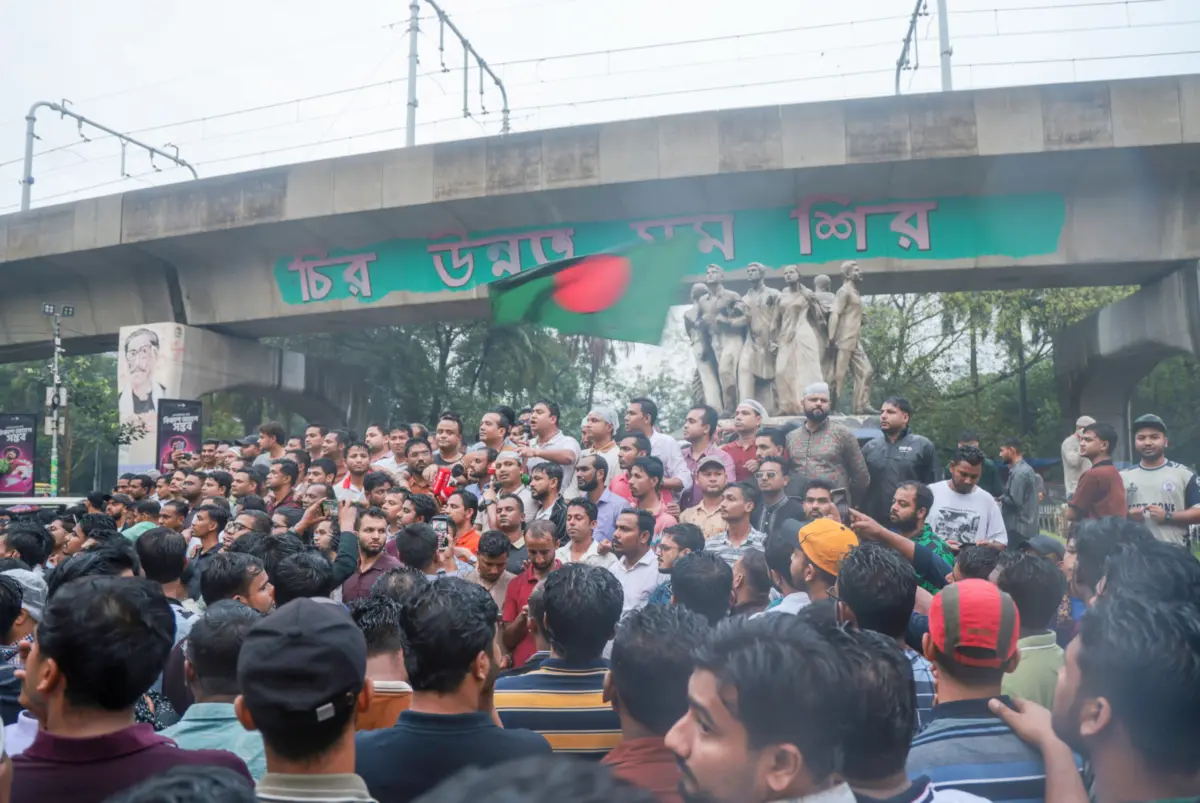
Bangladesh has plunged into a new wave of political instability, marked by widespread violence and arson, following the government’s rejection of former Prime Minister Sheikh Hasina’s request to return to the country from self-imposed exile in India. In response to the escalating unrest, which has claimed at least four lives and targeted critical infrastructure, including police stations, banks, and even the ancestral home of Nobel Peace Prize laureate Muhammad Yunus, the government has deployed paramilitary troops across the nation to restore order. The protests, primarily staged by supporters of Hasina’s now-banned Awami League party, coincide with the anniversary of her death sentence issued in absentia by Bangladesh’s International Crimes Tribunal for crimes against humanity related to the brutal crackdown on student-led protests in 2024. The current government, led by Prime Minister Tarique Rahman, maintains that Hasina is a convicted criminal who can only return under an extradition treaty with India, further deepening a political crisis that threatens to destabilize the nation two years after a transformative student uprising.
A Nation on Edge: The Escalating Crisis and Paramilitary Deployment
Since mid-November, Bangladesh has witnessed a dramatic surge in political violence, with reports of arson attacks, clashes, and vandalism spreading across at least 28 of the country’s administrative districts. The intensity of the unrest prompted an immediate and decisive response from Dhaka, with the deployment of 90 additional platoons of the paramilitary Border Guard Bangladesh (BGB) nationwide. This significant military-backed law enforcement presence underscores the gravity of the situation, as authorities strive to contain a movement that appears to be both localized and strategically coordinated.
The violence has already resulted in at least four fatalities since November 14. Among the victims are three political activists and a bus worker, who tragically died when his vehicle was torched in one of the numerous acts of arson. In Narail district, a particularly volatile region, two members of the ruling Bangladesh Nationalist Party (BNP) were killed. This incident sparked immediate and severe retaliation, with BNP supporters setting ablaze more than a dozen homes belonging to Awami League sympathizers in the area. A local resident, speaking anonymously due to fears of reprisal, conveyed the pervasive terror gripping the community, stating that as many as 50 houses had been damaged and urging women and children to remain indoors unless absolutely necessary.
The scope of the attacks has extended beyond direct political rivals, reaching symbols of national pride and economic stability. Late Wednesday, police confirmed that the ancestral home of Nobel Peace Prize winner Muhammad Yunus was set on fire in the port city of Chittagong. While the perpetrators remain unidentified, the incident carries significant symbolic weight, given Yunus’s past friction with Hasina’s government. Chittagong Metropolitan Police spokesman Aminur Rashid indicated that "criminals set fire to the eastern side of the house," which was being used as a storeroom, fortunately resulting in no casualties. Further compounding the economic impact, Grameen Bank, the pioneering microfinance institution founded by Yunus, reported that 22 of its branches had been subjected to arson attacks, disrupting vital financial services in rural areas.
National police chief Md Ali Hossain Fakir has assured the public that security has been restored in Gopalganj, a traditional stronghold of Sheikh Hasina’s Awami League. He appealed to the "peace-loving people of this area to stand against those involved in sabotage and disorder," reflecting the government’s dual strategy of forceful suppression and calls for public cooperation. However, the geographic spread and nature of the attacks suggest a deeper, more entrenched political battle.
Chronology of a Crisis: From Passport Request to Nationwide Unrest
The current wave of violence is rooted in a series of interconnected events that unfolded rapidly in November 2024:
- Early November 2024: Sheikh Hasina, living in self-imposed exile in India since August 2024, formally requests a new passport and identity card, signalling her intent to return to Bangladesh. She declares her intention to surrender before a court upon her return, with aides indicating that a date would be announced after formalities.
- November 9, 2024: The Bangladesh government, under Prime Minister Tarique Rahman, officially rejects Hasina’s request. State Minister for Foreign Affairs Humaiun Kobir publicly states that "Bangladesh does not give passports to terrorists who kill thousands of people and flee" and insists she can only return via an extradition treaty with India. Prosecutor Md Aminul Islam reiterates that Hasina faces execution if she returns.
- Mid-November 2024 onwards: Supporters of Hasina’s Awami League party, now banned, take to the streets in widespread protests. These demonstrations strategically overlap with the anniversary of her death sentence, issued last year. The protests quickly escalate into violent clashes, arson attacks, and acts of vandalism across numerous districts.
- November 14, 2024: The first fatalities are reported, including political activists and a bus worker, marking a deadly turn in the unrest.
- Late November 2024: Attacks intensify, targeting critical infrastructure. Two BNP members are killed in Narail, prompting retaliatory arson attacks on Awami League supporters’ homes. The ancestral home of Muhammad Yunus in Chittagong is set ablaze, and 22 Grameen Bank branches are attacked.
- Mid-to-Late November 2024: The Bangladesh government deploys 90 platoons of the paramilitary Border Guard Bangladesh (BGB) to help contain the spiralling violence and restore law and order nationwide. Prime Minister Tarique Rahman publicly blames India for inciting the unrest, accusing New Delhi of not considering Bangladesh’s interests and harbouring "masters" of the conspirators.
This rapid sequence of events underscores the fragility of political stability in Bangladesh and the deep-seated divisions that continue to plague its society.
Sheikh Hasina’s Contentious Legacy and the Shadow of 2024
Sheikh Hasina’s bid to return is not merely a personal desire but a politically charged maneuver rooted in her complex and often controversial political past. She served two significant terms as prime minister: first from 1996 to 2001, and then for nearly 15 consecutive years from 2009 until her ouster in July 2024. Her extended tenure was marked by significant economic development but also drew widespread criticism from human rights organizations for what they described as an "iron-fist rule" characterized by increasing authoritarianism, suppression of dissent, and alleged extrajudicial killings.
The catalyst for her downfall was the student-led uprising of July 2024, a nationwide protest movement that began as a demand for road safety but quickly broadened into a call for democratic reforms and an end to government corruption. Hasina’s government responded with extreme force, deploying security forces and party cadres against the unarmed students. United Nations estimates suggest that as many as 1,400 people may have been killed in the ensuing violence, a brutal crackdown that shocked the international community.
Following the collapse of her government in August 2024, Hasina fled to India, where she has since lived in self-imposed exile. Last year, Bangladesh’s International Crimes Tribunal, established to address atrocities committed during the country’s 1971 War of Independence but which has also been used for political trials, sentenced Hasina to death in absentia. The charges were for crimes against humanity directly related to the deadly suppression of the 2024 student protests. Hasina has vehemently denied these charges, portraying herself as a victim of political persecution. Her stated intention to return and surrender before a court is seen by many as a calculated move to challenge the legitimacy of the charges and rally her base.
The Government’s Uncompromising Stance and Accusations Against India
Prime Minister Tarique Rahman’s government, which came to power in the wake of the 2024 uprising, has taken an uncompromising stance against Hasina’s return. They view her not as a political figure seeking justice but as a "convicted criminal" who must face the full force of the law. State Minister for Foreign Affairs Humaiun Kobir’s firm declaration that Bangladesh will not issue a passport to a "terrorist" who has "killed thousands of people" underscores the government’s resolve. The government insists that her return can only occur under the existing extradition treaty with India, a process that would entail her formal handover to Bangladeshi authorities to face her death sentence. Prosecutor Md Aminul Islam has been explicit, stating, "Sheikh Hasina has no option but to face the execution of the verdict" if she returns.
Adding a geopolitical dimension to the domestic crisis, Prime Minister Rahman has directly accused India of complicity in the ongoing unrest. Speaking in parliament, Rahman stated, "It is not only that; they have not looked at the interests of Bangladesh and its people. At the same time, the country across the border, where they have fled to, is their master… To satisfy those masters, they have again started conspiring against Bangladesh and its people." These accusations reflect deep-seated mistrust and complicate the traditionally close, albeit often strained, bilateral relationship between Bangladesh and India. India’s decision to shelter Hasina, a figure deeply polarizing in Bangladesh, has become a significant point of contention, testing the diplomatic ties between the two South Asian neighbours.
Spontaneous Outcry or Orchestrated Mobilisation? The Nature of the Protests
A crucial question surrounding the current unrest is whether the protests are a genuine, spontaneous expression of public discontent or a carefully orchestrated campaign to destabilize the government. Khandakar Tahmid Rejwan, a lecturer of global studies and governance at the Independent University, Bangladesh (IUB) and contributing analyst at the Jamestown Foundation, suggests the latter. He told Al Jazeera that the protests "do not appear to be entirely spontaneous in nature."
Rejwan notes that a truly organic, nationwide movement would typically exhibit broader public mobilization across diverse geographical areas. Instead, the protest activity is largely concentrated in regions like Gopalganj, Faridpur, and Madaripur – areas historically recognized as strongholds of the Awami League’s support base. While "sporadic protests and demonstrations have also been reported in other parts of the country," their limited scale and geographical spread suggest "localized unrest rather than a nationwide mobilization." Rejwan concludes that, at this stage, the pattern of mobilization does not indicate a level of nationwide momentum capable of fundamentally challenging the incumbent government’s position, though the incidents are concerning for public order.
Conversely, Mushfiqul Fazal Ansarey, a senior Bangladeshi diplomat, argues that Hasina’s talk of returning is not an intent to face justice but a strategic ploy "intended to rally supporters and destabilize Bangladesh." Protesters are also vocalizing demands for the lifting of the ban on Hasina’s Awami League party and the release of detained party leaders and supporters from prison, indicating a clear political agenda beyond Hasina’s personal return. Ansarey further highlighted the reach of the unrest, citing reports of Awami League supporters attacking Nahid Islam’s entourage in Romford, east London. Islam, a member of parliament, was a prominent figure in the 2024 student-led uprising. Ansarey condemned the violence, stating, "Arson, killings and intimidation cannot be presented as political protest. The neighbouring country should ensure that its territory is not used to organise or incite violence against Bangladesh," directly reinforcing the government’s narrative of external influence.
Muhammad Yunus: A Nobel Laureate Caught in the Crossfire
The targeting of Muhammad Yunus’s ancestral home and the branches of Grameen Bank adds another layer of complexity and concern to the current crisis. Yunus, awarded the Nobel Peace Prize in 2006 for his pioneering work in microfinance, has long been a figure of international renown and national pride. However, he has also been a political target, particularly during Sheikh Hasina’s previous terms in power. Hasina’s government had initiated various investigations into Grameen Bank’s operations and Yunus’s personal finances, leading to his removal from the bank’s managing director position in 2011, a move widely criticized internationally as politically motivated.
The attacks on Yunus’s properties and institutions are therefore highly symbolic. They suggest that the current violence is not solely focused on government installations or rival political factions, but also on individuals perceived as opponents of the Awami League or symbols that challenge its narrative. The targeting of a Nobel laureate’s heritage site sends a chilling message about the extent of political intolerance and the readiness of some elements to attack figures considered above partisan politics.
Hasina’s Strategic Calculus: Why Return Now?
The question of why Sheikh Hasina, facing a death sentence, would now seek to return from exile is central to understanding the current crisis. Analysts, including Khandakar Tahmid Rejwan, believe several interconnected factors are at play.
Firstly, the domestic political context is ripe for potential disruption. The incumbent government, despite being in power for nearly 10 months, has faced significant challenges. Bangladesh has been grappling with inflationary pressures, economic stagnation, and a persistent fuel crisis. While these issues are partly linked to broader global economic developments, their daily impact on citizens inevitably erodes public morale and confidence in the government. Hasina and her supporters may see this as an opportune moment to exploit existing discontent and reassert their political relevance.
Secondly, there is an ongoing political debate surrounding the Awami League’s proscription. International actors and civil society voices have advocated for lifting the temporary ban on the party, suggesting that it be allowed to resume political activities, potentially after accountability for atrocities committed during the July 2024 uprising. Hasina’s potential return could be aimed at forcing this issue, rallying international attention, and pressuring the government to reconsider the ban.
Thirdly, India’s role cannot be overlooked. As Rejwan notes, Sheikh Hasina and other Awami League leaders who fled in August 2024 have reportedly continued to receive varying degrees of support from India, a long-standing ally. There has also been speculation about New Delhi exploring possibilities for negotiating her safe return to Bangladesh, potentially under arrangements that would ensure her security, perhaps even under the custody of the Bangladesh Army. This suggests a complex diplomatic game unfolding behind the scenes, where Hasina’s public declaration of return might be a strategic move to leverage India’s influence or test the waters for such negotiations.
However, Ansarey’s assessment remains that her public statements are primarily a tactic to "rally supporters and destabilise Bangladesh" rather than a genuine intent to face legal proceedings. The protests, regardless of their spontaneity, certainly serve to keep the Awami League’s political aspirations alive and maintain pressure on the Rahman government.
Broader Political Ramifications and the Path Forward
The current unrest carries significant political ramifications for Bangladesh’s future stability. Prime Minister Tarique Rahman’s government is actively seeking to consolidate its position and build broader alliances to counter the Awami League’s potential resurgence. In a notable development, Rahman has held talks with Shafiqur Rahman, the leader of the opposition party Jamaat-e-Islami. Mia Golam Porwar, Jamaat’s Secretary-General, indicated to The Daily Star that the meeting was viewed positively, expressing hope that such initiatives could strengthen democracy.
This potential convergence of political interests between the ruling BNP and Jamaat-e-Islami is a critical variable. Khandakar Tahmid Rejwan highlights that such an alliance, if their existing political differences are set aside, would be one of the most unfavorable developments for the Awami League. Jamaat-e-Islami, despite its own controversial history, possesses a robust grassroots organizational structure, a disciplined cadre base, and extensive networks for political mobilization, providing a formidable counter-force to the Awami League’s entrenched networks.
Another crucial factor is the extent of residual popular support for the Awami League. Rejwan questions how "politically dormant but ideologically sympathetic sections of the population" would respond if Sheikh Hasina were to return. Would her presence reactivate the Awami League’s grassroots support base, or would the party’s current political isolation and organizational setbacks limit its ability to mobilize them effectively? The answers to these questions will significantly shape the trajectory of Bangladeshi politics.
The implications also extend to Bangladesh’s foreign relations. Ansarey’s strong condemnation of external actors using their territory to "organise or incite violence against Bangladesh" points directly to the strain on India-Bangladesh relations. New Delhi’s stance on Hasina’s exile and potential return will be closely scrutinized, as will its broader regional policy. International actors are likely to watch the situation closely, emphasizing the need for stability, adherence to democratic principles, and respect for human rights.
Ultimately, the sustainability of any political understanding between the BNP and Jamaat-e-Islami, aimed at containing the Awami League’s political resurgence, will depend not just on elite-level negotiations but on their ability to manage competing interests and respond to the evolving sentiments of the wider electorate. As Bangladesh navigates this perilous period, marked by political violence, economic challenges, and a deeply fractured society, the stakes for its democratic future and regional stability remain exceptionally high. The coming weeks and months will be critical in determining whether the nation can find a path towards reconciliation and stability, or if it will descend further into prolonged political turmoil.
