

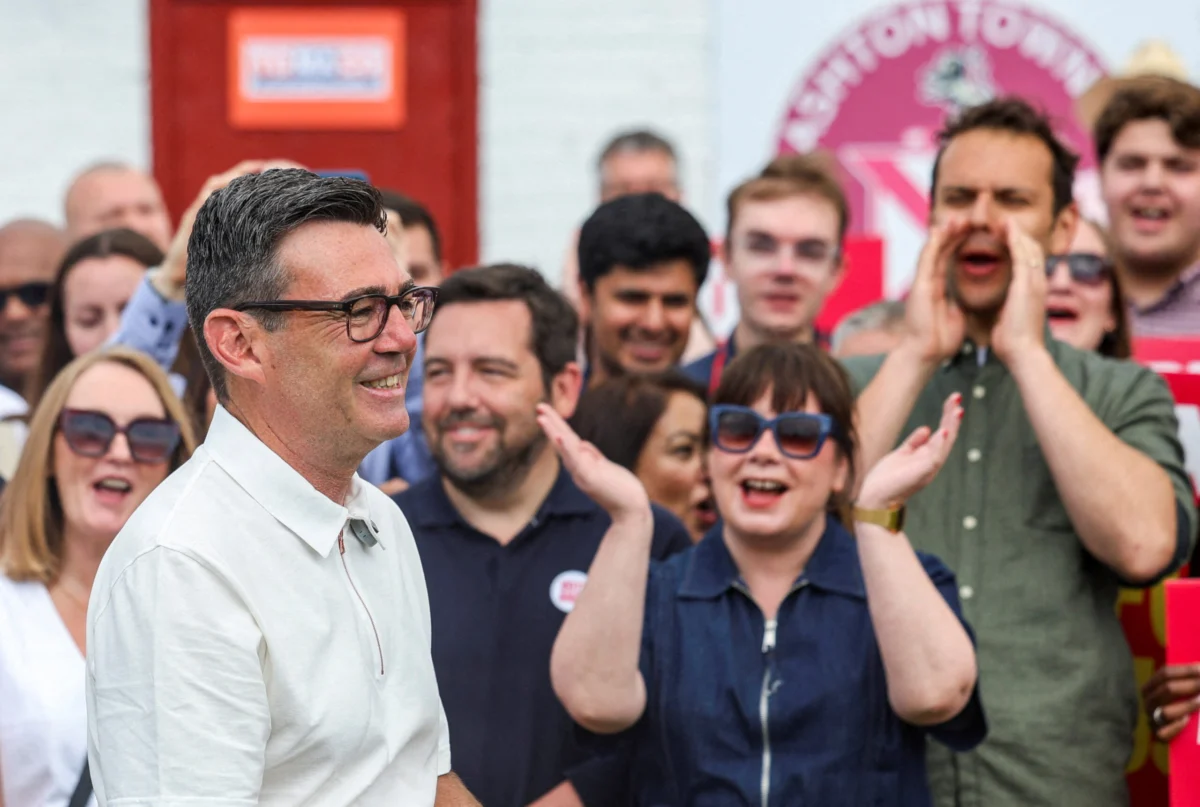
Ashton-in-Makerfield, United Kingdom – A palpable sense of relief, albeit mixed with lingering exhaustion, has finally settled over Ashton-in-Makerfield. For months, residents like charity shop worker Sue Hailwood have endured an unprecedented political maelstrom since the announcement in May of a critical by-election. This suburban northern ward, usually a quiet corner nestled between the post-industrial heritage of Wigan and the gleaming glass towers of Manchester, found itself thrust into the national, and even international, spotlight. The stakes were undeniably high: this by-election was widely seen as a pivotal precursor to a potential Labour leadership contest, one that could ultimately determine the UK’s next prime minister.
The electoral circus had been relentless. Swarms of political activists, journalists, and camera crews descended upon the town, transforming its streets into a bustling hub of political theatre. "It’s been absolutely horrendous," recounted Hailwood, reflecting on the constant stream of door-knocking volunteers and heated debates between protesters. Peter Thompson, proprietor of a local vinyl record shop, described the attention as "stupidly hectic." He noted the international flavour of the media contingent: "There have been Americans, a French magazine, a TV crew from Sweden and a TV crew from Denmark. It’s the most important by-election in the history of this country."

In the end, the intensity culminated on Thursday with a decisive victory for Andy Burnham, who secured a comfortable win. This result immediately ignited speculation regarding a challenge to 62-year-old Prime Minister Keir Starmer. Burnham, 56, wasted no time in confirming his intentions, stating his plan to contest the leadership. Starmer, in turn, responded defiantly on Friday, declaring his resolve to stand in any race and his refusal to "walk away." The coming days and weeks are now set to be a crucible for the Labour Party, and by extension, for the direction of British politics.
The Road to a Leadership Challenge: Rules and Precedents
Under the Labour Party’s complex internal rules, an aspiring leader must first garner nominations from 20 percent of Labour Members of Parliament (MPs). With the current parliamentary arithmetic, this translates to a requirement for Burnham to secure the backing of 81 Labour legislators. Beyond parliamentary support, he would also need endorsements from a specified number of local party branches and affiliated organisations, notably including influential trade unions. The process could be swift if momentum builds quickly, but it could also become protracted if Starmer entrenches his position or if other prominent figures decide to "throw their hats into the ring," further fragmenting the nomination landscape.
Andy Burnham is no stranger to leadership contests. Known by his supporters as the "king of the north" for his strong regional focus, particularly during his tenure as the Labour Mayor of Manchester, he previously made unsuccessful bids for the party leadership in both 2010 and 2015. His repeated attempts underscore a long-held ambition and a consistent political platform centred on empowering the regions. In his victory speech on Friday, Burnham articulated this vision, declaring, "People here have voted for change. They have voted for more power for the north and everywhere forgotten by Westminster." This sentiment resonates deeply in constituencies like Ashton-in-Makerfield, which often feel overlooked by the central London political establishment.

The Starmer Conundrum: A Leader Under Pressure
Keir Starmer’s leadership has been increasingly beleaguered since the 2024 general election. While Labour secured a significant number of MPs, marking a return to government after years in opposition, the victory was described as "wide but shallow." Many of these gains were secured with relatively narrow majorities, indicating a lack of overwhelming public enthusiasm for Starmer himself. Since that election, his initial "shine" has undeniably dimmed.
Starmer has faced a barrage of criticism for what opponents and even some within his own party have termed "missteps" and "embarrassing U-turns." These have ranged from policy reversals to perceived indecisiveness on key issues, contributing to a narrative of a leader struggling to articulate a clear and inspiring vision. Adding to his woes, Starmer has been under relentless pressure from the right-wing Reform Party, led by the charismatic former city trader Nigel Farage. Reform’s persistent attacks, particularly on issues like immigration and cultural identity, have chipped away at Labour’s support base and forced Starmer onto the defensive. According to most contemporary polls, Keir Starmer currently holds the unenviable distinction of being the most unpopular leader in the UK since systematic surveys began, a statistic that underscores the profound challenges facing his premiership.
In the Ashton-in-Makerfield by-election, Burnham’s victory was commanding. He secured 24,927 votes, handily defeating his main competitor, Reform candidate Robert Kenyon, by a margin of over 9,000 votes. This strong performance in a traditional Labour heartland, despite Reform’s national surge, provides Burnham with a potent argument for his electability and his ability to counter the populist right.

For many Labour voters on the ground, the by-election was not merely about local representation; it was a referendum on their party’s direction and, crucially, its leadership. Cameron Graham, a 31-year-old factory worker and staunch trade union member, exemplified this sentiment. He stated that his vote for Labour in the 2024 general election was primarily to back the party, not necessarily the leader. "I’d definitely prefer Burnham to Starmer," Graham asserted, echoing a growing sentiment among the Labour faithful.
Howard Bond, a recently retired sales manager and lifelong Labour voter, articulated similar reservations about Starmer. Despite his deep party loyalty, Bond confessed to feeling "unsure" about the incumbent prime minister. Outside a polling station, during his third media interview of the day, Bond expressed his conviction that "Burnham would do a better job." He passionately defended Burnham against Reform’s attacks regarding his local ties: "We got a leaflet through the door from Reform saying (Burnham) doesn’t live around here… That’s nonsense. His house is just over there. His kids went to school here. He plays at Ashton Football Club. He knows what he’s doing. He’s very articulate and I think he genuinely means well for the community." Bond, whose wife is an expatriate, also voiced his strong dislike for Farage’s anti-immigration stance, stating he "can’t stand" the Reform leader.
Reform’s Challenge and the Immigration Debate
The Reform Party, and its even more hardline counterpart, Restore – a far-right party notably backed by entrepreneur Elon Musk – demonstrated their national ambitions by busing in activists from across the country, with some even flying in from overseas. This concerted effort highlighted the central role of immigration in their political agenda.

Immigration has long been a potent and often divisive through-line in British politics, particularly on the right. In the weeks leading up to the by-election, it had dominated headlines, tragically manifesting in anti-immigrant unrest and collective punishment of ethnic minority communities in places like Belfast and Southampton, despite these communities having no connection to any alleged crimes.
Across from the polling station, 74-year-old John Van Dusen sat on his lawn chair, a flask of tea in hand, a Reform flag fluttering proudly overhead. His views were unequivocal: "Mass immigration is not good for this country. Illegal immigrants coming over on boats are not being stopped, and the French are helping them come across." This sentiment, while resonant with Reform’s national message, stood in stark contrast to the demographics of Ashton-in-Makerfield itself, where statistics show a remarkable 97 percent of residents were born in the area, suggesting a community not directly experiencing the direct impacts of recent immigration that Van Dusen describes.
Despite Reform’s national polling strength, which suggests it could win a general election if held "tomorrow," the party ultimately lost in Makerfield. Van Dusen, however, remained convinced that both Labour and the Conservatives "have done nothing" to stem undocumented migration. While Labour has indeed put forward stricter migration rules and a policy on legal immigration anticipated to reduce numbers later in the year, Professor Tim Bale, a politics expert at Queen Mary University of London, pointed to Starmer’s communication failings. "Starmer is a poor communicator, and one who messed up his first few months in office," Bale noted, adding, "He also doesn’t appear to have a vision that he can use to inspire either his MPs or the public."

In stark contrast, Bale observed that "Burnham can connect with the public and appears to have a clear sense of where the country needs to go. He’s proven that he can beat Farage in a seat that, under normal circumstances, would have fallen easily to Reform." This analysis underscores the significance of Burnham’s victory not just for his own ambitions, but as a potential blueprint for how Labour might counter the rising tide of the hard right. While Reform came second in the Makerfield race, Restore was a distant third, followed by the Conservatives, Green Party, and Liberal Democrats, highlighting the challenge all traditional parties face.
The Fragmented UK Political Landscape
The rise of Reform and Restore has undoubtedly alarmed many within the UK’s more traditional political sphere, signalling a significant shift in voter allegiances and the increasing salience of "culture war" issues. However, the direction of travel is not exclusively to the right. The Green Party, under its newly elected leader Zack Polanski, has also enjoyed strong gains on the left. A notable triumph came in February when they delivered a setback to Farage by winning the Gorton and Denton by-election against Reform’s candidate, demonstrating their own growing electoral potency.
Professor Sir John Curtice, a respected pollster, offered a critical insight into the evolving nature of British politics before Thursday’s vote. He observed that "The UK has really become a five-party country, with each drawing between 17 and 27 percent of the vote share, meaning they’re all essentially minority parties." These five dominant forces, as identified by Curtice, are the right-wing Conservatives, the leftist Greens, the centrist Liberal Democrats, the centre-left Labour, and the hard-right Reform.

Curtice attributed this fragmentation to two primary factors. Firstly, the Brexit vote acted as a catalyst, detaching traditional demographic predictors – such as race, social class, and age – from typical voting choices. This meant that long-held loyalties based on these factors began to erode. Secondly, he highlighted the growing prominence of "culture-war issues," which now hold equal weight to traditional political and economic concerns. As a result, Curtice explained, "the socially conservative are likely to be drawn to Reform, irrespective of their economic offering." This indicates a fundamental reshaping of the British electorate, where identity and values often supersede traditional economic platforms.
The by-election in Ashton-in-Makerfield, therefore, served as more than just a local contest. It was a microcosm of these broader national trends: the deep disquiet within the Labour Party over its leadership, the persistent and growing threat from the populist right, and the overall fragmentation of the British political system into a multi-party landscape where no single entity holds a dominant sway.
As the political caravan gradually packed up and departed Ashton-in-Makerfield, leaving behind a quieter high street, one local woman watched the retreating cavalcade of activists, camera crews, and journalists. With a wry laugh, she remarked, "Well, at least we’re going to get our town back after this." Her words encapsulated the mixed feelings of a community that had been unwillingly thrust into the epicentre of a national political drama, now awaiting the next act in what promises to be a turbulent period for UK politics. The battle for Labour’s soul, and potentially the country’s future, has only just begun.
