

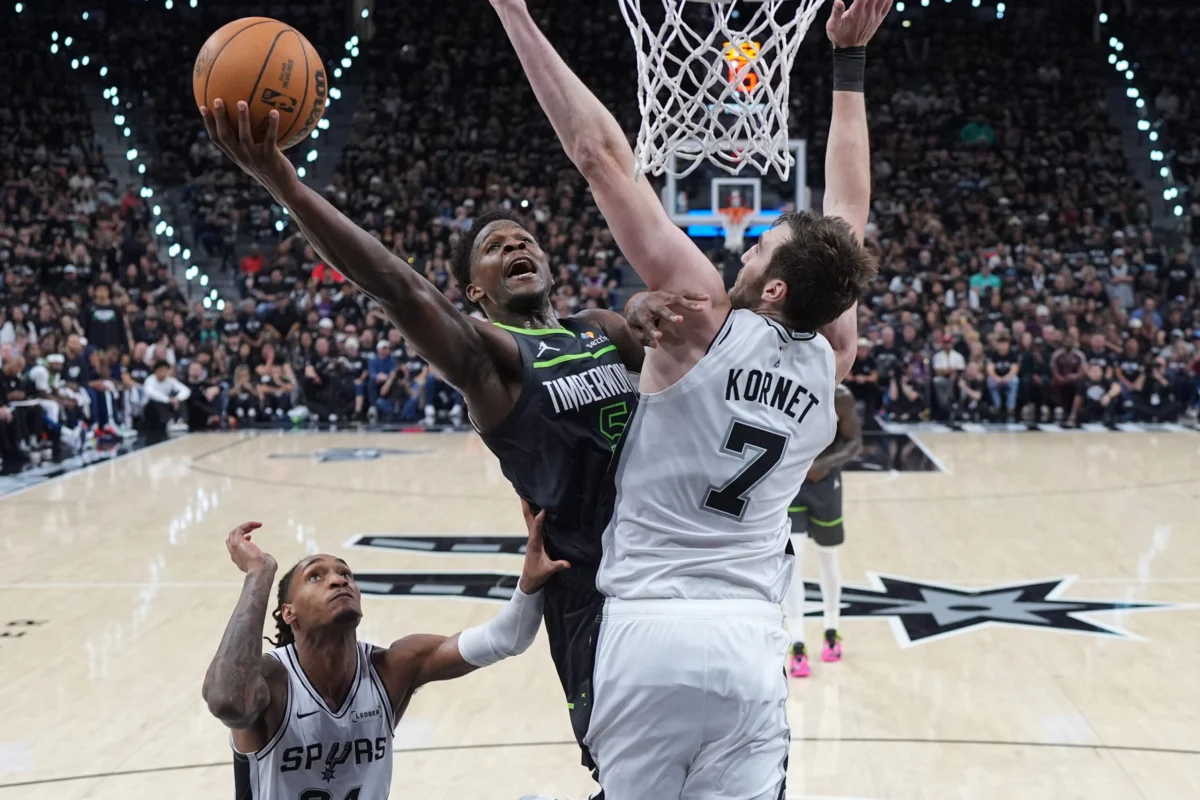
The Minnesota Timberwolves revitalized their postseason campaign on Sunday night, securing a hard-fought 114-109 victory over the San Antonio Spurs at the Target Center in Minneapolis. Driven by a sensational 36-point performance from All-Star guard Anthony Edwards, the Timberwolves successfully defended their home court to tie the Western Conference semifinals at 2-2. The contest was defined by high-stakes physicality, a controversial second-quarter ejection of Spurs phenom Victor Wembanyama, and a fourth-quarter scoring masterclass by Edwards that prevented Minnesota from falling into a precarious 3-1 series deficit.
The victory shifts the momentum of the series as both teams prepare to return to San Antonio for a pivotal Game 5. For Minnesota, the win was a testament to their depth and defensive identity, while the Spurs were left to rue a missed opportunity to seize control of the series despite a spirited effort from their supporting cast following the loss of their franchise cornerstone early in the game.
The Turning Point: The Ejection of Victor Wembanyama
The trajectory of the game altered significantly with 8:39 remaining in the second quarter. Victor Wembanyama, the Spurs’ defensive anchor and primary offensive threat, was involved in a physical sequence under the basket. After securing a rebound, Wembanyama attempted to pivot away from a double-team consisting of multiple Timberwolves defenders. In the process of protecting the ball, Wembanyama swung his right arm, delivering a sharp elbow to the chin of Minnesota forward Naz Reid.
Reid collapsed to the floor immediately, prompting an official review. Following a lengthy consultation at the replay monitor, crew chief Zach Zarba upgraded the initial common foul to a Flagrant Foul Penalty 2. Under NBA rules, a Flagrant 2 is defined as contact that is "unnecessary and excessive," resulting in an automatic ejection.
"There was wind-up, impact, and follow-through above the neck of an opponent," Zarba explained to a pool reporter after the game. The decision sparked immediate outrage from the San Antonio bench and left the Spurs without their leading shot-blocker and interior presence for the final 32 minutes of play. At the time of his departure, Wembanyama had recorded four points and four rebounds in just over 12 minutes of action, significantly below his season averages.
San Antonio’s Resilience and the Rise of Dylan Harper
Despite the psychological blow of losing Wembanyama, the Spurs demonstrated remarkable tactical flexibility. Led by acting head coach Mitch Johnson, San Antonio pivoted to a small-ball lineup that emphasized pace and perimeter shooting. The Spurs managed to turn a four-point halftime deficit into an eight-point lead during the third quarter, outscoring Minnesota 20-8 in the opening minutes of the second half.
De’Aaron Fox and rookie sensation Dylan Harper were the primary engines of the Spurs’ offense. Both players finished with 24 points, with Harper providing a massive spark off the bench. Harper’s ability to navigate Minnesota’s perimeter defense kept the Timberwolves on their heels, while Stephon Castle added 20 points, showcasing the depth of the Spurs’ young roster.
The Spurs entered the final frame with an 84-80 lead, having successfully frustrated Minnesota’s primary scorers for much of the third quarter. San Antonio’s defensive rotations remained crisp, and they utilized their speed to negate the size advantage held by Minnesota’s Rudy Gobert and Julius Randle. When De’Aaron Fox buried a step-back three-pointer with 8:51 remaining in the fourth quarter to give the Spurs a 94-86 lead, it appeared as though San Antonio might steal a road win without their star center.
The Anthony Edwards Takeover
With their season effectively on the line, Anthony Edwards took command of the game. Having scored 18 points in the first half, Edwards found another gear in the fourth quarter, scoring 16 of his game-high 36 points in the final 12 minutes.
Edwards ignited a 14-5 Minnesota run with a mid-range jumper, followed by a sequence of high-difficulty baskets. He connected on a short floater in traffic and a deep, straightaway three-pointer that cut the lead to three. His relentless attacking of the rim forced the Spurs into foul trouble, allowing him to tie the game at the free-throw line. With 5:12 remaining, Edwards drilled another three-pointer to give Minnesota a 98-97 lead, their first since the early stages of the third quarter.
"Just small-time plays," Edwards remarked in the post-game press conference. "Small-time plays win big-time games. That’s what we needed. Diving on the floor, offensive rebounds, and it was a great sub by Finchie for putting in Ayo [Dosunmu] for that last minute and a half."
The closing minutes were a clinic in poise for the Timberwolves. Rudy Gobert, who finished with 11 points and 13 rebounds, provided the exclamation point with a thunderous dunk at the 1:56 mark, extending the lead to 107-101. Although San Antonio made a late push—aided by free throws from Harper and Julian Champagnie to bring the score to 112-109—Ayo Dosunmu remained calm under pressure, sinking two free throws with 9.8 seconds left to ice the game.
Statistical Breakdown and Efficiency Metrics
The box score reflected a game of contrasting styles. Minnesota relied on their superior three-point shooting and interior rebounding, while San Antonio found success in transition and mid-range efficiency.
Minnesota Timberwolves Performance:
- Field Goal Percentage: 44.7% (38-of-85)
- Three-Point Shooting: 37.0% (10-of-27)
- Free Throw Shooting: 87.5% (28-of-32)
- Rebounding: 48 total rebounds, including 12 offensive boards.
- Key Contributors: Naz Reid (15 points, 9 rebounds), Jaden McDaniels (14 points), Julius Randle (12 points).
San Antonio Spurs Performance:
- Field Goal Percentage: 47.7% (41-of-86)
- Three-Point Shooting: 23.1% (6-of-26)
- Free Throw Shooting: 87.5% (21-of-24)
- Rebounding: 39 total rebounds.
- Key Contributors: De’Aaron Fox (24 points), Dylan Harper (24 points), Stephon Castle (20 points).
The most glaring disparity was from beyond the arc. Minnesota’s ability to convert 10 three-pointers compared to San Antonio’s six proved to be a critical five-point swing in a game decided by exactly five points. Furthermore, the absence of Wembanyama was felt most acutely on the defensive end; without his shot-blocking presence, Minnesota was able to attack the paint with more frequency in the closing minutes, leading to high-percentage looks for Edwards and Gobert.
Official Reactions and Controversy
The post-game discourse was dominated by the ejection of Wembanyama. Spurs coach Mitch Johnson expressed significant frustration with the officiating, though he was careful to balance his critique with concern for Naz Reid.
"I’m glad he [Wembanyama] took matters into his own hands—not in terms of hitting Naz Reid, I want to be very clear about that," Johnson said. "I’m glad Naz Reid is OK, and I didn’t want him to elbow him. But Victor is going to have to protect himself if no one else does it for him. And I think it’s disgusting."
Johnson’s comments suggested a belief that Wembanyama had been subjected to uncalled physicality prior to the incident, a sentiment often echoed by the Spurs’ coaching staff throughout the series. Conversely, Timberwolves coach Chris Finch praised his team’s mental toughness for not overlooking a Wembanyama-less Spurs squad.
"We never expected them just to go away," Finch said. "They won a game in the Portland series without Wembanyama, so they’re a very good, very disciplined team. We lost our way a little bit in the third quarter and gave them life, but our guys responded when it mattered."
Broader Implications and Series Outlook
The result of Game 4 ensures that the Western Conference semifinals will go at least six games, guaranteeing a return trip to Minneapolis. However, the immediate focus shifts to San Antonio for Game 5.
The psychological impact of the Wembanyama ejection will likely linger. The league office is expected to review the Flagrant 2 call, as is standard procedure, though further disciplinary action such as a suspension is considered unlikely given the incidental nature of the pivot. Nevertheless, the incident has added a layer of animosity to what was already a highly competitive series.
For Minnesota, the emergence of Naz Reid as a reliable secondary option and the clutch play of Ayo Dosunmu provide Coach Finch with more lineup flexibility. The Timberwolves’ defensive strategy of funneling drivers toward Rudy Gobert remained effective, even as the Spurs’ guards found success in the mid-range.
For San Antonio, the performance of Dylan Harper and Stephon Castle is a silver lining. If the Spurs can maintain that level of production from their backcourt while reintegrating Wembanyama into the lineup for Game 5, they remain a formidable threat to reclaim the series lead.
As the series moves back to Texas, the primary question remains whether Minnesota’s perimeter stars can maintain their shooting efficiency on the road, or if the Spurs’ home-court advantage and the return of a motivated Wembanyama will tip the scales back in San Antonio’s favor. Game 5 is scheduled for Tuesday night, with the basketball world watching to see which team will move one step closer to the Western Conference Finals.
