

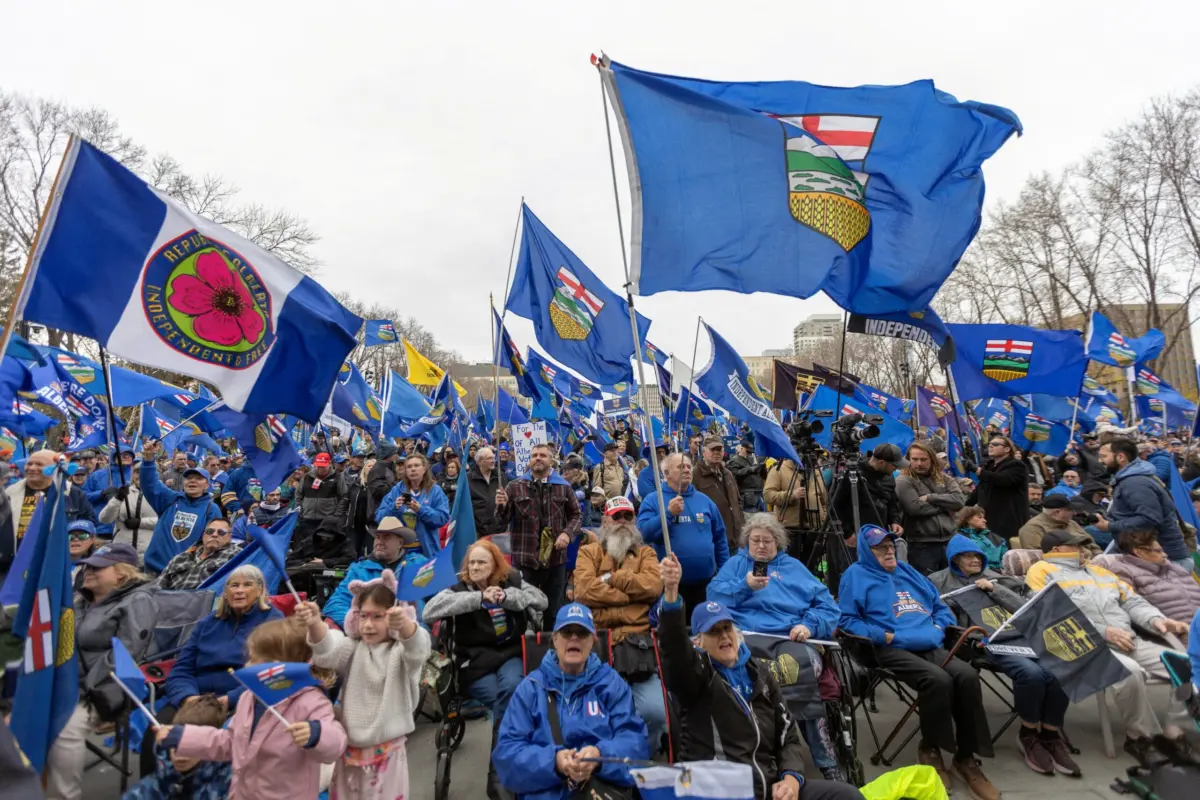
The province of Alberta stands at a historic crossroads as citizens prepare to cast ballots in a provincial referendum that could fundamentally alter the landscape of the Canadian federation. For Cory Morgan, the founder of the advocacy organization Pathway to Independence, Monday’s vote represents the culmination of more than 25 years of activism. While the concept of "Wexit"—a portmanteau of "Western" and "exit"—was once dismissed as a fringe movement relegated to the sidelines of provincial discourse, it has now moved into the center of the political arena. Even if the majority of Albertans reject the proposal, Morgan and his fellow travelers view this moment not as an end, but as a beginning.
The referendum asks Albertans to decide whether the provincial government should pursue a binding resolution in the future on the question of independence. It is a nuanced ballot question that offers two primary paths: remaining a part of Canada or initiating a legal process that would eventually lead to a formal secession vote. However, the complexity of the issue extends far beyond a simple "yes" or "no." The legal, economic, and social ramifications of such a move are staggering, involving intricate negotiations with the federal government in Ottawa, neighboring provinces, and the Indigenous peoples whose ancestral lands encompass the entirety of Alberta.
The Roots of Discontent: A History of Western Alienation
To understand why a province with some of the highest standards of living in North America would consider leaving one of the world’s most stable democracies, one must look back decades. The sentiment of "Western Alienation" is not a modern invention but a deeply ingrained political identity in the Canadian West.
The historical flashpoint most cited by separatists is the National Energy Program (NEP) of the 1980s. Introduced by the Liberal government of Pierre Elliott Trudeau, the NEP sought to redistribute Alberta’s oil wealth to the rest of the country while keeping domestic prices low. For Albertans, the policy was viewed as a direct assault on their provincial jurisdiction and economic prosperity. It is estimated that the NEP cost the province tens of billions of dollars in lost revenue and investment, fueling a resentment that has been passed down through generations.
In the 21st century, these tensions were rekindled under the leadership of Justin Trudeau. His administration’s commitment to aggressive climate targets, including the implementation of a national carbon tax and strict limits on oil and gas emissions, was perceived in Alberta as a modern-day NEP. Despite the federal government’s purchase of the Trans Mountain Pipeline to ensure Alberta’s oil could reach tidewater, many in the province felt that Ottawa was simultaneously sabotaging their primary industry through regulatory hurdles and "anti-oil" rhetoric.

The COVID-19 pandemic served as a further catalyst. Public health mandates and federal travel restrictions became a rallying cry for a new wave of conservative activists. These groups, often skeptical of centralized authority, found common ground with long-time separatists, creating a potent political coalition that eventually pressured the provincial government to put the question of sovereignty to the people.
The Political Landscape: Mark Carney and Danielle Smith
The referendum comes at a time of significant transition in Canadian federal politics. Following the resignation of Justin Trudeau in 2025, Mark Carney, the former Governor of the Bank of Canada and the Bank of England, assumed the leadership of the Liberal Party and the Prime Ministership. Carney, who spent his formative years in Edmonton, has attempted a more conciliatory tone toward his home province, acknowledging the "real frustrations" of Albertans while simultaneously warning of the dangers of secession.
At a "Forever Canadian" rally in Calgary just days before the vote, Carney delivered a stern message to those considering a "strategic" vote for independence. He characterized the referendum as a "dangerous bluff" that would lead to "years of deep division and great uncertainty." Carney’s strategy has been to emphasize the economic risks of independence—particularly for a landlocked province—while highlighting federal investments in western infrastructure and a commitment to a "pragmatic" energy transition.
Conversely, Alberta Premier Danielle Smith finds herself in a delicate balancing act. While her United Conservative Party (UCP) government facilitated the referendum by easing the rules for such votes, Smith herself has publicly stated she voted against secession. She has framed the referendum not as a desire to leave, but as a tool for leverage. By demonstrating a significant level of dissatisfaction, Smith hopes to force Ottawa into concessions on equalization payments, environmental regulations, and provincial autonomy.
Strategic Separatism: A Message to Ottawa
Political analysts have noted a phenomenon described as "strategic separatism." Data collected by Viewpoint Alberta, a research initiative at the University of Alberta, suggests that a significant portion of those intending to vote "yes" do not actually want to form a new country. Instead, they are "reluctant separatists" who view the ballot as the only way to get Ottawa’s attention.
Jared Wesley, a political science professor at the University of Alberta, argues that the ambiguity of the ballot question is intentional. "Strategic separatists and their leaders have been using that lower-bar threshold to entice folks to vote not to leave, but rather to send Ottawa a message that Albertans need to be heard," Wesley told Al Jazeera.

This strategy carries significant risks. As Mark Carney noted, a vote for independence is a binding signal that cannot easily be retracted once the legal machinery of secession is set in motion. If the "yes" side performs better than expected, it could trigger a constitutional crisis that the provincial government may not be prepared to manage.
The "Other" Nine Questions: A Multi-Pronged Strategy
Monday’s ballot is not limited to the question of independence. In a move designed to maximize provincial leverage, the Smith government included nine other questions covering a range of jurisdictional disputes. These include:
- Restricting temporary residents’ access to provincial healthcare and education.
- The establishment of a provincial police force to replace the RCMP.
- The creation of a provincial pension plan to opt out of the Canada Pension Plan (CPP).
- The right for Alberta to appoint its own provincial and superior court judges.
Premier Smith has urged Albertans to support these nine proposals even if they reject independence. Her argument is that a "strong mandate" on these specific issues will provide her with the political capital necessary to renegotiate Alberta’s place within the federation. However, critics argue that these questions are designed to create a "slow-motion secession" by gradually decoupling Alberta from federal institutions.
Comparative Analysis: From Quebec to Brexit
The Alberta referendum invites inevitable comparisons to other sovereignty movements. Ian Cooper, a political scientist with roots in Alberta, suggests that the 2016 Brexit referendum in the United Kingdom serves as a cautionary tale. In that instance, a vote intended to settle internal party disputes led to a transformative geopolitical shift that few had fully planned for.
However, a more apt domestic comparison is Quebec. The French-speaking province held independence referendums in 1980 and 1995. While both failed, they resulted in significant constitutional concessions and a permanent shift in how the federal government interacts with the provinces. Unlike Quebec, which is defined by a distinct linguistic and cultural identity, Alberta’s movement is primarily driven by economic and fiscal grievances.
Cory Morgan acknowledges this difference but argues that Alberta has developed its own "distinct culture" shaped by a spirit of rugged individualism and entrepreneurship. "The type of person drawn to Alberta is often an individualistic type of person," Morgan said. "They want the opportunity to go out and succeed or fail on their own."

The Economic Reality of a Landlocked Nation
Perhaps the most significant hurdle for the independence movement is geography. As a landlocked province, an independent Alberta would be entirely dependent on the goodwill of its neighbors—primarily Canada and the United States—to export its oil and gas. Under international law, landlocked states have certain rights of access to the sea, but these are often subject to complex bilateral agreements.
Furthermore, the "separation of assets and debts" would be a monumental task. Alberta would need to negotiate its share of the Canadian national debt while simultaneously laying claim to federal assets within its borders. The uncertainty surrounding trade agreements, currency, and international recognition would likely lead to a period of capital flight and economic instability, a point emphasized repeatedly by the "No" campaign.
Implications of the Result
Regardless of the outcome on Monday, the referendum has already succeeded in shifting the national conversation. If the "No" side wins by a large margin, it may provide Prime Minister Carney with the mandate he needs to pursue his vision of a more unified, green-energy-focused Canada. However, if the "Yes" side shows strength—even in defeat—it will signal that the grievances of the West remain a potent and unresolved force in Canadian politics.
For activists like Cory Morgan, the vote is a benchmark. "If they’ve decided it’s not time to go that route yet, then so be it. But that doesn’t mean I’ll stop," he said. The underlying issues—the perceived unfairness of the equalization formula, the frustration over environmental policy, and the desire for greater local control—are unlikely to disappear with a single trip to the polls.
As Albertans head to the ballot box, the eyes of the nation are on the province. The result will not only determine the immediate political future of Alberta but will also serve as a litmus test for the durability of the Canadian Confederation in an era of increasing polarization and regional tension. Whether the referendum serves as a "wake-up call" or a "dangerous bluff," its legacy will be felt for decades to come.
