


The private equity landscape, once characterized by predictable capital flows and reliable exit strategies, is undergoing a significant transformation. A persistent "DPI drought," a term referring to Distributions to Paid-In Capital, is forcing a re-evaluation of traditional investment timelines and liquidity expectations. As a result, the secondary market for private equity assets is not merely a niche segment but a burgeoning ecosystem offering crucial liquidity and strategic flexibility for both investors and fund managers. Advisors and family offices, in particular, must understand this evolving dynamic to effectively navigate the complexities of private market investing in the coming years.
The Deepening DPI Drought in Private Equity
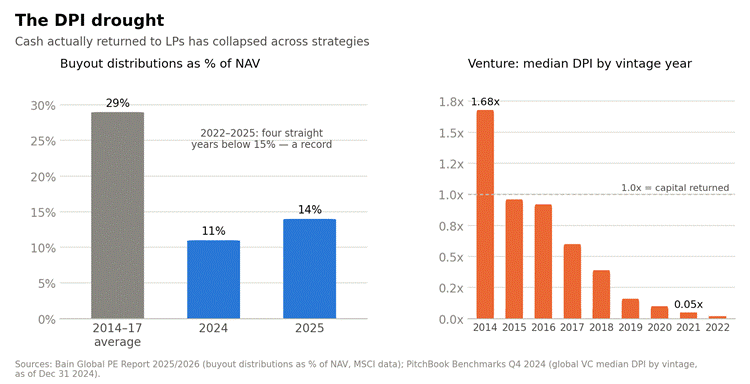
For decades, the success of a private equity fund was often measured by its ability to generate Distributions to Paid-In Capital (DPI). A DPI of 1.0x signifies that investors have received back their initial investment in cash, with any figure above that representing realized profit. Unlike Total Value to Paid-In Capital (TVPI) or Internal Rate of Return (IRR), which can be influenced by unrealized valuations, DPI offers a concrete measure of realized returns. However, recent data paints a stark picture of declining DPI across various private market strategies.
Bain & Company’s Global Private Equity Report indicates a significant downturn, with buyout funds distributing a mere 14% of their Net Asset Value (NAV) in 2025, a marginal improvement from the decade-low of 11% in 2024. This marks four consecutive years where distributions have fallen below the 15% threshold, a stark contrast to the 2014-2017 average of 29%. The venture capital segment is experiencing an even more pronounced deficit. PitchBook data reveals that median DPI for venture funds launched in 2019 stands at a meager 0.16x, while 2021 vintages are even lower at 0.05x, a dramatic drop from the 1.68x recorded for 2014 vintages. Growth equity, dependent on both initial public offerings (IPOs) and leveraged buyouts, finds itself in a similarly challenging position.

Stalled Exits Fueling Extended Holding Periods
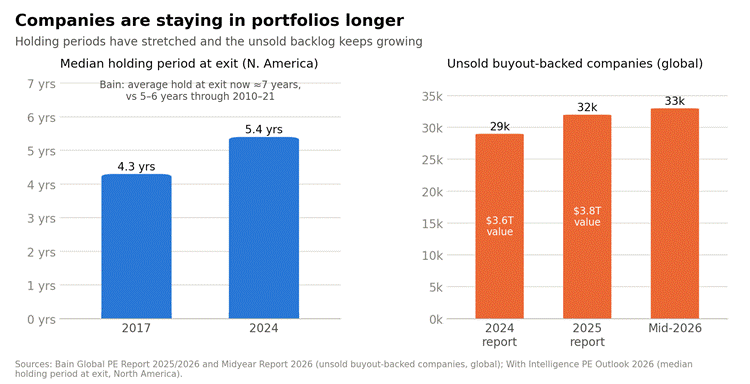
The root cause of this DPI drought is a significantly stalled exit market. Bain estimates that approximately 32,000 private equity-backed companies, valued at a staggering $3.8 trillion, remain unsold. This has led to a substantial increase in the average holding period for these investments, stretching to around seven years, up from the five to six years common in the 2010s. This trend is not confined to any single region; Canada, for instance, recorded no private equity or venture capital-backed IPOs in 2024 or 2025, with the first half of 2026 seeing exits dominated by just two major transactions: the Apotex IPO and the sale of Amica. This prolonged holding period directly impacts the cash flow to investors, exacerbating the DPI issue.
Managerial Ingenuity: Navigating the Liquidity Squeeze
In response to these exit challenges, general partners (GPs) have developed a range of innovative, albeit sometimes unconventional, strategies to provide liquidity to their limited partners (LPs) without resorting to a full sale. Dividend recapitalizations, where portfolio companies borrow against their assets to distribute cash to investors, reached $72 billion in 2025, marking the second-highest year on record, according to PitchBook LCD.
NAV loans, a more recent development, involve borrowing against the fund itself. This market is projected to expand significantly, with 17Capital forecasting it to reach $145 billion by 2030. Distributions in kind, where GPs transfer shares of portfolio companies directly to LPs rather than cash, are also becoming more prevalent. A notable example is Valor’s recent $8.5 billion distribution of SpaceX shares. In the private credit space, approximately 12% of loans now incorporate some form of payment-in-kind (PIK) interest, further delaying traditional cash distributions, as reported by the Financial Stability Board (FSB). Compounding these trends, MSCI data indicates that the value of net asset value held in funds past their expected liquidation age has reached a record $250 billion, signaling a need for extended fund lifecycles.
The Ascendance of the Secondaries Market
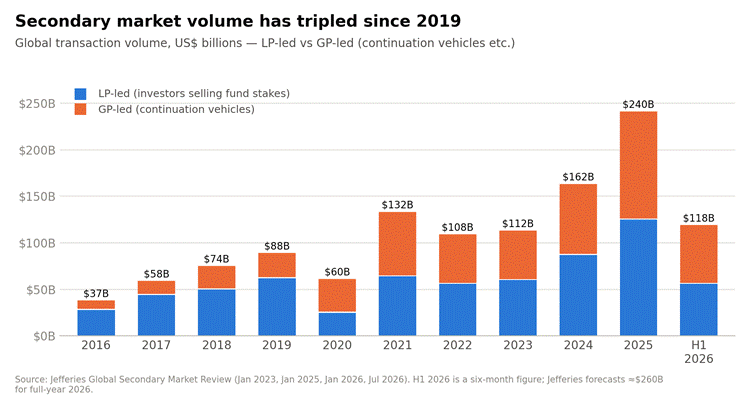
This evolving landscape has propelled the secondary market into a position of critical importance. A secondary transaction involves the purchase of an existing private markets position rather than a commitment to a new, unfunded pool of capital. The market encompasses two primary forms: LP-led transactions, where existing fund stakes are sold, and GP-led transactions, often involving continuation vehicles that allow GPs to hold onto attractive assets while providing liquidity to existing investors.

The growth in secondary market volume has been nothing short of explosive. Since 2019, transaction volumes have tripled, reaching $240 billion in 2025. The first half of 2026 set a new record with $118 billion in deals, with GP-led transactions now constituting the majority of activity. Continuation vehicles alone accounted for approximately 14% of sponsor-backed exits. This surge in activity has attracted substantial capital, with Preqin reporting that secondary assets under management (AUM) stand at $522 billion and are projected to reach $1.3 trillion by 2030. A significant pipeline of fundraising is also evident, with 216 funds currently seeking $115 billion.
The secondaries market is also diversifying beyond broad, diversified flagship funds, exemplified by Ardian’s $30 billion ASF IX. Specialist funds focusing on infrastructure, private credit, real estate, and venture capital are gaining traction. Notably, Toronto’s Dawson Partners closed a $7.7 billion fund dedicated to portfolio financing last year, highlighting the market’s increasing sophistication and specialization.
What Attracts Buyers to the Secondaries Market?
The appeal of the secondary market for buyers stems from several key advantages. Foremost is direct access to existing, performing investments. Unlike blind-pool commitments, secondary buyers can meticulously evaluate the underlying businesses, scrutinize available financial data, and assess the remaining runway to a potential exit.
Furthermore, the timeline to potential distributions can often be significantly shorter compared to a primary fund commitment. If a portfolio company is nearing a sale, a secondary buyer might realize returns much sooner than an investor in a newly formed fund whose investments have yet to be deployed and nurtured. However, this accelerated timeline is not without its uncertainties, as companies can still face delays in sales, require additional capital injections, or underperform against expectations.

Pricing is another critical consideration. Secondary interests are frequently offered at a discount to their reported Net Asset Value (NAV). This discount can provide a built-in margin of safety for buyers. However, it’s crucial to recognize that a discount alone does not guarantee an attractive investment. Reported valuations may not always reflect current market conditions, and a substantial discount could signal genuine concerns about the portfolio’s underlying assets, its financing structure, or the time required to achieve a successful exit. A buyer who secures a discount may still overpay if the reported NAV is an inaccurate reflection of the assets’ true worth.
Conversely, highly sought-after assets may trade at or even above their reported NAV. In such cases, the paramount question for the buyer is whether the purchase price adequately compensates for the inherent risks, associated costs, and the anticipated holding period.
The secondary market also empowers investors to construct more nuanced portfolios. By selectively acquiring existing fund interests or specific assets, buyers can diversify across different managers, sectors, and investment vintages, offering a level of control not typically available through primary commitments. These inherent advantages suggest that the secondaries market will likely maintain its relevance even as traditional exit markets recover, serving as a vital tool for managing private market exposure beyond simply addressing delayed distributions.
Implications for Advisors and Family Offices
For advisors building their first private equity allocations, the secondary market offers a compelling solution to mitigate the typical J-curve effect. By acquiring seasoned, already-funded portfolios, capital is deployed immediately, and any discount to NAV can provide an immediate uplift. Distributions often begin within one to three years, significantly shorter than the five to seven years typically associated with primary fund investments. For more mature allocations that have become over-weight and are experiencing under-distribution, the secondary market acts as a crucial release valve. Limited partners can divest older fund stakes to rebalance their portfolios, and GP-led offers provide an opportunity to realize cash rather than reinvesting. The emergence of evergreen secondary vehicles, accessible through the wealth channel with some minimums as low as C$25,000, further democratizes access. Jefferies estimates that approximately 41% of the $113 billion that flowed into evergreen funds in 2025 was directed towards secondary investments.
Family offices, having experienced the dual pressures of reduced distributions impacting new commitments and a growing need for liquidity, are increasingly active in the secondaries market. Their private equity allocations have seen a decline, from 22% to 17% according to UBS. A significant majority of North American family offices now prioritize improving liquidity, as highlighted by RBC/Campden. This has driven them to become substantial sellers, accounting for approximately 5-8% of LP-led secondary volume. Concurrently, 72% of family offices now invest in secondaries, a notable increase from 60% two years prior, according to Goldman Sachs.
While the current exit challenges in private equity are expected to eventually ease, the market infrastructure that has developed to address them is poised to endure.
Navigating the Risks: A Crucial Consideration for Advisors
As the secondary market continues its rapid expansion, wealth management professionals must recognize that this alternative route into private equity does not inherently diminish the associated risks. A thorough understanding of these potential pitfalls is paramount for responsible client advisory.
Firstly, NAV is an estimate, not a guaranteed sale price. Unlike publicly traded securities, private companies do not have continuous market pricing. Reported valuations can lag behind shifts in earnings, borrowing costs, financing conditions, or the actual price a buyer would be willing to pay at a given moment. This inherent valuation uncertainty requires careful due diligence.
Secondly, existing investments within the secondary market still carry fundamental business risks. Buyers must diligently assess the financial health of the underlying companies, their debt levels, future growth prospects, and viable exit strategies. While a longer investment history provides more data points, it does not eliminate the inherent uncertainties of business operations and market dynamics.
Thirdly, liquidity, while improved by the secondary market, remains fundamentally limited. A secondary transaction facilitates a sale for one investor, but it does not guarantee that the buyer can easily divest that interest again in the future. Expected distributions can be delayed, and capital may remain committed for extended periods, potentially longer than initially anticipated.
Finally, GP-led transactions warrant particular scrutiny due to the potential for conflicts of interest. Existing investors might prioritize immediate liquidity, while fund managers may aim to retain attractive assets. Incoming buyers will have their own distinct return expectations. Transparent disclosure, robust valuation processes, appropriate governance structures, and fair treatment of all investors are therefore essential for the integrity of these transactions.
For advisors, the implication is not to automatically favor secondaries over primary private equity investments. Instead, it underscores the necessity of a holistic assessment. The structure of the investment, its pricing, the quality of the underlying assets, and the specific liquidity needs of the investor must all be considered in tandem. Each secondary investment should be evaluated on its own merits, rather than being solely influenced by the allure of a discount or the promise of a truncated holding period.
Beyond the Exit Problem: The Enduring Evolution of Secondaries
While the immediate liquidity challenges in private equity have undoubtedly accelerated the growth of the secondary market, its significance extends far beyond the current economic cycle. As private markets have matured and expanded in scale, investors and managers alike have required more sophisticated mechanisms to manage ownership stakes over time. Investor liquidity needs evolve, portfolio allocations must be dynamically adjusted, and certain businesses may necessitate longer development periods than initially envisioned. A market that facilitates the transfer of ownership interests is therefore crucial for accommodating these diverse and changing circumstances.
For sellers, secondaries offer a flexible path to realize capital without the protracted process of divesting every individual portfolio company. For buyers, they provide access to established, operational investments at potentially attractive valuations relative to the inherent risks. For fund managers, continuation vehicles offer a strategic option to retain high-performing assets when an immediate exit may not be optimal.
It is important to note that these outcomes are not automatic. A secondary transaction transfers ownership and associated risks; it does not eliminate the fundamental requirement for successful business performance or a viable eventual exit. The broader lesson emerging from this evolution is that private equity liquidity is no longer solely dictated by a manager’s ability to execute a sale of a portfolio company. It is increasingly dependent on the willingness of another investor to acquire an existing interest and the ability of both parties to agree on a price that accurately reflects the underlying value and associated uncertainties.
The private equity exit problem remains a significant concern. However, the burgeoning secondary market is providing investors with a vital alternative response, transforming delayed liquidity for some into tangible investment opportunities for others. This dynamic shift is reshaping the private markets and demands the focused attention of all market participants.
