

The evolution of contemporary interior design often finds its most profound expressions at the intersection of historical reverence and avant-garde innovation. For Maxime Bousquet, a prominent member of the prestigious AD100 France list, a recently completed 3,000-square-foot duplex in the heart of Paris represents more than just a residential commission; it signifies a definitive shift in his creative trajectory. Standing before a 16-foot window framed by floor-to-ceiling velvet curtains, Bousquet describes the project as the dawn of a "new era" in his work. The space, a top-floor "jewel box" inhabited by a couple of dedicated art collectors, serves as a masterclass in integrating museum-grade contemporary art into a living environment that remains fundamentally domestic and intimate.

The residence is defined by its architectural ambition and its curated dialogue with the Surrealist movement, which celebrates its centenary in the very city where the apartment is located. Throughout the sprawling two-story space, motifs of the unconscious mind—dreamlike textures, unexpected juxtapositions, and distorted forms—complement a collection that includes works by Jean Cocteau, Pablo Picasso, and Sterling Ruby. By navigating the delicate balance between a private gallery and a functional home, Bousquet has created a precedent for how high-value art collections can be lived with, rather than merely displayed.
Structural Transformation and the Helena Rubinstein Influence
The realization of the duplex was a meticulous endeavor that spanned thirty months. When Bousquet first encountered the site, it consisted of the top two floors of a traditional Parisian building, but the layout was fragmented and lacked a cohesive flow. The renovation required a complete reimagining of the internal architecture to connect the levels and maximize the sense of volume provided by the high ceilings.

A central element of the structural overhaul was the installation of a ribbon-like staircase that twists upward from the entrance hall. This architectural feature does not merely serve a utilitarian purpose; it acts as a sculptural centerpiece, positioned adjacent to Bill Viola’s 2006 video work, Bodies of Light. To create additional outdoor utility, Bousquet made the bold decision to lower certain ceiling heights, facilitating the creation of a private terrace. This rooftop garden was inspired by the legendary green spaces of cosmetics pioneer Helena Rubinstein, whose own Parisian terraces in the mid-20th century became icons of urban landscape design. The new terrace is designed to function as an outdoor gallery, slated to house a rotating selection of sculptures, a dining area, and an outdoor fireplace, effectively extending the interior’s artistic narrative into the Parisian skyline.
The Philosophy of Living with Art
The clients, a couple deeply embedded in the international art world, were adamant that their home should not feel like a sterile institution. Bousquet’s primary challenge was to highlight a collection that features high-stakes works from galleries such as James Cohan, Thaddaeus Ropac, and Gavin Brown’s Enterprise, without allowing the art to overwhelm the daily life of the inhabitants.

In the entrance hall, the integration of technology and tradition is immediate. Viola’s digital medium is juxtaposed against the fluid, organic lines of the custom staircase. In the bar area, the design language shifts toward a blend of brutalism and mid-century modernism. Here, a 1900s monk’s chair and a 1930s pendant light by Pietro Chiesa provide a grounded, historical counterpoint to Sterling Ruby’s 2009 work, Friday the 13th. The inclusion of pieces by emerging and established names—such as Jessy Razafimandimby and Joe Bradley—demonstrates a collection that is both personal and academically rigorous. Bousquet’s success lies in his ability to treat these works as part of the room’s "living tissue" rather than isolated objects.
Materiality and Craftsmanship: A Study in Stone and Light
The material palette of the apartment is a testament to Bousquet’s commitment to tactile luxury and geological rarity. Hazelnut travertine serves as a unifying element, utilized not only for flooring but also for the skirting boards, creating a seamless visual transition between horizontal and vertical planes. This is further enriched by the use of Taj Mahal marble and glowing Iranian onyx, materials chosen for their ability to interact with the abundant natural light streaming through the 16-foot windows.

The interplay of textures is a recurring theme. In the living room, a carved stone fireplace—designed by Bousquet himself—sits in conversation with delicate blown crystal lamps sourced from Milan. The designer’s sourcing process involved a deep dive into the Parisian antique market, most notably through the Galerie Jacques Lacoste. One of the more unique finds included bronze wall lights with a natural patina, originally used to illuminate a swimming pool. This reuse of industrial or outdoor elements in a refined interior setting is a hallmark of Bousquet’s "new era," emphasizing the history and soul of individual objects.
Surrealism and the Principal Suite
The apartment’s aesthetic is heavily informed by Surrealism, the avant-garde movement founded in Paris by André Breton in 1924. Surrealism sought to bridge the gap between the dream world and reality, often through the use of fragmented imagery and the human form. Bousquet channeled this history into the principal suite, where the concept of the "portrait" is explored through furniture and décor.

The centerpiece of the bedroom is the Bocca della Verità bed, a 1960s creation by Italian sculptor Mario Ceroli. The bed features a monumental pine face as a headboard, a direct reference to the "Mouth of Truth" in Rome, lending a theatrical and slightly unsettling presence to the room. This surrealist flair is echoed in the dressing room, where the walls are adorned with a painting by Nadine Hautrive. The work is a contemporary reinterpretation of Eileen Gray’s Le Destin, a four-panel screen originally commissioned in 1914 by the legendary collector Jacques Doucet. By moving through shades of midnight blue to vibrant red, the dressing room acts as a chromatic bridge between the bedroom and the principal bath.
The Dining Room Fresco and the Human Touch
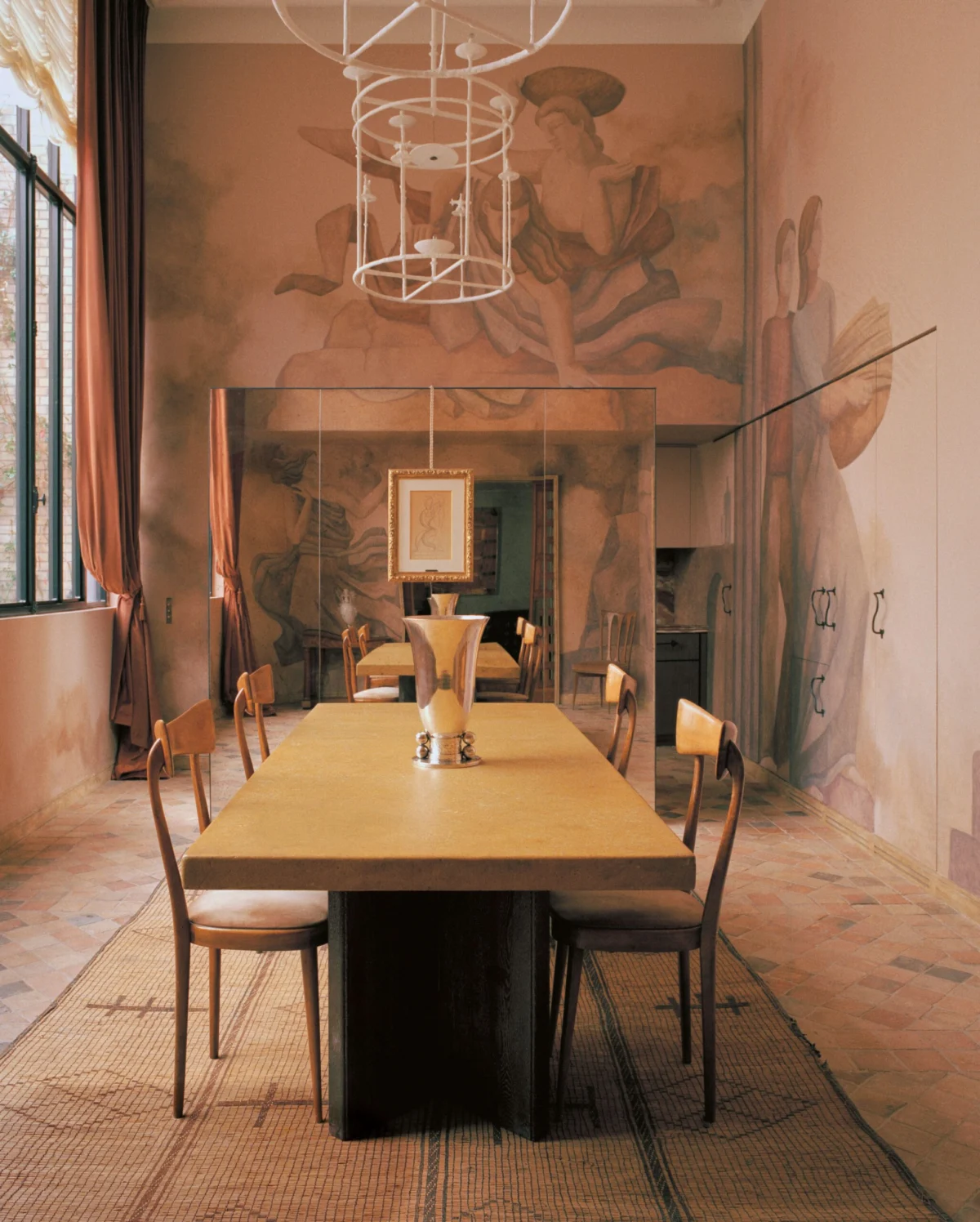
Perhaps the most immersive space in the duplex is the dining room, which functions as a 360-degree art installation. Every inch of the walls is covered in a custom fresco by artist Elvira Solana. Depicting the four seasons, the mural adopts a more angular, 1940s-inspired style than Solana’s typical work, aligning with the apartment’s mid-century furniture, such as the Otto Schultz armchairs and T.H. Robsjohn-Gibbings coffee table found in the adjacent living room.

Despite the grandeur of the murals and the high-value canvases by Picasso and Cocteau, Bousquet ensures the apartment remains anchored in the "human touch." In the principal bathroom, amidst a basin carved from a single block of stone and a double shower featuring antique sculptures, sits a heart-shaped stool designed by Bousquet. He describes this piece as his "signature" or a "love letter" left for his clients. This small, whimsical gesture serves a vital purpose: it breaks the potential austerity of the high-design environment, reminding the inhabitants that the space is, above all, a home built on affection and personal narrative.
Chronology of the Project
The timeline of the Bousquet duplex reflects the complexity of high-end Parisian renovations:

- Month 1-6: Acquisition and initial conceptualization. Bousquet and the clients established the "Surrealist Collector" theme and began sourcing key historical furniture pieces.
- Month 7-12: Structural engineering phase. This included the complex task of connecting the two floors and reinforcing the structure to support the new rooftop terrace and the weight of massive stone installations.
- Month 13-24: Interior build-out. Installation of the hazelnut travertine, Iranian onyx, and the custom ribbon staircase. During this time, Elvira Solana began the month-long process of painting the dining room fresco on-site.
- Month 25-30: Curation and final styling. The final placement of the art collection, including the delicate installation of Bill Viola’s video work and the integration of the Mario Ceroli bed.
Market Context and Design Implications
The completion of this project comes at a time when the "collectible design" market is seeing unprecedented growth. According to recent industry reports, the demand for interiors that integrate rare 20th-century furniture with blue-chip contemporary art has risen by 25% among high-net-worth individuals in Europe over the last three years. Bousquet’s work sits at the vanguard of this trend, moving away from the "minimalist gallery" aesthetic of the early 2000s toward a more layered, historically informed maximalism.
Furthermore, the project highlights the enduring influence of the AD100 list in shaping global design standards. As one of France’s leading interior architects, Bousquet’s shift toward Surrealism suggests a broader industry move toward interiors that prioritize narrative, psychology, and emotional resonance over mere stylistic trends.

Broader Impact on Parisian Interior Architecture
This duplex serves as a significant contribution to the architectural landscape of Paris. By successfully blending the heritage of the 1930s and 40s—seen in the Chiesa and Schultz pieces—with the radicality of contemporary artists like Ser Serpas and Zuzanna Czebatul, Bousquet has created a space that is timeless yet firmly rooted in the present.
The project demonstrates that the constraints of a historical building need not limit modern living. The decision to lower ceilings for a terrace, while counterintuitive in a city that prizes verticality, shows a sophisticated understanding of how luxury is defined today: not just by square footage, but by the quality of light, the flow of air, and the ability to commune with nature and art simultaneously. As the owners prepare to spend their first summer on the Rubinstein-inspired terrace, the apartment stands as a testament to the power of design to transform a collection of objects into a cohesive, living dream.
